

The documentary Killjoy captures the personal and the political of family violence and gender activism
- Written by: Sharon Crozier-De Rosa, Professor in History, University of Wollongong
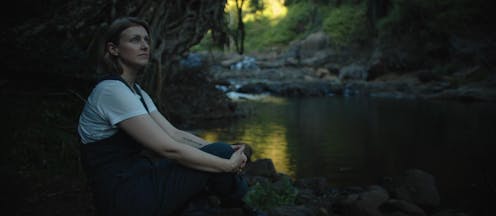
At 16, Kathryn Joy applied for a passport. To do this, they had to obtain their mother’s death certificate. After growing up in a house in which their father had killed their mother – an act he refused to talk about – Kathryn learned exactly how their mother had died: “gunshot wound to the head”.
The bare brutality of this information shocked them into looking anew at their father, escaping from small town to big city, spiralling into trauma-induced mental anguish, and embarking on a journey of self-discovery through tracing their family’s violent history.
Eight years of this journey are documented in the new Australian documentary Killjoy.
At home alone with a woman-killer
On January 31 1985, Allan James Stuckey fatally shot his wife, Carolyn Joy Stuckey, in their home in Lismore, New South Wales. Carolyn was 32. She had been having an affair with a fellow member of her local theatre club. Stuckey phoned the police to inform them he had killed his wife.
Carolyn’s and Allan’s three young children were in the house at the time of the shooting. They were entrusted to the sole care of their father in the long period between him being charged and being tried. He was found guilty of manslaughter.
After serving 22 months in prison, they were returned to his care.
For some years, Kathryn – by all accounts a physical likeness of their mother – lived alone with a woman-killer.
Finding a woman’s life in the historical archives
Carolyn’s brief story has all the ingredients of a tragic melodrama, but while the spectre of her death is ever-present (at one point eerily portrayed via film footage of her performing as the dead wife making ghostly visitations to her husband in Noël Coward’s play, Blythe Spirit) this is not Killjoy’s focus.
Rather, the narrative is held together by two investigative processes: finding out about how Carolyn had lived, as well as died; and understanding how to travel through, and with, pain and vulnerability to a place of fullness and purpose.

As all historians who try to trace the lives of women are aware, women still tend to be identified more with the private, domestic sphere. Because of this, it is more difficult to find their voices in public records.
Even when they are part of public conversation, their experiences are often mediated through a male lens. Controversies in recent years about how the media reports women’s deaths at the hands of their intimate partners have exposed this issue and have led to more sensitive reporting, including a decrease in “victim-blaming” and “perpetrator excusing” portrayals.
As Kathryn was to discover, through past newspapers and interviews with Carolyn’s former friends, this was not the case in the 1980s. Carolyn was the “scarlet woman” and Allan the “poor chap”. Their mother’s killer successfully pleaded “provocation” as a partial defence, hence the offensively brief prison sentence.
The film takes us with Kathryn as they trace their own history, irrevocably intertwined with that of their mother, through a patchwork of school photographs, theatre scrapbooks, prison letters, microfiche, personal interviews, video diaries, text messages, extracts of letters (both loving and threatening), court transcripts, expert testimonies, new friendships, memorial stones and grief rituals.
 The film takes us with Kathryn as they trace their own history, irrevocably intertwined with that of their mother.
Stan
The film takes us with Kathryn as they trace their own history, irrevocably intertwined with that of their mother.
Stan
The result is a unique journey into the inner turmoil, development, hopes and passions of a beautiful sensitive mind struggling to understand themselves against an ongoing backdrop of gender violence and political activism.
Control and killjoys
Ultimately, Killjoy is a story about control.
Provocation still exists as a partial defence in New South Wales, Queensland, the ACT and the Northern Territory. But even in the states where it has been abolished, men still cite a loss of control when trying to excuse themselves of woman-killing.
Women do not control their fates when an unconscionable number of them continue to die at the hands of their intimate partners – there have been 47 violent deaths in Australia by September 6 this year.
 Hope is warranted – although this does not ameliorate the critical need for continued activism.
Stan
Hope is warranted – although this does not ameliorate the critical need for continued activism.
Stan
The Australian government has committed itself to a National Plan to End Violence against Women and Children by 2032. Of specific relevance to Kathryn’s story as a child who experienced domestic homicide, it has pledged A$80 million to “trauma-informed support for children and young people to promote recovery and intervene early to prevent inter-generational violence”.
Hope is warranted – although this does not ameliorate the critical need for continued activism.
The film closes with Kathryn’s claim that, while not “cured”, had they the chance, they would tell their mum that their life is “so full” now. A gender violence researcher and activist, they have reached the stage where they embrace the label “feminist killjoy”, a reference to theorist Sara Ahmed’s concept of the justice warrior who gladly disrupts people’s blissful and/or wilful ignorance by calling out sexism, racism and more.
While the “killjoy” element of the film is a little undercooked, appearing as it does in the title and only again in brief commentary at the end, Killjoy is a raw, emotional production that allows viewers a privileged insight into how the personal is political, and into the personal made public.
Killjoy is now streaming on Stan.
The National Sexual Assault, Family and Domestic Violence Counselling Line – 1800 RESPECT (1800 737 732) – is available 24 hours a day, seven days a week for any Australian who has experienced, or is at risk of, family and domestic violence and/or sexual assault.
Authors: Sharon Crozier-De Rosa, Professor in History, University of Wollongong


















