

André Dao breaks rules and witnesses uncomfortable truths
- Written by: Alexander Howard, Senior Lecturer, Discipline of English and Writing, University of Sydney
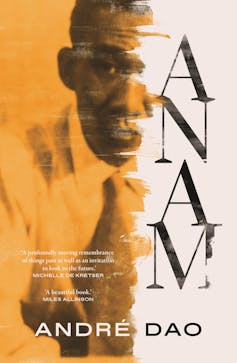
André Dao’s debut novel Anam (Penguin Random House) has just won the 2024 Prime Minister’s Literary Award for Fiction, worth A$80,000. This follows its shortlisting for this year’s Miles Franklin Award.
Born in Australia to Vietnamese refugee parents, Dao, who works as a writer, editor and artist in Melbourne, is a deserving winner.
The six winners of this year’s awards share an interest in identity and culture, form and innovation – and resilience and resistance. Together, they illuminate the complexities of the Australian experience.
Anam blurs the boundaries between fact and fiction. As Tess Do explained in her review for The Conversation, it started life “as an inquiry into his paternal grandfather’s ten-year detention without trial by the Vietnamese government in 1978, three years after the war ended”.

 Horne is most famous, of course, for his ironically titled book, The Lucky Country, often misinterpreted, but meant as a wake-up call to an unimaginative Australia, which he judged as mired in mediocrity.
As Julianne Schultz noted in The Conversation, Cropp’s eminently readable book, which draws extensively on the archives, puts Horne “in his context and, without a heavy hand, helps us understand his motivating psychology”.
But there is much more to it. One of the book’s great strengths, according to the judges, is its demonstration of how Horne’s life “speaks to the complexities at play in Australia’s post-World War II history”.
An important First Nations storyteller
The Non-Fiction Prize was awarded to Bundjalung and Kullilli journalist and ABC broadcaster Daniel Browning for his Close to the Subject: Selected Works (Magabala Books).
Like Dao’s novel, Browning’s collection, which covers his career since 2007, displays a keen interest in form and innovation. Browning acknowledges this in his introduction:
Implicit in these pages is an invitation: to weigh in to the diverse textures, subtexts and genres that make up my work. Criticise it, question its assumptions and by all means, disagree – but engage with it.
Horne is most famous, of course, for his ironically titled book, The Lucky Country, often misinterpreted, but meant as a wake-up call to an unimaginative Australia, which he judged as mired in mediocrity.
As Julianne Schultz noted in The Conversation, Cropp’s eminently readable book, which draws extensively on the archives, puts Horne “in his context and, without a heavy hand, helps us understand his motivating psychology”.
But there is much more to it. One of the book’s great strengths, according to the judges, is its demonstration of how Horne’s life “speaks to the complexities at play in Australia’s post-World War II history”.
An important First Nations storyteller
The Non-Fiction Prize was awarded to Bundjalung and Kullilli journalist and ABC broadcaster Daniel Browning for his Close to the Subject: Selected Works (Magabala Books).
Like Dao’s novel, Browning’s collection, which covers his career since 2007, displays a keen interest in form and innovation. Browning acknowledges this in his introduction:
Implicit in these pages is an invitation: to weigh in to the diverse textures, subtexts and genres that make up my work. Criticise it, question its assumptions and by all means, disagree – but engage with it.
 Showcasing an array of carefully curated essays and interviews, interspersed with poetry and personal reflections, Close to the Subject demonstrates Browning’s literary skill and confirms his status as an important First Nations storyteller.
He is deeply interested in inclusive collaborative practices and in producing content capable of representing, in his own words, “not simply the who, what, and why – but the cultural context in which these dialogues take place”.
Collaborative storytelling in action
Something similar can also be said of the 2024 Children’s Literature Prize winner. Tamarra: A Story of Termites on Gurindji Country (Hardie Grant Explore) is a prime example of inclusive collaboration and storytelling in action.
Showcasing an array of carefully curated essays and interviews, interspersed with poetry and personal reflections, Close to the Subject demonstrates Browning’s literary skill and confirms his status as an important First Nations storyteller.
He is deeply interested in inclusive collaborative practices and in producing content capable of representing, in his own words, “not simply the who, what, and why – but the cultural context in which these dialogues take place”.
Collaborative storytelling in action
Something similar can also be said of the 2024 Children’s Literature Prize winner. Tamarra: A Story of Termites on Gurindji Country (Hardie Grant Explore) is a prime example of inclusive collaboration and storytelling in action.
 Co-authored by several Indigenous and non-Indigenous artists, academics, and scientists, Tamarra is written in traditional Gurindji, Gurindji Kriol and English. It makes excellent use of interactive QR code technology, affording readers the chance to embark on an educational and cultural journey through Gurindji Country, in northern Australia.
It was rightly praised by judges for its engaging combination of art, photography and scientific facts, and for its “message of interconnectedness and harmony with Country”.
Desire and emotion
Last year, Will Kostakis publicly shared his response to a Catholic school that had asked him to “skip over the same sex components” on a 2024 Book Week visit. He had just published We Could be Something (Allen & Unwin). Today, it has won the Young Adult Literature Prize. The judges commend its “authenticity and insight”.
Co-authored by several Indigenous and non-Indigenous artists, academics, and scientists, Tamarra is written in traditional Gurindji, Gurindji Kriol and English. It makes excellent use of interactive QR code technology, affording readers the chance to embark on an educational and cultural journey through Gurindji Country, in northern Australia.
It was rightly praised by judges for its engaging combination of art, photography and scientific facts, and for its “message of interconnectedness and harmony with Country”.
Desire and emotion
Last year, Will Kostakis publicly shared his response to a Catholic school that had asked him to “skip over the same sex components” on a 2024 Book Week visit. He had just published We Could be Something (Allen & Unwin). Today, it has won the Young Adult Literature Prize. The judges commend its “authenticity and insight”.
 Featuring nuanced descriptions of inner Sydney life and Australia’s evolving LGBTQIA+ communities, Kostakis’ affectively charged novel aims to eschew clichés. It examines changing social attitudes toward homosexuality and sexual desire, while probing the inner lives and emotions of its two 17-year-old male protagonists. One of them is a teen novelist, crushed when his first novel falters.
Finally, the 2024 Poetry Prize was awarded to classicist Amy Crutchfield, who like Kostakis, is profoundly interested in desire and emotion. Divided into five sections, her debut collection, The Cyprian (Giramondo), reimagines the figure of Aphrodite – the Greek goddess of beauty, love, and passion – for our contemporary moment.
Featuring nuanced descriptions of inner Sydney life and Australia’s evolving LGBTQIA+ communities, Kostakis’ affectively charged novel aims to eschew clichés. It examines changing social attitudes toward homosexuality and sexual desire, while probing the inner lives and emotions of its two 17-year-old male protagonists. One of them is a teen novelist, crushed when his first novel falters.
Finally, the 2024 Poetry Prize was awarded to classicist Amy Crutchfield, who like Kostakis, is profoundly interested in desire and emotion. Divided into five sections, her debut collection, The Cyprian (Giramondo), reimagines the figure of Aphrodite – the Greek goddess of beauty, love, and passion – for our contemporary moment.
 Aphrodite is described using many different words, Crutchfield reminds us. “They allude to her powers in connection with sex, fertility, sex work, beauty, birth, seafaring and war, among other things.”
The poems in The Cyprian wear their learning lightly. Intimate, honest and lyrical, they move inexorably “towards love’s borders, lawless places, and across those borders, to situations where love fails us, or we fail love”. Crutchfield, like many of the 2024 winners, does interesting things with literary form.
Authors: Alexander Howard, Senior Lecturer, Discipline of English and Writing, University of Sydney
Aphrodite is described using many different words, Crutchfield reminds us. “They allude to her powers in connection with sex, fertility, sex work, beauty, birth, seafaring and war, among other things.”
The poems in The Cyprian wear their learning lightly. Intimate, honest and lyrical, they move inexorably “towards love’s borders, lawless places, and across those borders, to situations where love fails us, or we fail love”. Crutchfield, like many of the 2024 winners, does interesting things with literary form.
Authors: Alexander Howard, Senior Lecturer, Discipline of English and Writing, University of Sydney 

















