

The first known case of eggs plus live birth from one pregnancy in a tiny lizard
- Written by: Melanie Laird, Postdoctoral Fellow, University of Otago
For most animals, reproduction is straightforward: some species lay eggs, while others give birth to live babies.
But our recent research uncovered a fascinating mix between the two modes of reproduction. In an Australian skink, we observed the first example of both egg-laying and live-bearing within a single litter for any backboned animal.
This suggests some lizards can “hedge their bets” reproductively, taking a punt on both eggs and live-born babies to improve overall survival chances for offspring.
Read more: Ancient fossil fills a 75 million-year gap and rewrites lizard and snake history
Making reproductive leaps
Most vertebrate species (animals with a backbone) fall neatly into one of two distinctly different reproductive categories.
Oviparous species are egg-layers. These eggs may undergo external fertilisation – such as in spawning fish – or are fertilised and shelled internally, like those of reptiles and birds. Oviparous embryos rely on egg yolk as a source of nutrition to continue development until hatching.
In contrast, viviparous species are live bearers that carry their young to term. Some live-bearing species, including humans, support embryonic development internally via a placenta. Egg-laying is ancestral, meaning that modern live-bearers have descended from egg-laying ancestors.
Physiologically, the evolution of live birth from egg-laying is no mean feat. This transition requires a whole suite of changes, sometimes including the evolution of a placenta – an entirely new specialist organ – as well as loss of the hard outer eggshell, and keeping the embryo inside the body for a longer time.
 The placenta is a highly complex organ. One of its jobs is to transfer nutrition to the developing baby.
from www.shutterstock.com
Despite these complex steps, reptiles, particularly snakes and lizards, appear to be unusually predisposed to making the leap to live birth. This capacity has evolved in at least 115 groups of reptiles independently.
Read more: A hidden toll: Australia's cats kill almost 650 million reptiles a year
Having it both ways
It’s easy to see why reptiles, as a group, are fascinating models for studying how live birth evolves from egg-laying.
Of particular interest are two Australian skinks that have both live-bearing and egg-laying individuals (known as being bimodally reproductive). These lizards are incredibly valuable to evolutionary biologists as they offer a snapshot into evolutionary processes in action.
The three-toed skink Saiphos equalis is one such species. Reproduction in S. equalis varies geographically: populations around Sydney lay eggs, while those further north give birth to live young.
Whether individuals are live-bearing or egg-laying seems to be genetically determined: when researchers swap their environmental conditions (by moving them from one site to another), the females retain their original reproductive strategy.
Read more: Lizards help us find out which came first: the baby or the egg?
Mothers know best
Our latest research shows this lizard is intriguing in another completely unexpected way.
We observed a live-bearing female that laid three eggs, and then gave birth to a living baby from the same litter weeks later. We incubated two of the eggs, one of which hatched to produce a healthy baby.
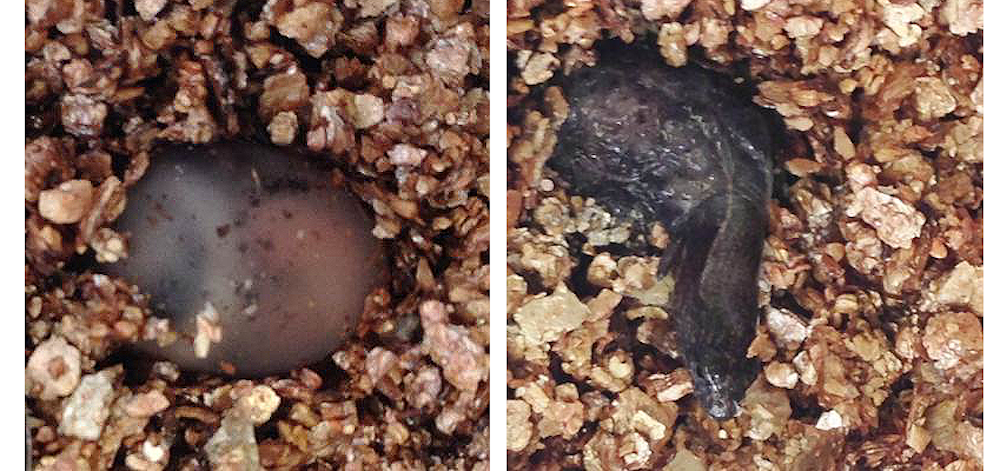 A live-bearing female S. equalis in our laboratory colony laid three eggs, one of which hatched to produce a healthy baby.
Camilla Whittington
This finding is remarkable for two reasons. First, as far as we are aware, this is the first example of both egg-laying and live birth within a single litter for any vertebrate.
Second, in some cases, individuals may be capable of “switching” between reproductive modes. In other words, as laying eggs and giving birth each come with their own advantages and disadvantages, individuals may be able to “choose” which option best suits the current situation.
Closer look at eggshells
To better understand this reproductive phenomenon, we investigated the structure of the egg coverings of these unusual embryos in minute detail (using an advanced technology called scanning electron microscopy).
We found that in this litter, the egg-coverings were thinner than those of normal egg-laying skinks and had structural characteristics that overlapped with those of both egg-layers and live-bearers (which have thinner coverings that are greatly reduced).
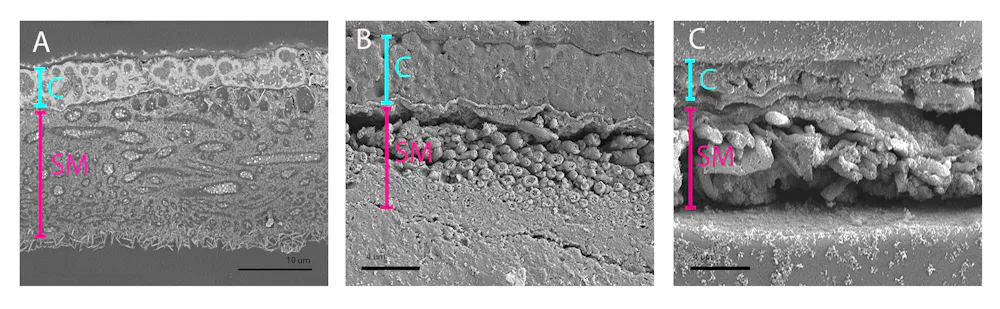 Egg coverings of S. equalis consist of an outer crust (C) and an inner shell membrane (SM). We compared the structure and thicknesses of these layers of both egg-laying (A) and live-bearing (B) S. equalis to identify similarities with our ‘unusual’ embryos (C).
Melanie Laird
How evolution works
We still don’t know the trigger that caused this female to lay eggs and give birth to a live baby from the same pregnancy.
However, our findings suggest that species “in transition” between egg-laying and live bearing may hedge their bets reproductively before a true transition to live birth evolves.
Being able to switch between reproductive modes may be advantageous, particularly in changing or uncertain environments.
 The three-toed skink lives in eastern Australia.
Doug Beckers / flickr, CC BY
For example, extreme cold, drought or the presence of predators can be risky for vulnerable eggs exposed to the environment, meaning that mothers that can carry offspring to term may have the upper hand.
In contrast, lengthy pregnancies can be taxing on the mother, so depositing offspring earlier as an egg may be beneficial in some situations.
We suggest that other species in which live birth has evolved from egg-laying relatively recently may also use flexible reproductive tactics.
Further research into this small Australian lizard, which seems to occupy the grey area between live birth and egg-laying, will help us determine how and why species make major reproductive leaps.
Read more: Curious Kids: why do hens still lay eggs when they don't have a mate?
Authors: Melanie Laird, Postdoctoral Fellow, University of Otago


















