

how hi-vis became a symbol of working class masculinity
- Written by: Elizabeth Humphrys, Lecturer and Head of Discipline, Social and Political Sciences & Climate, Society and Environment Research Centre (C-SERC), University of Technology Sydney
Recent weeks have seen mobilisations of construction workers protesting the imposition of an administrator on their union by the government. Protesters were decked out in black and hi-vis workwear, with fluorescent orange and yellow as far as the eye could see.
On the same day as the biggest rallies, Prime Minister Anthony Albanese held a press conference on the construction site of the new Western Sydney airport wearing a dress shirt, hard hat and hi-vis.

While visiting an operational worksite generally requires wearing hi-vis for safety, there’s deeper politics at play, with politicians often choosing such sites – and, consequently, clothes – to signal something else.
Hi-vis can be worn by so many types of people: from protesters with diverse political views, to leaders in high office. So how did hi-vis become so deeply embedded in our culture, from protests to political press conferences, appearing in music videos, comedy and worn by GWS Giants supporters?
Context is everything
In Australia, hi-vis is legally required and standardised PPE (personal protective equipment) in many industries. Hi-vis garments often combine two types of light-reflection: fluorescent material for daytime use, and strips of silvery retro-reflective material for night use.
Beyond being required for safety, hi-vis carries other meanings, which intersect with class, gender, race and politics.
We’ve been researching these meanings, and we have found in Australia, hi-vis can symbolise safety, authority, working class masculinity, “being employed”, or the idea of the “average Australian”.
Hi-vis can enable official access, and it can stop others from entering particular spaces.
A design history of hi-vis
The history of hi-vis begins with early experiments with artificial fluorescent pigments in the 19th century, and the development of Day-Glo pigments from the 1930s. Fluorescence was used in World War II, for example in illuminating runways and marking dugouts, and the post-war period saw a commercial explosion of uses, particularly in the United States.
One of the first examples of high-visibility fluorescent workwear was in 1964 in Glasgow, when British Railways introduced an optional orange vest for track workers.
There was some resistance by the Glaswegian workers to its introduction, with fears it was “over-conspicuous” or might make workers appear less “brave”. By the 1970s there was begrudging acceptance from British Rail workers.
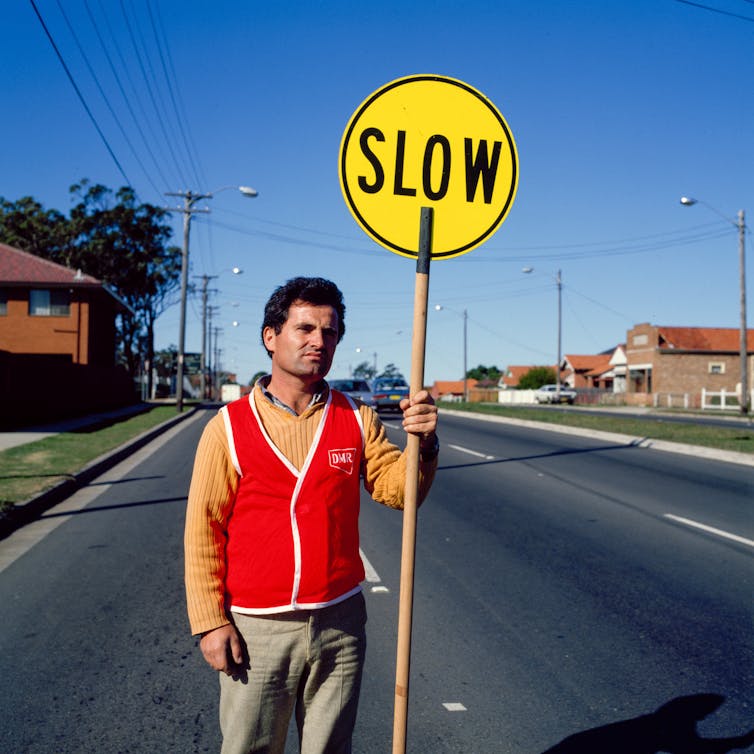
 Staged photograph with new safety equipment, Wiley Park, 1983, NSW Department of Main Roads.
State of New South Wales (Transport for NSW), CC BY
Staged photograph with new safety equipment, Wiley Park, 1983, NSW Department of Main Roads.
State of New South Wales (Transport for NSW), CC BY
Australia was slightly slower in uptake. There’s further scope for research as to why, but heat and the unpleasant synthetic materials used in early vests is a good place to start.
At Sydney’s Powerhouse you can see an early hi-vis uniform, a postal delivery vest from around 1975, made from plastic webbing. Back then, soft synthetic fibres were not widespread and natural fibres did not hold fluorescent pigments well.
Following state-based changes to Australia’s work health and safety legislation in the 1980s, there was a gradual increase in fluoro vests on worksites, although there remained an awkwardness to their use, as archival photos suggest.
 Former NSW Minister for Public Works and Roads Laurie Brereton with NSW DMR workers at the opening of Concord Rd Interchange, 1985.
State of New South Wales (Transport for NSW), CC BY
Former NSW Minister for Public Works and Roads Laurie Brereton with NSW DMR workers at the opening of Concord Rd Interchange, 1985.
State of New South Wales (Transport for NSW), CC BY
During the 1990s, Australian politicians visiting worksites continued to wear suits, sometimes a hard hat, with the vests only worn by trades and labouring workers.
This changed by the early 2000s, when politicians started to lean into wearing hi-vis.
Between the mid-1980s and early 2000s there was a gradual growth in hi-vis use, before it exploded in the first decade of the 21st century. Hi-vis shifted from an undesirable, rare and sometimes embarrassing safety measure, toward an everyday mass-produced “consumable” and major cultural symbol of our time.
 The sod turning ceremony for the Karuah bypass, 2002, Pacific Highway, NSW, featuring former NSW Minister for Roads and Transport, Carl Scully, Mark Vaile and John Bartlett.
State of New South Wales (Transport for NSW), CC BY
The sod turning ceremony for the Karuah bypass, 2002, Pacific Highway, NSW, featuring former NSW Minister for Roads and Transport, Carl Scully, Mark Vaile and John Bartlett.
State of New South Wales (Transport for NSW), CC BY
Our research indicates four main reasons for this shift.
First, changes to work health and safety legislation and regulations meant employers had to take more responsibility for workers’ safety. Hi-vis was a quick way to (appear to) address this.
Next, mass textile manufacturing became increasingly available, delivered through global supply chains, making hi-vis more affordable and accessible.
Improvements in the longevity of colour-fast fluorescent pigments worked hand in hand with the fourth factor: the growing availability of lightweight synthetic fabric suitable for Australian heat.
 As mass textile manufacturing became increasingly available, hi-vis became more affordable.
Bettina Frankham
As mass textile manufacturing became increasingly available, hi-vis became more affordable.
Bettina Frankham
By this century, hi-vis workwear was no longer just limited to wear on the construction site. Workers were just as likely to wear it off the job, and the number of industries it was seen in exploded.
Wearing hi-vis beyond safety
There are obvious safety reasons for the use of hi-vis in industries with dangerous equipment, in emergency services, for cyclists, and for delivery workers.
But how do we explain the security guard outside a pharmacy chain store, the cleaner at a swimming centre, the entrepreneur promoting their scented bathroom products on Instagram?
All of them wear hi-vis for reasons other than safety, at times deploying it as a symbol of “work” or productivity.
As for the CFMEU, more research is needed, but it is likely hi-vis helps produce and project a genuine sense of group membership and solidarity – as it does for GWS supporters.
And while many voters may remain unconvinced by politicians’ hi-vis-clad performances of productivity and “everyday” accessibility, press secretaries nonetheless continue to engineer situations in which hi-vis is worn. This indicates the deep political power of hi-vis, even on the backs of those with soft hands.
Authors: Elizabeth Humphrys, Lecturer and Head of Discipline, Social and Political Sciences & Climate, Society and Environment Research Centre (C-SERC), University of Technology Sydney


















