Labor's cancer package would cut the cost of care, but beware of unintended side effects
- Written by: Kees Van Gool, Health economist, University of Technology Sydney
Labor’s big-ticket election promise is a A$2.3 billion package to provide free medical scans and specialist consultations for cancer patients, plus automatic listing of new cancer therapies on the Pharmaceutical Benefits Scheme (PBS) once they’re recommended by the nation’s expert advisory panel.
One in two Australians will be diagnosed with cancer by the age of 85, and around 145,000 new diagnoses are made each year. So most of us have a close relative or friend who will be affected by the policy.
But there are some important policy considerations a Shorten government would need to plan for to ensure the package provides optimal care, improves patient outcomes, and does actually reduce out-of-pocket costs.
Read more: Shorten promises $2.3 billion package to relieve costs for cancer patients
What’s the problem with cancer care?
New therapies for cancer are rapidly evolving, and are often extremely expensive. Seeking treatment involves navigating a complex array of public and private providers across multiple health care sectors, often leaving patients with high out-of-pocket costs.
These costs are highly dependent on which providers the patients choose (and the fees they charge), the level of private insurance cover, and the volume of services used.
A recent Queensland study found the median out-of-pocket expenses for a breast cancer patient, for example, was A$4,192.
It’s possible but very time-consuming for patients to “shop around” to reduce costs. But this is an unreasonable burden to place on patients.
The Labor proposal provides an opportunity to develop a comprehensive cancer control program that encompasses prevention, early diagnosis, treatment and follow-up – at a reasonable cost.
Read more: Cutting cancer costs is a worthy policy, but we need to try to prevent it too
Better care for cancer patients
Cancer treatment is well researched; there are clear evidence-based guidelines that establish clinical pathways for the best treatment.
Nevertheless, there is substantial variation in treatments given to cancer patients. This difference cannot always be explained by their clinical conditions, and sometimes the care is not evidence-based.
It’s important that the proposed reforms do not just fund more care, but support more of the best care.
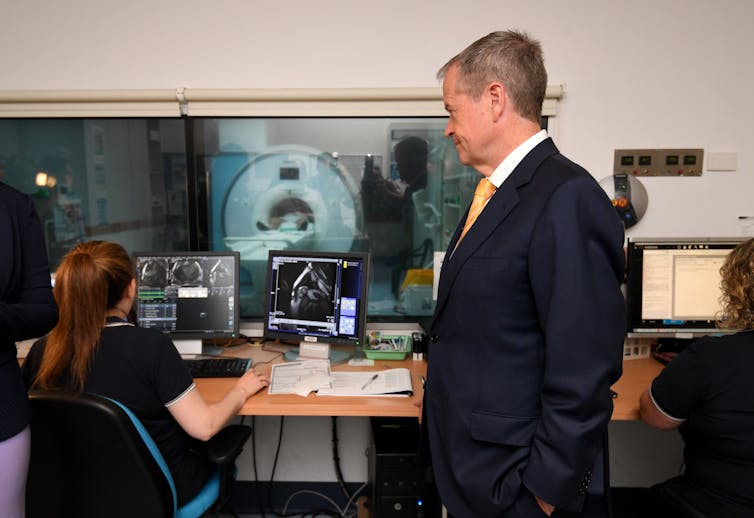 Opposition leader Bill Shorten announced the A$2.3 billion cancer package in last week’s budget reply.
Dan Peled/AAP
Opposition leader Bill Shorten announced the A$2.3 billion cancer package in last week’s budget reply.
Dan Peled/AAP
The approach that has shown promise in other countries is known as “bundled payments”.
Under bundled payments, a series of health care services – that can span over time and across multiple health care sectors and providers – are bundled together for funding purposes. This gives providers or institutions greater flexibility in how they spend money delivering care to the patient.
There is a danger that bundling can provide incentives to skimp on care, because the provider receives the same amount of funding no matter how much care is provided. But this can be addressed by monitoring the quality of care and the patients’ outcomes.
Ensuring the financial benefits flow to patients
Australian governments have made several attempts to provide better safety nets that cushion patients from extra charges.
Study after study shows that, in these circumstances, providers are likely to raise their fees. So while patients get some financial benefit, the doctors benefit also.
Under current Medicare rules, the Australian government does not and cannot determine doctors’ fees. It can only determine the amount of the Medicare benefit.
In general practice, most consultations are bulk-billed implying that the fee the doctor charges is equivalent to the Medicare benefit.
Only 31% of specialist consultations are bulk-billed, leaving more patients with an out-of-pocket payment.
Read more: Specialists are free to set their fees, but there are ways to ensure patients don't get ripped off
What can government do to encourage cancer care providers to bulk-bill?
Labor has announced they will add a bulk-billing incentive payment, as occurs in primary care. Specialists will receive an additional payment if they bulk-bill a cancer-related service.
This will not guarantee that every patient will not incur any out-of-pocket costs – although it should increase the likelihood that they will. Indeed, the Labor target is that 80% of patients will be bulk-billed.
However, previous research has shown that while the GP bulk-billing incentive led to a reduction in costs for those eligible (concession card holders), it also increased costs for those not eligible.
Careful monitoring is required to ensure the volume of services – and their fees for non-cancer patients – do not go up.
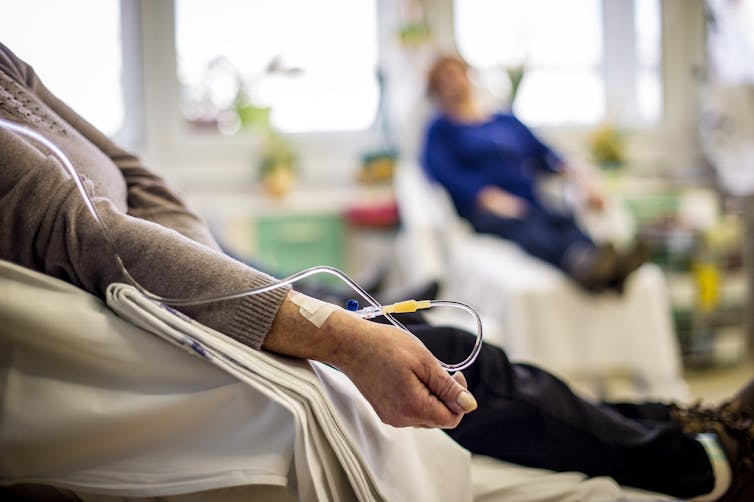 Not all cancer care is based on the best available evidence.
Napocska/Shutterstock
Not all cancer care is based on the best available evidence.
Napocska/Shutterstock
A further unprecedented complication is that for some services, it will be necessary to differentiate Medicare payments on the basis of the patient’s cancer status.
To guarantee patients face no out-of-pocket costs would require more radical reform. Again, the bundled payment system could be a vehicle for such reforms whereby payments are conditional on all the patient’s service providers agreeing to deliver care with no additional fee to the patient.
Depending on whether a patient is privately insured, the bundled payment could be financed by private health funds and Medicare.
Of course, it’s not yet clear that bundled payment schemes can be directly applied to the Australian setting.
The Labor cancer package requires careful and rigorous research effort to inform and guide the policy development.
A new vision for Medicare
Medicare is now 35 years old. It was built on fee-for-service payment, and focused on short, acute episodes of illness.
Now it’s time to move to new funding mechanisms that provide better care for complex, ongoing conditions, at a cost patients and the country can be sure represent efficient use of resources.
Read more: More visits to the doctor doesn't mean better care – it's time for a Medicare shake-up
Cancer is a good place to start and it could indeed be the most significant reform of Medicare so far.
Imagine a health system where every Australian was assured of optimal care, no matter what their illness or economic circumstances. That is a health system worth paying taxes for.
Authors: Kees Van Gool, Health economist, University of Technology Sydney