

Our electricity workforce must double to hit the 2030 renewables target. Energy storage jobs will soon overtake those in coal and gas
- Written by: Jay Rutovitz, Research Director, Institute for Sustainable Futures, University of Technology Sydney
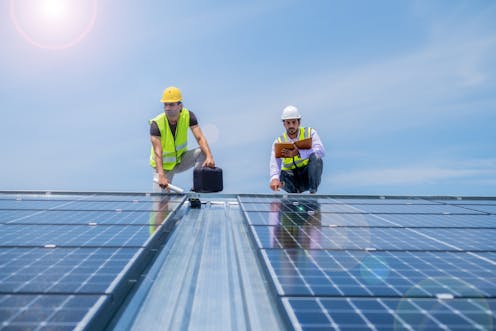
The electricity workforce will need to double in five years to achieve Australia’s 2030 renewable energy target, our new report finds. More than 80% of these jobs will be in renewables. Jobs in energy storage alone will overtake domestic coal and gas jobs (not including the coal and gas export sector) in the next couple of years.
The Australian Energy Market Operator (AEMO) updates its Integrated System Plan every two years. It’s a blueprint for the energy transition from coal to renewable energy. The plan lays out scenarios for how the electricity system might change to help put in place all the elements needed to make the transition happen.
AEMO and the RACE for 2030 co-operative research centre commissioned the Institute for Sustainable Futures to undertake modelling on the workforce needed for this transition. The “step change” scenario in the Integrated System Plan is broadly aligned with the 2030 renewables target. Under this scenario, we found the electricity workforce would need to grow from 33,000 to peak at 66,000 by 2029.
Rooftop solar and batteries together are projected to account for over 40% of these jobs. Wind farms will employ around one-third and solar farms just under 10%. Jobs would also treble in transmission line construction to connect renewables in regional areas to cities and other states in the next few years.

Job growth would surge in a ‘renewable energy superpower’
In the “green energy export” scenario, Australia becomes a “renewable energy superpower”. The country uses renewable energy to export green hydrogen and power heavy industry. In this scenario, the electricity workforce would almost treble to 96,000 by the late 2020s.
By 2033, after construction peaks, more than half of electricity sector jobs will be in operations and maintenance. This applies to both the step change and green energy export scenarios.
A significant employment downturn is projected during the 2030s. But in the green energy export scenario jobs then climb steeply again to a peak of 120,000. This projection reflects AEMO’s expectations of when green export growth will occur.
New South Wales is projected to have the most renewable energy jobs in the 2020s. However, Queensland would become the largest state for renewable jobs (especially in wind farms) in the green energy export scenario.
 Projected total job numbers by scenario.
Author provided
Projected total job numbers by scenario.
Author provided
What are the other possibilities?
“Progressive change” is another scenario in the Integrated System Plan. For this scenario, we modelled slower growth in renewable energy. It reflects constraints on the economy and supply chains (including labour and minerals) for renewables.
In an “enhanced manufacturing” scenario, local renewable energy manufacturing increases. Our modelling found it could create a peak of 5,000 extra jobs.
Importantly, these projections don’t include upstream jobs in supply chains for the sector (for example, increased mining to supply the resources that renewables need) or electrification of homes.
Creating this many jobs is very challenging
Our modelling shows the workforce needs to grow very rapidly to make Australia’s energy transition happen. Unfortunately, the challenges of building this workforce are daunting. They include:
there’s a shortage of almost all key occupations in demand for the electricity sector – electricians, engineers, construction managers – according to Australia’s Skills Priority List
“extraordinary growth” forecast by Infrastructure Australia in other major infrastructure projects, such as transport, which will compete for many of the same skilled workers
under AEMO’s scenarios, employment will be subject to boom-bust cycles, which increases the risk of skill shortages and damaging impacts, such as housing shortages, in regional areas
Australia has relied heavily on skilled migrants – and will look to do so again – but many parts of the world are chasing the same workers.
The International Energy Agency has noted:
Labour and skills shortages are already translating into project delays, raising concerns that clean energy solutions will be unable to keep pace with demand to meet net zero targets.
What can be done to avoid skill shortages?
Some action has been taken to increase the workforce. The federal government, for instance, is subsidising apprentices under the New Energy Apprenticeship program.
But action isn’t happening at the scale and pace required.
What else can be done?
Firstly, Jobs Skills Australia and Powering Skills Organisation (which oversees energy skills training) have outlined ways to increase the system’s capacity to train more skilled workers. This includes creating better pathways into renewable energy for students, especially in recognised Renewable Energy Zones.
Secondly, Jobs Skills Australia has noted the need for renewable energy businesses to increase their intakes of apprentices. It recommends expanding the Australian Skills Guarantee to include generation and transmission projects.
The guarantee has set mandatory targets for apprentices or trainees to complete 10% of labour hours on Commonwealth-funded major construction and information technology projects (A$10 million plus). It could also be applied to major government funding programs for renewable energy and transmission. These include:
the Capacity Investment Scheme, a government tender program to support a large volume of new renewables and storage projects
Rewiring the Nation, a $20 billion fund for transmission lines
grants from the Australian Renewable Energy Agency and the Clean Energy Finance Corporation.
Thirdly, government tenders could moderate the peaks and troughs in employment by limiting the maximum and minimum volumes built each year.
Fourthly, including more women and First Nations Australians can increase labour supply and workforce diversity. Only one-in-two First Nations Australians are employed compared to around two in three in the wider population. Yet they account for around one-in-ten people in some major Renewable Energy Zones.
Government pre-employment programs, working with industry and First Nations groups, could also increase the supply of workers. These could have a dramatic social impact too.
It’s a challenging problem whichever way you look at it. We need rapid change to build renewable energy capacity before coal plants retire and to tackle climate change. But that depends on growing the workforce amid skill shortages.
There’s a range of ways to increase the supply of workers and improve local outcomes. But we are running out of time. Urgent action is needed.
Authors: Jay Rutovitz, Research Director, Institute for Sustainable Futures, University of Technology Sydney


















