

‘Vegetarian’ possums eat meat when the weather’s cold
- Written by: Patrick Finnerty, Postdoctoral research fellow in conservation, University of Sydney
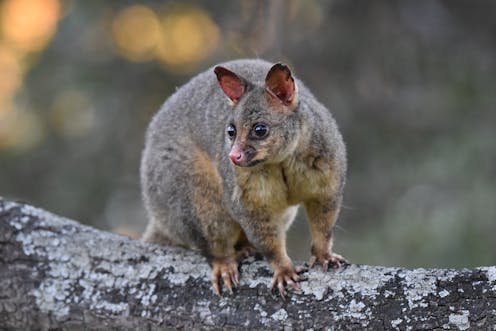
When dead animals are left lying around in nature, who takes advantage of the free feed – carnivores or herbivores? The answer may surprise you.
In Australia, people tend to think carnivores – such as dingoes, ravens, foxes and wedge-tailed eagles – lead the clean-up crew.
But our new research shows common brushtail possums – often thought to be herbivores – also dine on animal carcasses.
Understanding when and where brushtail possums scavenge is important. It can improve our knowledge of how carcasses are disposed of in nature, and how nutrients cycle through ecosystems.
Seeking a nutritious meal
Scavenging may provide specific essential nutrients otherwise lacking in herbivore diets.
Carcasses often contain much greater levels of crude protein than leafy greens do. Similarly, chewing on bones, may increase the intake of calcium and phosphorus, two key minerals essential for growth.
Scavenging on carrion may also help herbivores meet nutritional requirements in regions where typical food resources may be restricted during some seasons. Similarly, in times of drought, thirst may also drive herbivores to scavenge in an attempt to extract fluids from carcasses.
Though it may seem gruesome, scavenging is crucial to healthy ecosystems. Clearing carcasses from the landscape by feeding them back into food chains recycles nutrients into living systems.
Our previous research has found native marsupial herbivores feasting on the dead.
In alpine Australia, possums accounted for 61% of all recorded carcass scavenging – a proportion far surpassing species more typically considered carcass consumers.
In our latest research, we wanted to understand the factors that influence carrion consumption by brushtail possums in different ecosystems.
What we did
We monitored fresh eastern grey kangaroo carcasses across both alpine (Kosciuszko National Park) and temperate (Wolgan Valley, Greater Blue Mountains National Park) regions in New South Wales. We also compared sites in both open (grassland with no canopy cover) and closed (woodland) habitats, in cool and warm seasons.
At each carcass, we used a remote camera “trap” to record scavenging behaviours.
We found possums were one of the main scavengers, often feeding from carrion more than typical scavengers such as dingoes and ravens.
Possum scavenging rates varied by habitat and season. Regardless of region, possums scavenged exclusively in closed canopy habitats under the trees, probably for protection from predators and other scavengers such as dingoes, red foxes, and wedge-tailed eagles.

Out in the cold
Possum scavenging activity varied according to the season.
In temperate regions, possums scavenged only in winter when other food resources were limited.
In alpine areas, where food is scarce even in summer, possums scavenged year-round. But they still ate more from carcasses in cooler months. This may be necessary for possums to get the nutrition they need when other normal food resources — such as leaves, flowers and fruit — are limited.
Competition between scavengers may also change with the seasons. For example, in alpine regions, we saw fewer large scavengers such as dingoes in winter, possibly reducing competition and making it easier for possums to access carrion.
During warmer months, insect activity increases. These tiny scavengers often start eating a carcass within minutes of its death, accelerating its decomposition. It means animals such as possums have less time to feed on the carrion.
Flexible ‘herbivores’ around the world
Previous research has shown many herbivore diets are more flexible than previously thought. All over the world, certain plant-eaters have been found scavenging on animal remains – especially when other food sources are limited, such as during drought or after fire.
In Africa, hippopotamuses were found to have consumed flesh from the carcasses of other animals. In the United States, white-tailed deer fed on discarded fish.
Similarly, on a small island off Cape Town, introduced European fallow deer ate dead rabbits. On the Eurasian tundra (treeless plains), reindeer devoured lemming carcasses. In Italy, crested porcupine ate dead pigeons.
These are all still primarily herbivorous animals, they just happen to dip into carcass resources when they need to.
 My, what big teeth you have. All the better for eating other animals. Hippos are not always strictly herbivorous.
Gaston Piccinetti, Shutterstock
Improving our understanding of ‘bloody hungry’ herbivores
Our study found brushtail possums are an important scavenging species across several Australian ecosystems. It also highlights how scavenging can vary with a region, season and habitat.
Understanding the unusual foraging behaviour of the common brushtail possum could also help inform more effective wildlife management. Specifically, understanding how carcasses can support possum populations during cooler months in places like New Zealand, where they are considered an invasive pest, may lead to more effective control measures.
Our methods could also help scientists understand herbivore scavenging in other environments. This may provide valuable insights into complexities of food webs and how nutrients move through ecosystems.
Authors: Patrick Finnerty, Postdoctoral research fellow in conservation, University of Sydney
Read more https://theconversation.com/vegetarian-possums-eat-meat-when-the-weathers-cold-231825


















