

As Mediscare 2.0 takes centre stage, here's what you need to know about hospital 'cuts' and cancer funding
- Written by Stephen Duckett, Director, Health Program, Grattan Institute
Health is proving a bone of contention in the 2019 election campaign. Labor has positioned health as a key point of difference, and the Coalition is arguing that Labor’s promises are untrue in one case and underfunded in another.
This cheat sheet will help you sort fact from fiction in two key health policy areas: public hospital funding and cancer care.
Public hospitals
In his budget reply, Opposition Leader Bill Shorten promised that Labor would restore every dollar the government had “cut” from public hospital funding.
The government counter-claimed that hospital funding has increased. So who is right?
The short answer is both.
In 2011, the then Labor government negotiated a funding agreement with the states for the Commonwealth to share 45% of the growth in the cost of public hospital care, funded at the “national efficient price”. This price is based on the average cost of the procedure, test or treatment.
The funding share was to increase to 50% of growth from July 1, 2017.
Read more: Public hospital blame game – here's how we got into this funding mess
At the 2013 election, the then Liberal opposition agreed to match that promise and, indeed, claimed they were the only ones who could be trusted to keep the promise:
A Coalition government will support the transition to the Commonwealth providing 50% growth funding of the efficient price are hospital services as proposed. But only the Coalition has the economic record to be able to deliver.
However, in the 2014 budget the Coalition scrapped its promise. The 2014 budget papers list the savings that were made by the decision. It was a clear and documented cut that the Coalition was proud to claim at the time.
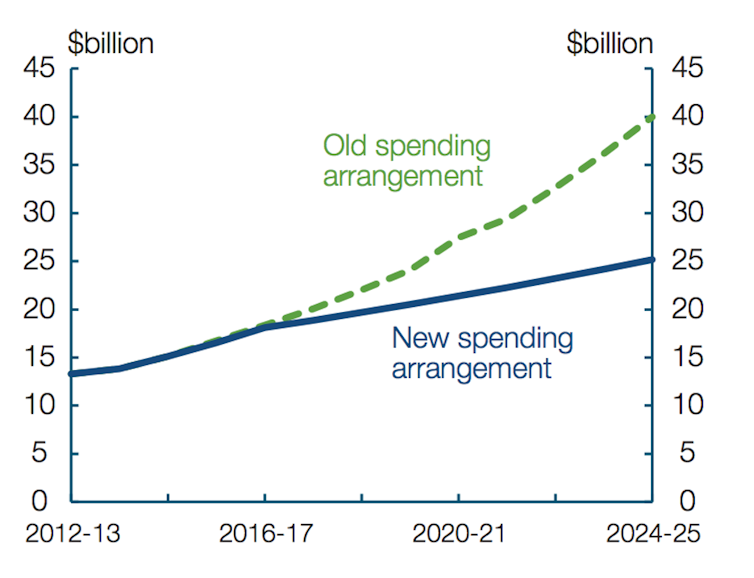 The green line represents the Gillard hospital funding agreement; the blue line is the revised projection from the 2014 budget.
Budget 2014-15
The green line represents the Gillard hospital funding agreement; the blue line is the revised projection from the 2014 budget.
Budget 2014-15
Since then, the Turnbull government has backtracked on the 2014 cuts to health but only to restore sharing to 45% of the costs of growth.
Labor has estimated the impact of the gap between 45% and 50% on every public hospital in the country, and spruiks the difference at every opportunity.
Hospital costs increase faster than inflation because of growth and ageing population, the introduction of new technologies, and new approaches to treatment.
As a result, the Commonwealth’s existing 45% sharing policy drives increased spending, and so Commonwealth spending is now at record levels, albeit not at the even higher levels that Labor had promised.
Labor’s promise is, appropriately, phrased as an additional quantum of money to the states, sufficient to restore the 50% share in the cost of growth.
 The public hospital funding gap comes down to how much of the growth in hospital funding each party has committed to.
Shutterstock
The public hospital funding gap comes down to how much of the growth in hospital funding each party has committed to.
Shutterstock
The details of how this funding should be operationalised to the states should be left to detailed negotiations after the election as it is not good practice for all the details of your negotiating position to be aired in the heat of a campaign.
So Labor is right to say hospital funding is lower than it would have been if the 50% growth share commitment had been maintained. But the Coalition is right to say the Commonwealth is spending more on hospital care than when it came to office.
Cancer care
The second major element of the Labor campaign was a high-profile A$2.3 billion package to address high out-of-pocket costs for Australians with cancer. The package has three key components:
- additional public hospital outpatient funding to reduce waiting times
- a new bulk-billing item for consultations
- more funding for MRI machines for cancer diagnosis.
Read more: Labor's cancer package would cut the cost of care, but beware of unintended side effects
Labor did not promise to eliminate out-of-pocket costs for cancer, not even for consultations. It claimed bulk-billing would increase from 40% to 80% of consultations.
This promise has led to another showdown between Labor and the Coalition. Health Minister Greg Hunt claims to have found a A$6 billion black hole in Labor’s cancer policy.
The Coalition has produced a list of 421 Medicare items used for cancer treatment - including treatment in private hospitals - and noted Labor has not allocated funds to cover the fees specialists charge for these items.
But Labor rightly claims the 421-item list is not what it promised. Labor’s promise was about increasing the rate of bulk-billing for consultations and is based on a new item which is only available if the specialist bulk-bills.
Expect more claims and counter-claims in the weeks ahead.
Authors: Stephen Duckett, Director, Health Program, Grattan Institute

















