

How do you stop elephant herds from trashing crops and trees? Target sensitive nostrils with a ‘scent fence’
- Written by: Patrick Finnerty, Postdoctoral research fellow in conservation, University of Sydney
Elephant numbers are surging in southern Africa, with fewer natural predators, reduced hunting pressure and feeding by farmers and tourist operators.
While this is good for elephants, it’s making life harder for humans who live near them. These huge herbivores can raid crops and destroy large trees in national parks with impunity, causing problems for farmers and land managers alike.
Traditional solutions aren’t ideal. Culling is controversial, and building fences strong enough to deter elephants is very expensive.
But there’s another option: a fence made of scent. We have explored how specific plant scents can stop wallabies from eating native seedlings. The technique works on Australian herbivores. Would it work for southern Africa’s much larger elephants?
Our new research put this idea to the test. We mimicked the scent of a shrub known as common guarri (Euclea undulata), which elephants avoid eating, and built a Y-shaped maze for elephants. We placed the scent on one side of the Y and left the other side scent-free.
The results were clear – our elephants voted with their trunks and avoided the stinky side. This suggests scent could play a useful role in fending off hungry pachyderms.

How can elephants be a problem?
The world has three species of elephant. The small Asian elephant is endangered while the even smaller African forest elephant, which lives in rainforests in West Africa and the Congo Basin, is critically endangered.
But the largest species, the African savannah elephant, is bouncing back in southern Africa from decades of poaching and habitat loss.
This is great on a conservation front. But it brings fresh problems. As elephant herds expand, they increasingly come into conflict with people – especially farmers. Losing a year’s crop to hungry elephants is devastating. When farmers try to stop them, the elephants can attack and even kill.
In large numbers, elephants can damage the natural environment like other herbivores – but even more so. In South Africa’s Kruger National Park and other wild places, their enormous appetites have reshaped whole plant communities. The plants elephants like disappear, while those they don’t spread. Elephants also destroy large trees and prevent the growth of new ones.
Oranges unable to be sold by Zimbabwean farmers are dumped, which attracts elephants and fuels population growth.As elephant numbers grow, desperate farmers and land managers have scrambled for solutions. Killing problem elephants has been a common fix. But the practice now faces strong public opposition. Fencing is costly and usually impractical for lower-income farming areas. Other deterrents, such as using flashing lights and annoying sounds to scare off the pachyderms have had mixed success.
Curiously, elephants are scared stiff of bees. This knowledge has been used effectively by Kenyan farmers, who install beehives around their fields. Studies have shown the technique deters up to 80% of elephants. This method has limits, though, as there are only so many bees an area can sustain and maintaining hives takes work.
The scent defence
To deter an elephant, it helps to think like an elephant. We’ve long known carnivores rely heavily on scent to find prey. But scent is very important to herbivores too, as our team has explored. Herbivores rely on smell to tell them which plants to eat and which to avoid.
In Australia, we have used this knowledge to artificially replicate the scent of boronia pinnata, a flowering shrub which swamp wallabies avoid. These wallabies are the local native equivalent of deer in their eating habits – they eat many different plants, including tree seedlings land managers would rather they did not.When we put vials of boronia scent next to vulnerable native seedlings in Sydney’s Ku-ring-gai Chase National Park, we found these seedlings were 20 times less likely to be found and eaten by pesky wallabies.
Researchers have found similar scent “misinformation” tactics substantially reduced how many eggs from threatened birds were eaten by invasive predators such as ferrets, cats and hedgehogs in New Zealand, while others have found it can reduce losses of wheat grain to house mice in Australia.
But would this approach work on elephants? We were hopeful. We know elephants can smell water from afar. Better still, elephants have the strongest sense of smell of any land animal.
We went to South Africa to test it out.
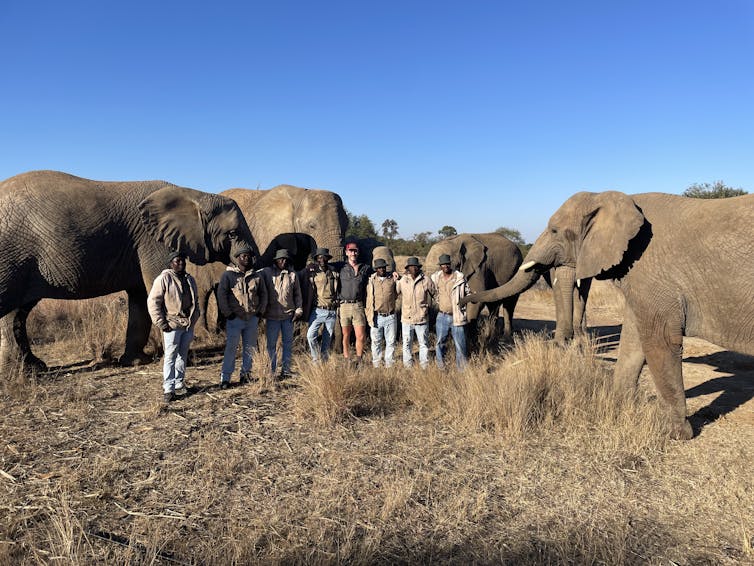
 Our entire research team, including humans and elephants.
Patrick Finnerty, CC BY-NC-ND
Our entire research team, including humans and elephants.
Patrick Finnerty, CC BY-NC-ND
A proof of concept
We set up our experiment at the Adventures with Elephants tourism and research centre north of Johannesburg, which is home to six semi-tame elephants.
Here, we built a large maze shaped like a Y to let us test our idea in a controlled and safe environment. This is essential when working with temperamental animals weighing up to six tonnes.
From almost ten meters away, elephants had to choose which path through the Y to follow using only their sense of smell. Plants and odour vials were hidden down each arm of the maze, ensuring the animals were not using vision to choose. Both exits to the maze contained lots of leaves and stems of the jacket plum (pappea capensis), a tree elephants love to eat. On one side of the Y, we placed a single glass vial containing just 1 millilitre of a mixture mimicking the smell of common guarri.
 It took just 1 ml of this scent to nudge elephants to go elsewhere.
Patrick Finnerty
It took just 1 ml of this scent to nudge elephants to go elsewhere.
Patrick Finnerty
The results were exciting. Time and time again, the elephants avoided the side where the artificial odour was present.
An elephant stands at the top of the Y maze, scents the unpleasant plant on the right arm, and chooses to walk down the left arm.Scaling up
Our results suggest using scent could provide a practical way we could avoid human-elephant conflicts and help people protect crops and national parks at a larger scale.
Combining artificial odours with existing control measures such as fencing or beehives could offer more accessible and cost-effective methods to live alongside elephants.
What’s next? We aim to scale up this research in the hope of creating a practical, versatile and cheap tool which people in elephant territory can use to protect crops, trees, and houses from these giant herbivores.
We acknowledge our research co-authors, Clare McArthur and Peter Banks (University of Sydney) Adrian Shrader (University of Pretoria) and Melissa Schmitt (University of North Dakota), and Paul Finnerty for help designing and constructing the maze. We also thank Sean Hensman and the staff at Adventures With Elephants, South Africa, for allowing us to conduct our study on their premises.
Authors: Patrick Finnerty, Postdoctoral research fellow in conservation, University of Sydney


















