

The Treaty Principles Bill is already straining social cohesion – a referendum could be worse
- Written by: Alexander Gillespie, Professor of Law, University of Waikato
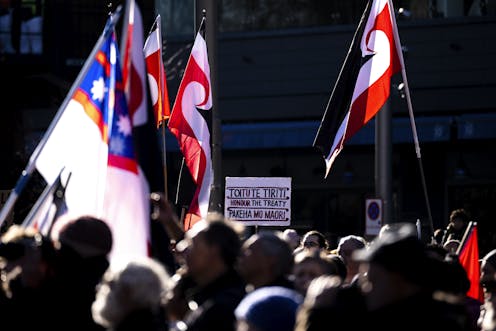
With the protest hikoi from the far north moving through Auckland on its way to Wellington, it might be said ACT leader David Seymour has been granted his wish of generating an “important national conversation about the place of the Treaty in our constitutional arrangements”.
Timed to coincide with the first reading of the contentious Principles of the Treaty of Waitangi Bill on Thursday, the hikoi and other similar protests are a response to what many perceive as a fundamental threat to New Zealand’s fragile constitutional framework.
With no upper house, nor a written constitution, important laws can be fast-tracked or repealed by a simple majority of parliament. As constitutional lawyer and former prime minister Geoffrey Palmer has argued about the current government’s legislative style and speed, the country “is in danger of lurching towards constitutional impropriety”.
Central to this ever-shifting and contested political ground is te Tiriti o Waitangi/Treaty of Waitangi. For decades it has been woven into the laws of the land in an effort to redress colonial wrongs and guarantee a degree of fairness and equity for Māori.
There is a significant risk the Principles of the Treaty of Waitangi Bill would undermine these achievements, as it attempts to negate recognised rights within the original document and curtail its application in a modern setting.
But while the bill is almost guaranteed to fail because of the other coalition parties’ refusal to support it beyond the select committee, there is another danger. Contained in an explanatory note within the bill is the following clause:
The Bill will come into force if a majority of electors voting in a referendum support it. The Bill will come into force 6 months after the date on which the official result of that referendum is declared.
Were David Seymour to argue his bill has been thwarted by the standard legislative process and must be advanced by a referendum, the consequences for social cohesion could be significant.
The referendum option
While the bill would still need to become law for the referendum to take place, the option of putting it to the wider population – either as a condition of a future coalition agreement or orchestrated via a citizens-initiated referendum – should not be discounted.
One recent poll showed roughly equal support for and against a referendum on the subject, with around 30% undecided. And Seymour has had success in the past with his End of Life Choice Act referendum in 2020.
He will also have watched the recent example of Australia’s Voice referendum, which aimed to give a non-binding parliamentary voice to Indigenous communities but failed after a heated and divisive public debate.
The lobby group Hobson’s Pledge, which opposes affirmative action for Māori and is led by former ACT politician Don Brash, has already signalled its intention to push for a citizens-initiated referendum, arguing: “We need to deliver the kind of message that the Voice referendum in Australia delivered.”
The Treaty and the constitution
ACT’s bill is not the first such attempt. In 2006, the NZ First Party – then part of a Labour-led coalition government – introduced the Principles of the Treaty of Waitangi Deletion Bill.
That bill failed, but the essential argument behind it was that entrenching Treaty principles in law was “undermining race relations in New Zealand”. However, ACT’s current bill does not seek to delete those principles, but rather to define and restrain them in law.
This would effectively begin to unpick decades of careful legislative work, threaded together from the deliberations of the Waitangi Tribunal, the Treaty settlements process, the courts and parliament.
As such, in mid-August the Tribunal found the first iteration of ACT’s bill
would reduce the constitutional status of the Treaty/te Tiriti, remove its effect in law as currently recognised in Treaty clauses, limit Māori rights and Crown obligations, hinder Māori access to justice, impact Treaty settlements, and undermine social cohesion.
In early November, the Tribunal added:
If this Bill were to be enacted, it would be the worst, most comprehensive breach of the Treaty/te Tiriti in modern times. If the Bill remained on the statute book for a considerable time or was never repealed, it could mean the end of the Treaty/te Tiriti.
Social cohesion at risk
Similar concerns have been raised by the Ministry of Justice in its advice to the government. In particular, the ministry noted the proposal in the bill may negate the rights articulated in Article II of the Treaty, which affirms the continuing exercise of tino rangatiratanga (self-determination):
Any law which fails to recognise the collective rights given by Article II calls into question the very purpose of the Treaty and its status in our constitutional arrangements.
The government has also been advised by the Ministry of Justice that the bill may lead to discriminatory outcomes inconsistent with New Zealand’s international legal obligations to eliminate discrimination and implement the rights of Indigenous peoples.
All of these issues will become heightened if a referendum, essentially about the the removal of rights guaranteed to Māori in 1840, is put to the vote.
Of course, citizens-initiated referendums are not binding on a government, but they carry much politically persuasive power nonetheless. And this is not to argue against their usefulness, even on difficult issues.
But the profound constitutional and wider democratic implications of the Principles of the Treaty of Waitangi Bill, and any potential referendum on it, should give everyone pause for thought at this pivotal moment.
Authors: Alexander Gillespie, Professor of Law, University of Waikato


















