

Live in an apartment and want to charge an electric car at home? Here are 4 ways to help that happen
- Written by: Thomas Longden, Senior Researcher, Urban Transformations Research Centre, Western Sydney University
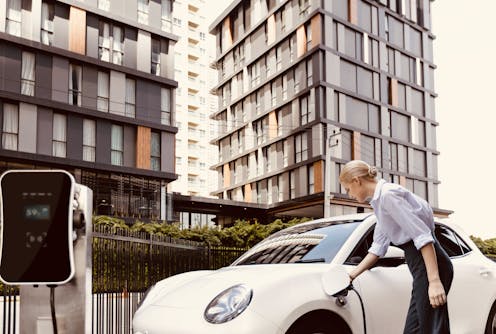
Being able to charge your car at home is a big drawcard for many electric vehicle buyers. But it’s rare to find chargers installed at apartment complexes in Australia.
Installing chargers in existing apartment blocks can be complicated. Owners may not agree on whether to install them, or which technology to use. And the complex may not be well-equipped for the extra electricity load.
So how can these challenges be overcome? A policy paper my colleagues and I published today set out to answer that question.
We surveyed 43 experts in installing charging infrastructure in apartments in New South Wales. They identified four key ways to ensure more apartment residents can confidently charge their electric vehicles at home before hitting the road.
Getting more Australians in electric cars
The Electric Vehicle Council predicts 100,000 electric vehicle sales in Australia this year. However, sales have reportedly flatlined – partly due to concerns about access to charging.
Clearly, chargers in apartment complexes are crucial to increasing electric vehicle uptake.
To date, electric vehicle sales in Australia have been led by motorists in outer-metropolitan suburbs where houses rather than apartments are the dominant dwelling type. The trend is partly attributed to the ease of installing home chargers in houses.
Research shows most Australians – both those living in houses and apartment buildings – would prefer a car-charging option at home.
Increasing electric vehicle sales is also vital for climate action. Passenger cars and light commercial vehicles contribute more than 10% of Australia’s total emissions.
Patchy policy
Electric vehicle strategies in Australia give little attention to those living in apartments.
The Australian Capital Territory’s Zero Emissions Vehicles Strategy introduced a A$2,000 incentive to install charging at multi-unit buildings.
Last year, the New South Wales government established the $10 million EV Ready Buildings Grant to help apartment buildings assess and install electric vehicle infrastructure. NSW’s electric vehicle strategy is currently being revised, offering an opportunity for further support.
Australia’s national strategy pledges to “make it easy to charge an EV across Australia” but focuses on public charging stations.
Under the National Construction Code – Australia’s main set of technical and construction requirements – new apartments must be built “ready” for electric vehicle chargers if residents want to install them in the future.
But complications can arise when trying to install chargers into existing apartments.
Retrofitting vehicle chargers is complicated
Getting electric vehicle chargers into apartment blocks requires the following steps:
gaining support from apartment owners
conducting a building energy assessment to determine, for example, if electricity infrastructure needs upgrading
choosing between individual or shared chargers
choosing how to share the upfront costs and pass on the cost of electricity
navigating the planning approval process
getting the funds to start the project
finding energy auditors and installers with relevant expertise.
This final point is crucial. Because electric vehicle charging in apartment blocks is relatively rare, few people have the necessary skills or experience.
We tapped into the knowledge of those who do have experience installing chargers in existing apartment buildings in NSW. The research was commissioned by the James Martin Institute for Public Policy.
After a few months of searching and sending 166 invitations, we found 43 experts from industry, strata organisations and local councils.
Their expertise spans strata processes as well as physically installing charging infrastructure.
What we found
The survey was conducted by an interviewer by video call. This allowed us to ask set questions and then discuss broad themes. Most experts identified two main challenges.
The first was gaining support from apartment owners – those who would be asked to share the cost of installing charging infrastructure at a complex.
Often, the views of owners were divided between a few motivated residents and sceptics who were averse to new technologies. Apartment owners who did not drive an electric vehicle were less likely to support the installation of chargers.
The second challenge our experts identified was deciding on whether to install personal or shared chargers. In some cases, shared charging was seen as the only viable option, due to lower costs and confusion about electricity load or technical requirements.
The experts also reported concern among apartment owners about fire risks and insurance. Electric vehicles have a relatively low risk of battery fire when compared with electric bikes and scooters. However, some insurance companies have refused to cover apartments where electric vehicles are charged.

Four policy opportunities
The experts highlighted four key steps governments and others can take to encourage more charging infrastructure in existing apartment buildings in NSW. The opportunities also apply to other states and territories.
1. Promote successful projects: Case studies of apartment blocks where electric vehicle chargers were successfully installed may help overcome anxiety or scepticism from apartment owners and show how challenges can be managed. Guidance sheets and other educational materials would also assist.
2. Educate apartment owners on fire safety: More guidance for planners, insurers and owners on fire safety options may lead to speedier planning approvals and help limit insurance costs. Governments should also play a role in dispelling misconceptions about fire risk during electric vehicle charging.
3. Expand grants schemes: Expanding NSW’s EV Ready Buildings Grant scheme would ensure more residents in existing apartment buildings could install chargers. Other states should consider similar schemes.
4. Explore finance options: Zero- or low-interest financing and subsidies would make the installation of charging infrastructure more affordable for apartment owners. Governments should also consider targeted schemes for low-income apartment residents.
The above is not a comprehensive list. Other suggestions from experts included broader improvements to electricity networks where needed, and more installer training.
Electric vehicle charging in apartments is important for a just and equitable energy transition. Without government support for the technology, apartment residents may hesitate to purchase their vehicle of choice.
Authors: Thomas Longden, Senior Researcher, Urban Transformations Research Centre, Western Sydney University


















