

Astronomers have pinpointed the origin of mysterious repeating radio bursts from space
- Written by: Natasha Hurley-Walker, Radio Astronomer, Curtin University

Slowly repeating bursts of intense radio waves from space have puzzled astronomers since they were discovered in 2022.
In new research, we have for the first time tracked one of these pulsating signals back to its source: a common kind of lightweight star called a red dwarf, likely in a binary orbit with a white dwarf, the core of another star that exploded long ago.
A slowly pulsing mystery
In 2022, our team made an amazing discovery: periodic radio pulsations that repeated every 18 minutes, emanating from space. The pulses outshone everything nearby, flashed brilliantly for three months, then disappeared.
We know some repeating radio signals come from a kind of neutron star called a radio pulsar, which spins rapidly (typically once a second or faster), beaming out radio waves like a lighthouse. The trouble is, our current theories say a pulsar spinning only once every 18 minutes should not produce radio waves.
So we thought our 2022 discovery could point to new and exciting physics – or help explain exactly how pulsars emit radiation, which despite 50 years of research is still not understood very well.
More slowly blinking radio sources have been discovered since then. There are now about ten known “long-period radio transients”.
However, just finding more hasn’t been enough to solve the mystery.
Searching the outskirts of the galaxy
Until now, every one of these sources has been found deep in the heart of the Milky Way.
This makes it very hard to figure out what kind of star or object produces the radio waves, because there are thousands of stars in a small area. Any one of them could be responsible for the signal, or none of them.
So, we started a campaign to scan the skies with the Murchison Widefield Array radio telescope in Western Australia, which can observe 1,000 square degrees of the sky every minute. An undergraduate student at Curtin University, Csanád Horváth, processed data covering half of the sky, looking for these elusive signals in more sparsely populated regions of the Milky Way.

And sure enough, we found a new source! Dubbed GLEAM-X J0704-37, it produces minute-long pulses of radio waves, just like other long-period radio transients. However, these pulses repeat only once every 2.9 hours, making it the slowest long-period radio transient found so far.
Where are the radio waves coming from?
We performed follow-up observations with the MeerKAT telescope in South Africa, the most sensitive radio telescope in the southern hemisphere. These pinpointed the location of the radio waves precisely: they were coming from a red dwarf star. These stars are incredibly common, making up 70% of the stars in the Milky Way, but they are so faint that not a single one is visible to the naked eye.
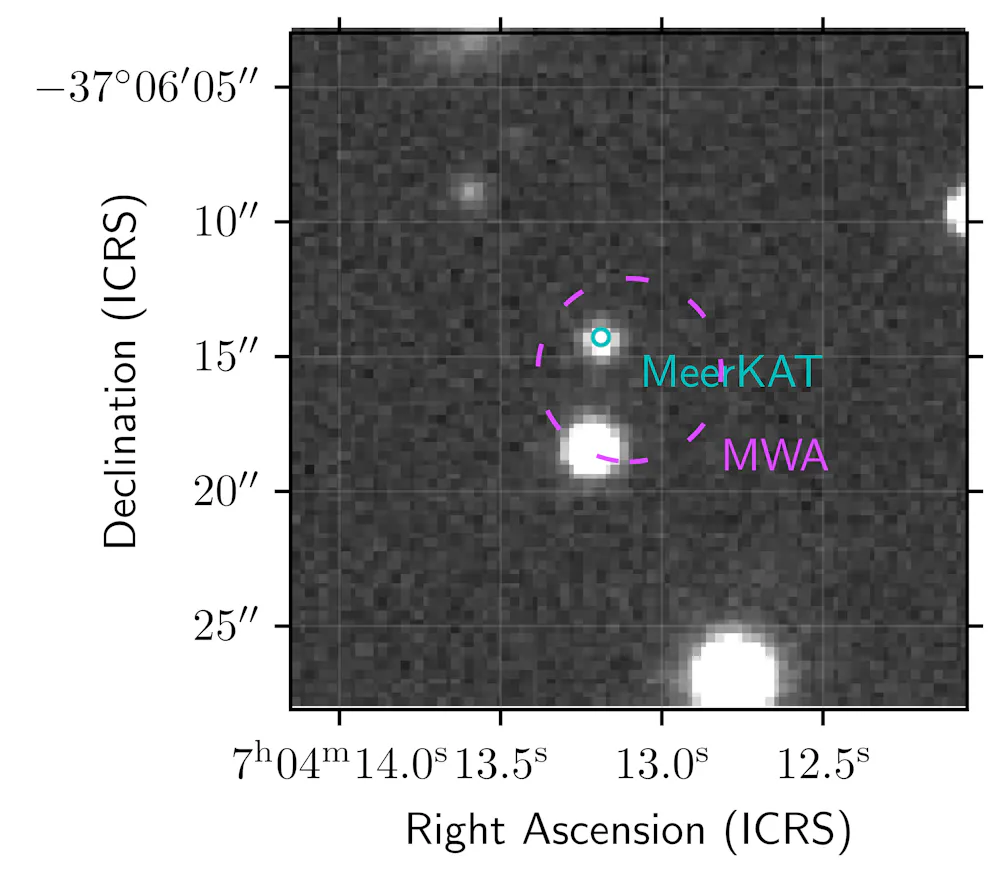 The source of the radio waves, as seen by the MWA at low resolution (magenta circle) and MeerKAT at high resolution (cyan circle). The white circles are all stars in our own Galaxy.
Hurley-Walker et al. 2024 / Astrophysical Journal Letters
Combining historical observations from the Murchison Widefield Array and new MeerKAT monitoring data, we found that the pulses arrive a little earlier and a little later in a repeating pattern. This probably indicates that the radio emitter isn’t the red dwarf itself, but rather an unseen object in a binary orbit with it.
Based on previous studies of the evolution of stars, we think this invisible radio emitter is most likely to be a white dwarf, which is the final endpoint of small to medium-sized stars like our own Sun. If it were a neutron star or a black hole, the explosion that created it would have been so large it should have disrupted the orbit.
It takes two to tango
So how do a red dwarf and a white dwarf generate a radio signal?
The red dwarf probably produces a stellar wind of charged particles, just like our Sun does. When the wind hits the white dwarf’s magnetic field, it would be accelerated, producing radio waves.
This could be similar to how the Sun’s stellar wind interacts with Earth’s magnetic field to produce beautiful aurora, and also low-frequency radio waves.
An artist’s impression of the AR Sco system: a binary red dwarf and white dwarf that interact to produce radio emission.We already know of a few systems like this, such as AR Scorpii, where variations in the brightness of the red dwarf imply that the companion white dwarf is hitting it with a powerful beam of radio waves every two minutes. None of these systems are as bright or as slow as the long-period radio transients, but maybe as we find more examples, we will work out a unifying physical model that explains all of them.
On the other hand, there may be many different kinds of system that can produce long-period radio pulsations.
Either way, we’ve learned the power of expecting the unexpected – and we’ll keep scanning the skies to solve this cosmic mystery.
Authors: Natasha Hurley-Walker, Radio Astronomer, Curtin University