

are employers our biggest threat to free speech?
- Written by: Carl Rhodes, Professor of Organisation Studies, University of Technology Sydney
Free speech has become a political hobby horse in today’s world of increasingly divisive populism.
On the one side, the cancel culture left is accused of erecting ideological barriers that silence the expression of political opinions that do not conform to the party line. On the other, the right often supports no-holds-barred public dialogue, including the most hurtful, offensive, defamatory and downright hateful statements.
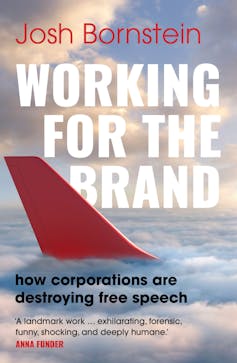
Working for the Brand: how corporations are destroying free speech by Josh Bornstein (Scribe)
A central figure in this political divide is self-declared “free speech absolutist” Elon Musk, who framed his US$44 billion purchase of Twitter as a win for free speech, “the bedrock of a functioning democracy”. He soon declared: “Cancel culture has been canceled.”
Josh Bornstein, author of the new book Working for the Brand: How Corporations are Destroying Free Speech, paints a very different picture of the fate of individual liberty in today’s corporate society.
He presents a series of stark examples. In the new workplace, employees are fired for social media jokes that misfire, workplace contracts are used to punish industrial action, and sharing news deemed controversial can lose you your livelihood.
Brand over democracy?
Musk speaks about free speech in platitudes through a giant megaphone. Bornstein speaks with well-researched facts, historically situated knowledge and reasoned argument. His central thesis is that, in the era of social media, corporations exert increasing and excessive control over what their employees can and cannot say in public. The level of censure is so extreme, he writes, that democracy itself is existentially threatened.

 Journalist Antoinette Lattouf (second from left) leaving a Fair Work Commission hearing.
Toby Zerna/AAP
The ABC claimed she had violated a direction “not to post on social media about matters of controversy”. However, Bornstein writes, it had been “agreed that she could continue to post content from reputable sources, including human rights organisations such as Amnesty International”. The controversial video she had shared on her Instagram was a report from Human Rights Watch, asserting Israel was engaging in a war crime by using the starvation of civilians as a method of war in the Gaza Strip.
Bornstein, who represented Lattouf in her case against the ABC, calls what happened to her an example of the ABC applying “brand-management orthodoxy” and capitulating to “a loud mob” – though the broadcaster has “denied that it succumbed to public pressure”. The legal dispute is ongoing.
No democratic checks
Government complicity in eroding workers’ rights is also canvassed in Bornstein’s book. A case in point was the Australian conservative government’s implementation of its WorkChoices industrial relations legislation in 2005.
Ostensibly, the purpose was greater flexibility for both workers and employers through individual employment agreements. In practice, collective labour power weakened, and working conditions eroded for many. Some found their pay packets shrunken.
Working for the Brand is harrowing reading at times. After 24 years of employment, Australian trade unionist Henk Doevendans was sacked by BHP Coal for misconduct in 2012. The company claimed his picket line sign reading “no principles SCABS No guts” contravened the company’s stated values of always demonstrating “courtesy and respect”. He took his case to the High Court, but failed to get his job back.
Journalist Antoinette Lattouf (second from left) leaving a Fair Work Commission hearing.
Toby Zerna/AAP
The ABC claimed she had violated a direction “not to post on social media about matters of controversy”. However, Bornstein writes, it had been “agreed that she could continue to post content from reputable sources, including human rights organisations such as Amnesty International”. The controversial video she had shared on her Instagram was a report from Human Rights Watch, asserting Israel was engaging in a war crime by using the starvation of civilians as a method of war in the Gaza Strip.
Bornstein, who represented Lattouf in her case against the ABC, calls what happened to her an example of the ABC applying “brand-management orthodoxy” and capitulating to “a loud mob” – though the broadcaster has “denied that it succumbed to public pressure”. The legal dispute is ongoing.
No democratic checks
Government complicity in eroding workers’ rights is also canvassed in Bornstein’s book. A case in point was the Australian conservative government’s implementation of its WorkChoices industrial relations legislation in 2005.
Ostensibly, the purpose was greater flexibility for both workers and employers through individual employment agreements. In practice, collective labour power weakened, and working conditions eroded for many. Some found their pay packets shrunken.
Working for the Brand is harrowing reading at times. After 24 years of employment, Australian trade unionist Henk Doevendans was sacked by BHP Coal for misconduct in 2012. The company claimed his picket line sign reading “no principles SCABS No guts” contravened the company’s stated values of always demonstrating “courtesy and respect”. He took his case to the High Court, but failed to get his job back.
 A BHP protest.
Darren England/AAP
In 2017, Canadian Uber driver David Heller planned to join a class action lawsuit, seeking the right to be paid minimum wages and conditions. Uber tried to stop him, relying on the mandatory arbitration term in his standard-form contract. Bornstein writes: “In 2020, Canada’s Supreme Court found the clause to be ‘unconscionable’, and declared the contract void based on the inequality of bargaining power between the parties and the cost of arbitration.”
These are just a handful of the many examples Bornstein uses to argue that the politics of corporate cancel culture has become so extreme that “it’s difficult to conceive of a democratic nation state possessing anything resembling the power that corporations now have over their employees”.
There are no democratic checks on corporate power. If your employer doesn’t like what you say (or worse, it signals a potential risk to the bottom line), they can exercise their considerable might to take your livelihood away.
Serious misconduct or politically targeted?
Even universities, increasingly governed through the logic of neoliberal managerialism, are losing their status as bastions of free speech as they turn their attention to protecting their brands.
In May 2016, “queer Marxist” academic Roz Ward posted a humorous remark on Facebook about getting rid of “the racist Australian flag on top of state parliament” and putting “a red one up there”. In June, she was suspended by her employer, La Trobe University. The charge was serious misconduct (“usually a precursor to summary dismissal”, Bornstein writes), involving breaches of the university’s code of conduct.
Ward had founded and led Safe Schools, an anti-bullying program for schools designed to protect LGBTQI+ students. The program was expanded (from its initial pilot in Victorian schools) around Australia in 2013. A backlash led by the Australian Christian Lobby, conservative politicians and the Murdoch press had made Ward “a target of the hard right in Australia”.
A BHP protest.
Darren England/AAP
In 2017, Canadian Uber driver David Heller planned to join a class action lawsuit, seeking the right to be paid minimum wages and conditions. Uber tried to stop him, relying on the mandatory arbitration term in his standard-form contract. Bornstein writes: “In 2020, Canada’s Supreme Court found the clause to be ‘unconscionable’, and declared the contract void based on the inequality of bargaining power between the parties and the cost of arbitration.”
These are just a handful of the many examples Bornstein uses to argue that the politics of corporate cancel culture has become so extreme that “it’s difficult to conceive of a democratic nation state possessing anything resembling the power that corporations now have over their employees”.
There are no democratic checks on corporate power. If your employer doesn’t like what you say (or worse, it signals a potential risk to the bottom line), they can exercise their considerable might to take your livelihood away.
Serious misconduct or politically targeted?
Even universities, increasingly governed through the logic of neoliberal managerialism, are losing their status as bastions of free speech as they turn their attention to protecting their brands.
In May 2016, “queer Marxist” academic Roz Ward posted a humorous remark on Facebook about getting rid of “the racist Australian flag on top of state parliament” and putting “a red one up there”. In June, she was suspended by her employer, La Trobe University. The charge was serious misconduct (“usually a precursor to summary dismissal”, Bornstein writes), involving breaches of the university’s code of conduct.
Ward had founded and led Safe Schools, an anti-bullying program for schools designed to protect LGBTQI+ students. The program was expanded (from its initial pilot in Victorian schools) around Australia in 2013. A backlash led by the Australian Christian Lobby, conservative politicians and the Murdoch press had made Ward “a target of the hard right in Australia”.
 LBGTI advocate Roz Ward.
La Trobe’s action came after her Facebook post was leaked to The Australian newspaper, sparking an aggressive campaign by media and politicians. Bornstein writes: “Acting premier James Merlino called Ward’s Facebook comments ‘appalling’, ‘offensive’, and ‘stupid’, adding that he expected the university to investigate Ward’s conduct.”
Bornstein represented Ward and her union, the National Tertiary Education Union, in the successful fight to save her job. “She was not left at the mercy of a non-negotiable employment contract,” he points out. Following a legal letter to the university, it dropped its disciplinary investigation and allowed Ward back to work. Resistance was not futile.
As Bornstein notes, today’s big businesses use their authority to tell people how to dress, when to go to the toilet, and how to speak. They subject workers to drug tests and workplace surveillance, while forcing them into health and wellness regimes.
As far back as 2011, he reports, Amazon coerced employees to work in temperatures greater than 100 degrees Fahrenheit, all the time being under threat of getting the sack if the surveillance system reported they were not working fast enough.
As work and non-work time blur into each other on the glimmer of a smartphone screen, corporate power infiltrates all aspects of people’s lives like never before, all the time hiding behind a woke-washed smile.
The future of work and freedom
Bornstein’s book is a testament to the obscene levels of social, cultural and political power wielded by corporations in today’s world.
It ends by assessing how the steady weakening of organised labour over the past 40 years, supported by corporate friendly governments, have been the central enablers of this shift. A renewal of democracy is the solution, Bornstein concludes, with union-led workplace democracy as its flag bearer.
Organised labour is the antidote to corporate excess. “Rebuilding democracy requires, at a minimum, rebuilding the collective power of employees and their unions,” Bornstein concludes. Little is said about just how that might be achieved, however.
The anti-union Musk and his self-interested free speech absolutism won’t combat the corporate cancel culture that Bornstein painstakingly documents. If anything, it is a subterfuge that maintain the status quo of corporate power.
In fact, laid off Tesla workers sign non-disparagement clauses compelling them not to criticise Tesla’s “officers, directors, employees, shareholders and agents, affiliates and subsidiaries in any manner likely to be harmful to them or their business, business reputation or personal reputation”. And Musk threatened to take away benefits from workers who chose to organise.
LBGTI advocate Roz Ward.
La Trobe’s action came after her Facebook post was leaked to The Australian newspaper, sparking an aggressive campaign by media and politicians. Bornstein writes: “Acting premier James Merlino called Ward’s Facebook comments ‘appalling’, ‘offensive’, and ‘stupid’, adding that he expected the university to investigate Ward’s conduct.”
Bornstein represented Ward and her union, the National Tertiary Education Union, in the successful fight to save her job. “She was not left at the mercy of a non-negotiable employment contract,” he points out. Following a legal letter to the university, it dropped its disciplinary investigation and allowed Ward back to work. Resistance was not futile.
As Bornstein notes, today’s big businesses use their authority to tell people how to dress, when to go to the toilet, and how to speak. They subject workers to drug tests and workplace surveillance, while forcing them into health and wellness regimes.
As far back as 2011, he reports, Amazon coerced employees to work in temperatures greater than 100 degrees Fahrenheit, all the time being under threat of getting the sack if the surveillance system reported they were not working fast enough.
As work and non-work time blur into each other on the glimmer of a smartphone screen, corporate power infiltrates all aspects of people’s lives like never before, all the time hiding behind a woke-washed smile.
The future of work and freedom
Bornstein’s book is a testament to the obscene levels of social, cultural and political power wielded by corporations in today’s world.
It ends by assessing how the steady weakening of organised labour over the past 40 years, supported by corporate friendly governments, have been the central enablers of this shift. A renewal of democracy is the solution, Bornstein concludes, with union-led workplace democracy as its flag bearer.
Organised labour is the antidote to corporate excess. “Rebuilding democracy requires, at a minimum, rebuilding the collective power of employees and their unions,” Bornstein concludes. Little is said about just how that might be achieved, however.
The anti-union Musk and his self-interested free speech absolutism won’t combat the corporate cancel culture that Bornstein painstakingly documents. If anything, it is a subterfuge that maintain the status quo of corporate power.
In fact, laid off Tesla workers sign non-disparagement clauses compelling them not to criticise Tesla’s “officers, directors, employees, shareholders and agents, affiliates and subsidiaries in any manner likely to be harmful to them or their business, business reputation or personal reputation”. And Musk threatened to take away benefits from workers who chose to organise.
 Tesla CEO Elon Musk.
Jay Janner/Austin American Statesman/AAP
Australia is far from immune. Earlier this year, mining giants BHP and Rio Tinto were lambasted by the federal sex discrimination commissioner Anna Cody. They had both used non-disclosure agreements to prevent women from taking legal action, or even speaking out publicly about having been subject to extreme sexual harassment and discrimination.
There is more to freedom than being able to mouth off on social media without restraint.
In an age of corporate double-speak, Bornstein’s book provides a compelling case for why corporations actively and deliberately stand in the way of democratic debate and discourse. The problem has been laid bare. If only we knew how to do something about it.
Authors: Carl Rhodes, Professor of Organisation Studies, University of Technology Sydney
Tesla CEO Elon Musk.
Jay Janner/Austin American Statesman/AAP
Australia is far from immune. Earlier this year, mining giants BHP and Rio Tinto were lambasted by the federal sex discrimination commissioner Anna Cody. They had both used non-disclosure agreements to prevent women from taking legal action, or even speaking out publicly about having been subject to extreme sexual harassment and discrimination.
There is more to freedom than being able to mouth off on social media without restraint.
In an age of corporate double-speak, Bornstein’s book provides a compelling case for why corporations actively and deliberately stand in the way of democratic debate and discourse. The problem has been laid bare. If only we knew how to do something about it.
Authors: Carl Rhodes, Professor of Organisation Studies, University of Technology Sydney 

















