

What was damnatio memoriae? How to get cancelled in Ancient Rome
- Written by: Michael Hanaghan, Senior Research Fellow in Latin Christianity in Late Antiquity, Australian Catholic University
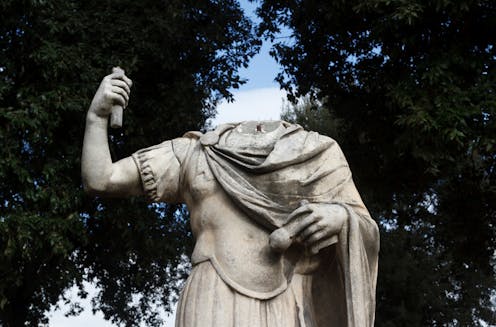
People throughout history have deliberately tried to forget corrupt or criminal leaders who offend the public’s sense of morality or justice. The term damnatio memoriae (“condemnation of memory”) describes this kind of deliberate forgetting in ancient times.
Damnatio memoriae refers to the deliberate political erasure of a person following their political failure and, usually, their death. It’s like a kind of post-mortem cancel culture.
So where did this idea come from and what did it look like in Ancient Rome?
An old idea
The term was probably first coined in the title of a thesis written by two late 17th century philologists named Christoph Schreiter and Johann Heinrich Gerlach. But it described a much older practice.
In antiquity, erasure might include the removal of heads from statues or the deletion of names on inscriptions.
Several emperors – including Nero and Domitian – were subject to the kind of erasure practices encapsulated by the term damnatio memoriae.
But one particularly good example of damnatio memoriae involves Crispus, the first son of the Roman emperor Constantine the Great (the first Roman emperor to convert to Christianity).
In 326CE, Constantine executed Crispus by – according to one version of the tale – “cold poison”. Constantine, in all likelihood, had discovered Crispus was having an affair with Constantine’s second wife, Fausta. This was especially scandalous because Fausta was Crispus’ own stepmother.
Fausta later died in an overheated bath. This may have been a botched abortion attempt or a deliberate albeit unusual method of execution.
Whatever the case, Crispus was killed and, in the aftermath, was subjected to damnatio memoriae.

Crispus the Cancelled
At the time of his death, Crispus was an important political figure. A political deal had raised him to the position of Caesar (which meant “junior emperor” and, arguably, heir to the throne).
Crispus’ military campaigns had been successful and he’d been the subject of public praise. He had held the highest constitutional office – the consulship – on no less than three occasions.
This meant Crispus’ name had been written on stone all across the Roman empire, from official government proclamations to the more mundane milestones marking Roman roads.
In 2022, I visited the northern Italian city of Brescia, which was once a significant Roman town. As I wandered through the museum, admiring its rich collection, I made my way down some stairs and was stopped in my tracks by one such milestone.
 A line is clearly missing – this is where Crispus’ name would once have been.
Michael Hanaghan
A line is clearly missing – this is where Crispus’ name would once have been.
Michael Hanaghan
A line is clearly missing in the picture between the words victori semper Aug (meaning “the eternally victorious senior emperor”) and the next line Fl Iul Constantio (the name “Flavius Julius Constantius”).
The museum’s plaque confirmed Crispus’ name had once appeared there alongside his fellow junior emperors – his half-brothers Constantine II and Constantius II.
It once read in full:
To our four masters, Flavius Constantine the Great, the eternally victorious senior emperor, and to our most noble junior emperors, Flavius Julius Crispus, Flavius Claudius Constantine, and Flavius Julius Constantius.
The gap where Flavius Julius Cripus was once written is quite obvious – and that is really the point.
This is not a secret erasure of someone’s name, but a public display of its removal.
It served as a powerful reminder of the ongoing stigma that should be associated with Crispus’ name for all Romans making their way along the road in the years that followed.
At the same time, this erasure directly challenged Crispus’ importance and relevancy to history by removing a record of his existence, and in this particular case, of his prominence as a junior emperor.
The name of Crispus’ half-brother Constantine II was also chiselled away from this milestone, almost certainly after he was killed in a civil war against his younger brother Constans in the year 340.
How was damnatio memoriae done?
It was once assumed damnatio memoriae must have been ordered and organised. In recent years, however, scholars have come to understand the deliberate erasure of names as a far more organic and localised process.
Centuries before Crispus, inscriptions referring to Julius Caesar’s close confidant, Marc Antony, had been similarly deleted and removed. After Caesar’s death, Marc Antony had taken up with Caesar’s ex (Cleopatra) and fallen out spectacularly with Caesar’s heir (Octavian, who would soon rename himself Augustus).
 Marc Antony – friend of Caesar, lover of Cleopatra – was subjected to damnatio memoriae after he died, following defeat in war by Augustus.
The Metropolitan Museum of Art
Marc Antony – friend of Caesar, lover of Cleopatra – was subjected to damnatio memoriae after he died, following defeat in war by Augustus.
The Metropolitan Museum of Art
Marc Antony was subjected to damnatio memoriae after losing his war against Augustus, but not all mentions of his name were erased – many, including some that celebrate Antony’s sexual prowess, remain.
Prominent women could also be subject to this kind of memory erasure.
Messalina, the famously promiscuous second wife of Claudius, was the subject of a senatorial decree after her death that sought to erase her name and even ban its mention. Yet inscriptions referring to Messalina nevertheless remain.
But even if we don’t know exactly how damnatio memoriae was done, or how consistently it was applied, we do know it happened.
In the case of the milestone I saw in Brescia, we can only really speculate as to why Crispus’ name was removed from this one in particular. Maybe it was in a prominent position where it gained too much attention, or perhaps there was a localised push to remove his name.
Whatever the case, this milestone is physical evidence for something that we all instinctively do when a politician has failed in controversial, embarrassing or upsetting circumstances: we do our best to forget them.
Authors: Michael Hanaghan, Senior Research Fellow in Latin Christianity in Late Antiquity, Australian Catholic University
Read more https://theconversation.com/what-was-damnatio-memoriae-how-to-get-cancelled-in-ancient-rome-242193


















