

how home relocations can help address the housing crisis
- Written by: Johari Amar, Lecturer in Property, Bond University
Australia’s housing crisis represents a fundamental market imbalance where undersupply meets excess demand.
In major cities like Sydney, Melbourne and Brisbane, the dream of home ownership is slipping away from many as median house prices far exceed average household incomes.
Because of this, many people are weighing up all practical solutions as they seek to one day own their own homes.
The supply and demand puzzle
The supply side of the crisis is multifaceted – critical shortages of skilled labour and the increasing cost of building materials (since before COVID) have driven up construction costs, while the availability of serviced land in desirable locations remains limited.
The planning processes for residential development can be slow and unpredictable, creating additional barriers to new housing supply. This adds further pressure on construction affordability.
The demand pressures are equally concerning.
Rising living costs have made housing increasingly unaffordable, pushing many potential buyers into an expensive rental market.
This has created a cascade effect where younger people are staying at home longer, prioritising shift works over education and sharing accommodation with more people to manage costs.
Read more: 20 people in a two-bedroom apartment: the growing health and safety risks of 'hot bedding'
In this challenging environment, house relocation – the practice of physically moving existing homes to new locations – is a possible alternative solution.
How does house relocation work?
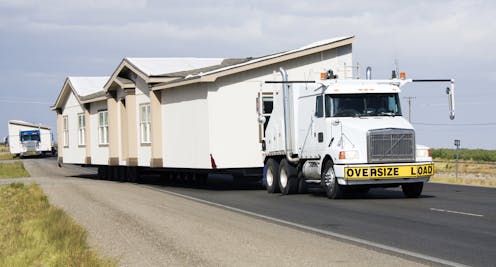
House relocation involves preparing an existing house for transport, moving it to a new location (generally by lifting it onto a large truck) and re-establishing it on new foundations on a vacant block of land.
House relocations are complex for those in charge of moving the dwelling.In Australia, this practice has a history dating back to the 1860s, especially in Queensland. This is because traditional, timber-framed, Queenslander-style homes are usually elevated on stilts with wraparound verandas, and this design and construction method means they are particularly suitable for relocation.
Comprehensive statistics on house relocations in Australia are limited. However, in New Zealand, about 3,000 houses are relocated annually. This accounts for up to 12% of the housing supply, according to estimates from the New Zealand Heavy Haulage Association.
Is it a viable solution?
The economics of house relocation are compelling.
Relocating a house in Queensland, for instance, typically costs $45,000–80,000, including restumping and council fees.
The relocated homes can sell for $60,000–300,000, depending on size, condition and quality.
Of course, people relocating homes also need to own a block of land to put the house on.
Aside from being cost-effective, relocated houses are completed more quickly than a new construction. This can reduce waste and the carbon footprint associated with demolition and new builds. It also preserves heritage homes.
Construction and demolition data reveal most demolished houses (73%) are relatively modern structures built after the Second World War. This suggests redevelopment decisions are driven by land value rather than building condition.
And it indicates there is significant potential for house relocation as an alternative to demolition.
However, while the cost benefits are clear, most people prefer to live in urban areas with access to employment and amenities.
As such, there are opportunity costs of relocating homes to rural or remote areas where land is cheaper. These include longer commutes, reduced access to services and diminishing market demand for timber houses.
Why hasn’t this unconventional approach gained traction?
Despite its potential, house relocation faces significant obstacles.
Unlike other forms of relocatable dwellings (such as caravans or “prefab” homes), which are treated as personal property, relocated homes straddle the line between “real” property and personal property.
When a home is prepared for relocation, it must be detached from its existing site to a degree that changes its legal status.
This process involves more than just disconnection. The house must be sufficiently detached to be treated as a separate asset, yet its ultimate destination requires it to become real property for a title to be issued and registered once again.
This has significant implications:
Breaking down the barriers
House relocation may not be a silver bullet for Australia’s housing crisis but it’s a proven solution that has successfully been used for generations.
The challenge lies not in proving the concept but in supporting systematic changes and making it more accessible and widely adopted. Some ideas include:
simplifying approval processes to make house relocations easier and more affordable
offering financial incentives for using relocated homes in affordable housing projects
improving infrastructure to streamline the transport and installation of relocated houses
promoting the awareness of relocated homes to boost public acceptance and demand.
The housing crisis won’t be solved by waiting for new developments alone.
But instead of tearing down perfectly good houses and sending them to landfill, we could be giving them new life in areas where they’re needed most, while freeing valuable urban land for denser developments.
Authors: Johari Amar, Lecturer in Property, Bond University


















