

Are you burnt out at work? Ask yourself these 4 questions
- Written by: Michael Musker, Senior Research Fellow, South Australian Health & Medical Research Institute
It’s normal to feel stressed at work from time to time. But for some people, the stress becomes all-consuming, leading to exhaustion, cynicism and hatred towards your job. This is known as burnout.
Burnout used to be classified as a problem related to life management, but last week the World Health Organisation re-labelled the syndrome as an “occupational phenomenon” to better reflect that burnout is a work-based syndrome caused by chronic stress.
The newly listed dimensions of burnout are:
- feelings of energy depletion or exhaustion
- increased mental distance from one’s job, or feelings of negativism or cynicism related to one’s job
- reduced professional efficacy (work performance).
Read more: Extinguished and anguished: what is burnout and what can we do about it?
In the era of smartphones and 24-7 emails, it’s becoming increasingly difficult to switch off from the workplace and from those who have power over us.
The new definition of burnout should be a wake-up call for employers to treat chronic stress that has not been successfully managed as a work health and safety issue.
How do you know if you’re burnt out?
If you think you might be suffering burnout, ask yourself the following questions:
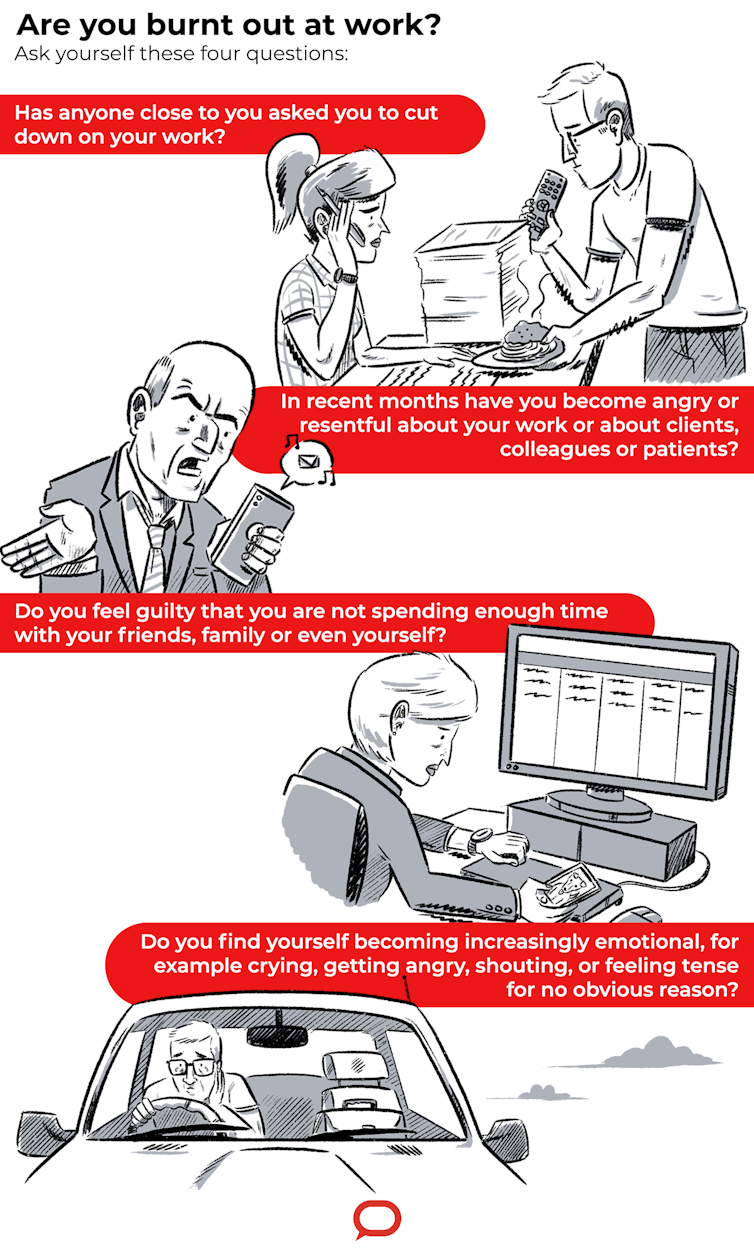
has anyone close to you asked you to cut down on your work?
in recent months have you become angry or resentful about your work or about colleagues, clients or patients?
do you feel guilty that you are not spending enough time with your friends, family or even yourself?
do you find yourself becoming increasingly emotional, for example crying, getting angry, shouting, or feeling tense for no obvious reason?
If you answered yes to any of these questions, it might be time for change.
These questions were devised for the United Kingdom Practitioner Health Programme and are a good starting point for all workers to identify if you are at risk of burning out.
(You can also complete the British Medical Association’s online burnout questionnaire, although it’s tailored for doctors so the drop-down menu will ask you to select a medical specialty).
If you think you’re suffering burnout, the first step is to talk to your line manager or workplace counsellor. Many workplaces now also have confidential external psychologists as part of their employee assistance programme.
 Wes Mountain/The Conversation, CC BY-ND
What causes burnout?
We all have different levels of capacity to cope with emotional and physical strains.
When we exceed our ability to cope, something has to give; the body becomes stressed if you push yourself either mentally or physically beyond your capacity.
Read more:
Three reasons to get your stress levels in check this year
People who burn out often feel a sense of emotional exhaustion or indifference, and may treat colleagues, clients or patients in a detached or dehumanised way. They become distant from their job and lose the zeal for their chosen career.
They might become cynical, less effective at work, and lack the desire for personal achievement. In the long term, this is not helpful for the person or the organisation.
While burnout isn’t a mental health disorder, it can lead to more serious issues such as family breakdowns, chronic fatigue syndrome, anxiety, depression, insomnia, and alcohol and drug abuse.
Who is most at risk?
Any worker who deals with people has the potential to suffer from burnout. This might include teachers, care workers, prison officers or retail staff.
Emergency service workers – such as police, paramedics, nurses and doctors – are at even higher risk because they continually work in high-stress conditions.
A recent survey of 15,000 US doctors found 44% were experiencing symptoms of burnout. As one neurologist explained:
I dread coming to work. I find myself being short when dealing with staff and patients.
French research on hospital emergency department staff found one in three (34%) were burnt out because of excessive workloads and high demands for care.
Wes Mountain/The Conversation, CC BY-ND
What causes burnout?
We all have different levels of capacity to cope with emotional and physical strains.
When we exceed our ability to cope, something has to give; the body becomes stressed if you push yourself either mentally or physically beyond your capacity.
Read more:
Three reasons to get your stress levels in check this year
People who burn out often feel a sense of emotional exhaustion or indifference, and may treat colleagues, clients or patients in a detached or dehumanised way. They become distant from their job and lose the zeal for their chosen career.
They might become cynical, less effective at work, and lack the desire for personal achievement. In the long term, this is not helpful for the person or the organisation.
While burnout isn’t a mental health disorder, it can lead to more serious issues such as family breakdowns, chronic fatigue syndrome, anxiety, depression, insomnia, and alcohol and drug abuse.
Who is most at risk?
Any worker who deals with people has the potential to suffer from burnout. This might include teachers, care workers, prison officers or retail staff.
Emergency service workers – such as police, paramedics, nurses and doctors – are at even higher risk because they continually work in high-stress conditions.
A recent survey of 15,000 US doctors found 44% were experiencing symptoms of burnout. As one neurologist explained:
I dread coming to work. I find myself being short when dealing with staff and patients.
French research on hospital emergency department staff found one in three (34%) were burnt out because of excessive workloads and high demands for care.
 When you’re close to burnout, there’s a fine line between coping and not coping.
gpointstudio/Shutterstock
Lawyers are another profession vulnerable to burnout. In a survey of 1,000 employees of a renowned London law firm, 73% of lawyers expressed feelings of burnout and 58% put this down to the need for a better work-life balance.
No matter what job you do, if you are pushed beyond your ability to cope for long periods of time, you’re likely to suffer burnout.
It’s OK to say no to more work
Employers have an organisational obligation to promote staff well-being and ensure staff aren’t overworked, overstressed, and headed towards burnout.
There are things we can all do to reduce our own risk of burnout. One is to boost our levels of resilience. This means we’re able to respond to stress in a healthy way and can bounce back after challenges and grow stronger in the process.
Read more:
Corporate resilience training works – but what are we being asked to bear?
You can build your resilience by learning to switch off, setting boundaries for your work, and thinking more about play. As much as you can, inoculate yourself against job interference and prevent it from ebbing into your personal life.
No matter what your profession, don’t let your job become the only way you define yourself as a person.
And if your job is making you miserable, consider moving jobs or at least have a look at what else is out there. You may surprise yourself.
If you or anyone you know needs help or support, you can call Lifeline on 13 11 14.
When you’re close to burnout, there’s a fine line between coping and not coping.
gpointstudio/Shutterstock
Lawyers are another profession vulnerable to burnout. In a survey of 1,000 employees of a renowned London law firm, 73% of lawyers expressed feelings of burnout and 58% put this down to the need for a better work-life balance.
No matter what job you do, if you are pushed beyond your ability to cope for long periods of time, you’re likely to suffer burnout.
It’s OK to say no to more work
Employers have an organisational obligation to promote staff well-being and ensure staff aren’t overworked, overstressed, and headed towards burnout.
There are things we can all do to reduce our own risk of burnout. One is to boost our levels of resilience. This means we’re able to respond to stress in a healthy way and can bounce back after challenges and grow stronger in the process.
Read more:
Corporate resilience training works – but what are we being asked to bear?
You can build your resilience by learning to switch off, setting boundaries for your work, and thinking more about play. As much as you can, inoculate yourself against job interference and prevent it from ebbing into your personal life.
No matter what your profession, don’t let your job become the only way you define yourself as a person.
And if your job is making you miserable, consider moving jobs or at least have a look at what else is out there. You may surprise yourself.
If you or anyone you know needs help or support, you can call Lifeline on 13 11 14.
Authors: Michael Musker, Senior Research Fellow, South Australian Health & Medical Research Institute
Read more http://theconversation.com/are-you-burnt-out-at-work-ask-yourself-these-4-questions-118128


















