

Aristotle’s Poetics is a bible for screenwriters – but it’s often misread
- Written by: Emma Cole, Senior Lecturer in Drama, The University of Queensland
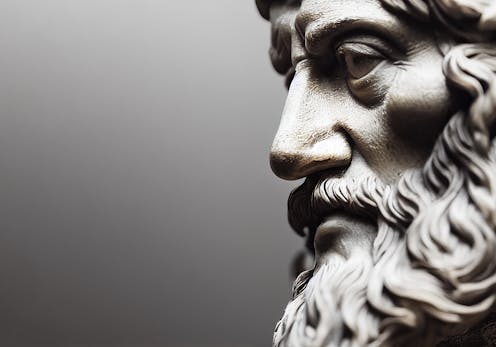
Aristotle’s Poetics has arguably influenced modern culture more than any other ancient text. The Greek philosopher’s 4th century BCE treatise on what constitutes the best form of poetry is our earliest surviving piece of standalone literary criticism. It has had a profound influence on storytelling ever since.
The Poetics haunts theatre and film history. Today, you can find handbooks on the Poetics written for Hollywood screenwriters. Indeed, writer and director Aaron Sorkin urges screenwriters to be “evangelical” about the book. Yet despite its influence, the Poetics is frequently misunderstood.
These misreadings, such as of the idea of a character’s “fatal flaw”, have been as influential as Aristotle’s actual ideas.
Who was Aristotle?
Aristotle lived between 384–322 BCE. A student of Plato, he wrote widely about philosophical ideas, from ethics and politics through to biology and the mind.
His philosophy intersected with art and poetry throughout his entire life, including in his (now fragmentary) earlier work On Poets, and within broader treatises such as his Rhetoric.

We cannot pinpoint when the Poetics was written, although we assume it was available for use by the time Aristotle founded his school, the Lyceum, in 335 BCE.
Despite the influence of Aristotle’s philosophy, his surviving work equates more closely to teaching materials than it does to polished writing intended for publication.
The somewhat provisional nature of Aristotle’s writing is heightened in the case of the Poetics. It is, in fact, a fragmentary text, of which only the first half survives.
The book
The brevity of the Poetics in part accounts for its pervasiveness. Indeed, in 1999, Entertainment Weekly quoted American filmmaker Gary Ross describing the Poetics as “42 pages of simple, irrefutable truths”.
Although what Aristotle originally delivered was a treatise on all genres of Greek poetry, with specific reference to epic, tragedy, and comedy, in what survives, tragedy dominates.

 Goodreads
This reversal of fate is tied to Oedipus’ crucial error: in his youth and during an episode of ancient road rage, Oedipus murdered a stranger. During the play, Oedipus learns of his true ancestry. This revelation means that Oedipus realises the murdered stranger was in fact his father, and Oedipus’ now wife is his birth mother.
We pity Oedipus, who knows not what he has done, and fear the possibility that we too could unknowingly err in such a way.
Yet many tragedies don’t fit Aristotle’s model. Given that so few ancient Greek tragedies survive (around 90% are lost) we must be careful not to assume Aristotle’s ideas are representative of dominant trends within the genre.
The book’s influence
When people today mention the “rules” of classical drama, there is often a tenuous thread connecting them back to Aristotle’s Poetics. The idea of a fatal flaw, for example, harks back to the idea of a character’s harmartia, or error.
The so-called “three unities”, of time, place, and action, nod to Aristotle’s insistence that the plot of a tragedy take place across just one day, and his focus on the plot being complete, whole, and of magnitude.
Yet Aristotle never refers to the idea of a “fatal flaw” or “three unities”. There is also no real unity of place in Greek tragedy, with the chorus often transporting the audience to different locations to fill in mythic backstories through their song.
Ideas such as a fatal flaw or tragic unities in fact go back 17th-century interpretations of the Poetics. Neoclassical writers such as René Rapin, who published his Reflections on Aristotle’s Treatise on Poetry in 1674, massaged Aristotle’s ideas to align more closely to the Roman poet Horace’s later treatise on the same subject, The Art of Poetry.
The terms that do genuinely originate within the Poetics are similarly problematic. Many today will agree on how an emotionally powerful “cathartic” experience might feel, even if they can’t quite define the term.
Yet in the surviving form of the Poetics, Aristotle never explains what he means when he says the best tragedy accomplishes a catharsis of pity and fear.
The truth is, although we can agree that Aristotle requires catharsis as a feature of tragedy, whether it is supposed to teach us, purify us, or purge us is up for debate.
Although Aristotle’s Poetics has become landmark in the screenwriting industry, several 20th-century theatre practitioners built their practice around explicitly rejecting his ideas.
Goodreads
This reversal of fate is tied to Oedipus’ crucial error: in his youth and during an episode of ancient road rage, Oedipus murdered a stranger. During the play, Oedipus learns of his true ancestry. This revelation means that Oedipus realises the murdered stranger was in fact his father, and Oedipus’ now wife is his birth mother.
We pity Oedipus, who knows not what he has done, and fear the possibility that we too could unknowingly err in such a way.
Yet many tragedies don’t fit Aristotle’s model. Given that so few ancient Greek tragedies survive (around 90% are lost) we must be careful not to assume Aristotle’s ideas are representative of dominant trends within the genre.
The book’s influence
When people today mention the “rules” of classical drama, there is often a tenuous thread connecting them back to Aristotle’s Poetics. The idea of a fatal flaw, for example, harks back to the idea of a character’s harmartia, or error.
The so-called “three unities”, of time, place, and action, nod to Aristotle’s insistence that the plot of a tragedy take place across just one day, and his focus on the plot being complete, whole, and of magnitude.
Yet Aristotle never refers to the idea of a “fatal flaw” or “three unities”. There is also no real unity of place in Greek tragedy, with the chorus often transporting the audience to different locations to fill in mythic backstories through their song.
Ideas such as a fatal flaw or tragic unities in fact go back 17th-century interpretations of the Poetics. Neoclassical writers such as René Rapin, who published his Reflections on Aristotle’s Treatise on Poetry in 1674, massaged Aristotle’s ideas to align more closely to the Roman poet Horace’s later treatise on the same subject, The Art of Poetry.
The terms that do genuinely originate within the Poetics are similarly problematic. Many today will agree on how an emotionally powerful “cathartic” experience might feel, even if they can’t quite define the term.
Yet in the surviving form of the Poetics, Aristotle never explains what he means when he says the best tragedy accomplishes a catharsis of pity and fear.
The truth is, although we can agree that Aristotle requires catharsis as a feature of tragedy, whether it is supposed to teach us, purify us, or purge us is up for debate.
Although Aristotle’s Poetics has become landmark in the screenwriting industry, several 20th-century theatre practitioners built their practice around explicitly rejecting his ideas.
 Bertolt Brecht pictured in 1954.
Wikimedia Commons, CC BY
Bertolt Brecht defined his Epic Theatre as “non-Aristotelian”, with his signature Verfremdungseffekt (the effect of making the familiar appear strange) standing in opposition to the emotional immersion of catharsis.
The question of whether Brecht rejected Aristotle’s theories, or neoclassical misinterpretations of them, demonstrates the enormous complexity of Aristotle’s legacy.
Contemporary meanings
Today, the Poetics has taken on a life of its own. Even if the lost second half of the Poetics was found, containing Aristotle’s views on comic drama (and, many hope, an actual definition of catharsis), we cannot undo the legacy of the version we have today.
The fingerprints of the Poetics are everywhere. Aaron Sorkin (A Few Good Men, The West Wing) stresses to potential screenwriters that,
You should be evangelical about Aristotle’s Poetics. If there is something wrong with your script, that is because you broke one of those rules.
Bertolt Brecht pictured in 1954.
Wikimedia Commons, CC BY
Bertolt Brecht defined his Epic Theatre as “non-Aristotelian”, with his signature Verfremdungseffekt (the effect of making the familiar appear strange) standing in opposition to the emotional immersion of catharsis.
The question of whether Brecht rejected Aristotle’s theories, or neoclassical misinterpretations of them, demonstrates the enormous complexity of Aristotle’s legacy.
Contemporary meanings
Today, the Poetics has taken on a life of its own. Even if the lost second half of the Poetics was found, containing Aristotle’s views on comic drama (and, many hope, an actual definition of catharsis), we cannot undo the legacy of the version we have today.
The fingerprints of the Poetics are everywhere. Aaron Sorkin (A Few Good Men, The West Wing) stresses to potential screenwriters that,
You should be evangelical about Aristotle’s Poetics. If there is something wrong with your script, that is because you broke one of those rules.
 Aaron Sorkin speaks at an event at the White House marking the 25th anniversary of The West Wing in September.
Manuel Balce Ceneta/AAP
For some, Aristotle’s pervasiveness is problematic. Brazilian drama theorist and practitioner Augusto Boal, for example, argues movies, theatre, and television are united “through a basis in Aristotelian poetics, for repression of the people”.
Whether the legacy of the Poetics is positive or negative, what is clear is that no other classic text has left such a mark on how we tell stories, create theatre, and structure film.
Who knows what its influence will be on the next generation of artists, and how they will interpret the Poetics’ meaning.
Authors: Emma Cole, Senior Lecturer in Drama, The University of Queensland
Aaron Sorkin speaks at an event at the White House marking the 25th anniversary of The West Wing in September.
Manuel Balce Ceneta/AAP
For some, Aristotle’s pervasiveness is problematic. Brazilian drama theorist and practitioner Augusto Boal, for example, argues movies, theatre, and television are united “through a basis in Aristotelian poetics, for repression of the people”.
Whether the legacy of the Poetics is positive or negative, what is clear is that no other classic text has left such a mark on how we tell stories, create theatre, and structure film.
Who knows what its influence will be on the next generation of artists, and how they will interpret the Poetics’ meaning.
Authors: Emma Cole, Senior Lecturer in Drama, The University of Queensland 

















