

the ancient philosophies behind China’s record-breaking new animated film
- Written by: Yanyan Hong, PhD Candidate in Communication and Media Studies, University of Adelaide
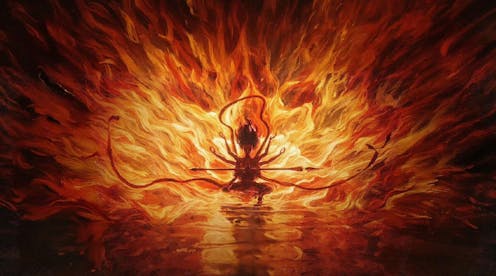
On the surface, Ne Zha 2: The Sea’s Fury (2025), the sequel to the 2019 Chinese blockbuster Nezha: Birth of the Demon Child, is a high-octane, action-packed and visually stunning animated spectacle, full of hilarious moments and thrilling fight scenes.
But beneath all that, it’s something much deeper: a bold re-imagining of Chinese traditional mythology, cultural history and philosophies.
Unlike Hollywood’s classic hero’s journey, Ne Zha 2 is rooted in Chinese thought, weaving together ideas from Buddhism, Confucianism, Daoism, Mohism, Legalism and more.
Through the story of a baby-faced warrior god who battles demons, it channels centuries of Chinese tradition into something refreshing, relevant and undeniably global.
The film’s success speaks for itself. Directed by Yang Yu (aka Jiao Zi), Ne Zha 2 has shattered multiple global box office records, pulling in more than US$1 billion in China in just one week.
It has even entered the top 10 highest-grossing films of all time, and is the second highest-grossing animated film behind Inside Out 2 (2024).
But what makes Ne Zha 2 so compelling beyond its visual spectacle? At its heart, it’s an inspiring story about identity, free will, self-determination and rebellion – ideas that resonate far beyond China.
A child hero forged in myth and philosophy
Ne Zha is a rebellious deity in traditional Chinese folklore – a boy born with immense superpower, who defies both divine and social expectations.
Most people who know of Ne Zha will trace his legend back to Fengshen Yanyi, or Investiture of the Gods, a Ming Dynasty novel that blends mythology with historical elements.
Ne Zha’s true origins, however, trace back to India.
“Ne Zha” is a shortened transliteration of the Sanskrit Nalakuvara (or Nalakūbara), an Indian mythological figure who appears in Buddhist and Hindu mythology.
As Buddhism spread to China during the Tang Dynasty, Ne Zha evolved from an intimidating guardian deity into the rebellious, fire-wheeled warrior we know today.
In Ne Zha 2, this “fighting spirit” against authority and hierarchy is taken even further, turning the story into a deeper philosophical exploration of morality, fate, self-worth and power.
Good and evil – a Daoist perspective
One of the most thought-provoking aspects of Ne Zha 2 is how it challenges the idea of good and evil.
In Daoist philosophy, evil and good, often known as Yin and Yang, are not absolute, but are rather shifting, interconnected forces.
Through its two protagonists: the “Demon Pill” (Ne Zha) and his noble dragon prince buddy, “Spirit Pearl” (Ao Bing), the film beautifully reflects this Daoist idea of balance and self-discovery.
Their merging further blurs the line between hero and villain and brings to life a core concept from the 2,400-year-old text Dao De Jing (Tao Te Ching), written around 400 BC by Chinese philosopher Laozi (also called Lao Tzu).
Laozi emphasises that righteousness and villainy aren’t always what they seem. “When the world knows beauty as beauty, there arises ugliness,” he says.
Those we assume to be noble may turn out to be dark inside, while those deemed evil might be fighting for what is right.
Ne Zha’s character in the film embodies this Daoist philosophy. Echoing the Xisheng Jing, The Scripture of Western Ascension, he declares, “My fate is up to me, not the Heaven.”
He is the demon child who is willing to die fighting for his own destiny, proving that even the smallest, most underestimated individual can change the world.
Beyond family bonds: rebirth of Confucianism
In one scene, Ne Zha is struck by the “heart-piercing curse”, a brutal spell that covers his body in ten thousand thorns, causing unbearable pain and keeping him under control by targeting his heart. Ne Zha’s human mother, Lady Yin, clings to him as his thorns pierce her skin – yet she refuses to let go.
It’s a moment of heartbreak, parental love and inner awakening. As his mother takes her final breath, in Ne Zha’s grief, his body shatters into a million pieces. And then, he is reborn.
This is the film’s emotional climax, in which the so-called demon child awakens to “Rén” (benevolence), a core Confucian virtue.
Confucianism teaches that true morality isn’t imposed by rules but arises naturally from within. Ne Zha doesn’t just seek revenge, he awakes to fight for those who have been oppressed, embracing his identity with unwavering resolve.
But perhaps the most profound transformation comes from the dragon prince Ao Bing. As the last hope of his people, burdened by centuries of expectation, he finally makes a choice, not for legacy, not for his ancestors, but for himself.
In this moment, his once-imposing father Dragon King releases his grip: “Your path is yours to forge.”
The weight of tradition gives way to something new, reflecting a changing China where younger generations are defining their own paths.
Wisdom of Legalism and Mohism
Beyond Daoist and Confucian ideals, Ne Zha 2 also weaves in Legalist reform and Mohist resistance. These philosophies challenge rigid hierarchies (or in Ne Zha’s case, “divine order”) and advocate for collective justice.
Across Ne Zha’s three major trials and the climactic celestial-demon war, a brutal truth emerges: those deemed unworthy – whether groundhogs, mystical beings, or ordinary humans – are sacrificed to uphold the elite’s rule.
Take the small groundhogs. Dressed in patched clothes, surviving on pumpkin porridge. They’ve never harmed anyone. Yet, they are mercilessly crushed in the name of celestial balance.
Then there’s Shiji Niangniang, or Lady Rock, a recluse who harms no one. She indulges only in her own beauty and speaks to her enchanted mirror. Yet the heavens brand her a demon, sealing her fate.
A similar cruelty befalls the Dragon Clan and the people of Chentangguan, all caught in a war where they are mere pawns on a celestial chessboard.
Even the last battle is not just Ne Zha’s fight, but a battlefield showing the Chinese spirit of collectivism. Dragons, shrimp soldiers, crab generals, octopus warriors, humans and millions of goblins stand side by side to rewrite destiny.
The celestial-demon war itself plays out like a lesson in Sun Tzu’s Art of War, which states that “All warfare is based on deception.” War is about strategy, resilience and the unstoppable will to rise.
Ne Zha carries the weight of Eastern cultural essence: Daoist balance, Confucian ethics, Mohist resistance, Legalist reform and the strategic wisdom of The Art of War. It is a truly Chinese story, igniting next year’s Oscar buzz and sparking a global awakening to Eastern culture.
Just as Ne Zha is reborn in flames, so too does Chinese animation rise, not by breaking from its past, but by forging a bold future.
Authors: Yanyan Hong, PhD Candidate in Communication and Media Studies, University of Adelaide


















