

E. coli in milk won't necessarily make you sick – but it signals risks from other bacteria
- Written by: Tom Ross, Professor in Food Microbiology, Centre for Food Safety and Innovation, Tasmanian Institute of Agriculture, University of Tasmania
Last Thursday, dairy company Lactalis Australia recalled eight varieties of milk over concerns the products could be contaminated with the bacteria Escherichia coli (E. coli).
This recall affects several brands of milk purchased at Coles, Woolworths, IGA and other retailers in Victoria and southern New South Wales with a use-by date of July 2.
Milk provides many of the nutrients needed for human growth and development, including protein, fat, carbohydrates (lactose) and calcium. But because milk is such a complete mix of nutrients, it’s also an ideal breeding ground for bacteria. This is why milk spoils quickly, particularly when it’s left out of the fridge.
But the presence of E. coli in food – including the recalled milk – doesn’t necessarily mean the food is unsafe. It means the product is more likely to cause illness, and indicates further testing is needed. To minimise risk to public health, it’s advised that implicated products are not consumed.
Read more: Science or Snake Oil: is A2 milk better for you than regular cow’s milk?
Cow’s milk
Milk from a cow is laden with bacteria. The bacteria come from the skin on the teats of the cow, and sometimes directly from the milk if the cow has mastitis (a bacterial infection in the udder).
The same is true of human breast milk – the milk itself contains bacteria, while bacteria can also come from the mother’s skin. But a difference in a cow is that the cow’s udder is close to its anus, so contamination of the udder with the cow’s faeces is common.
Pathogenic bacteria (those that cause illness) that can occur in cow’s milk include some strains of E. coli, Listeria monocytogenes (L. monocytogenes), salmonella, Bacillus cereus (B. cereus) and Staphylococcus aureus (S. aureus).
While B. cereus and S. aureus can cause unpleasant illnesses, most people recover quickly and completely.
But some strains of E. coli and L. monocytogenes can cause more serious illness and even death. A raw (unpasteurised) milk product contaminated with pathogenic E. coli was found to have caused the death of an infant in Victoria in 2014.
Read more: Explainer: what is E.coli?
L. monocytogenes and S. aureus can be present in the milk in the cow’s udder, or on the udder itself, while B. cereus is found in the soil on dairy farms and in milking shed environments.
E. coli, however, arises from faecal contamination of the udder. While every effort is made by dairy farmers to clean cows’ udders before the milking begins, it’s not possible to do this with complete certainty. A low risk remains that faecal bacteria will enter the raw milk.
E. coli won’t necessarily make you sick
E. coli is commonly found in the faeces of warm-blooded animals, including mammals and birds. Most strains of E. coli are not harmful. Rather, the presence of E. coli is widely used in public health management as an indicator of faecal contamination (called an “indicator bacterium”).
It’s important we measure faecal contamination in food and water sources because gastrointestinal pathogens can be released from the infected host (in this case, the cow) through their faeces.
So faecal contamination of food or water represents a risk that a person exposed to those sources would become ill from gastrointestinal pathogens including pathogenic strains of E. coli, salmonella, norovirus, Clostridium perfringens, and many others.
Those infected would then be likely to repeat the cycle of infection – that is, to shed the pathogens that made them sick via their faeces into their environment, and from there, to infect other people.
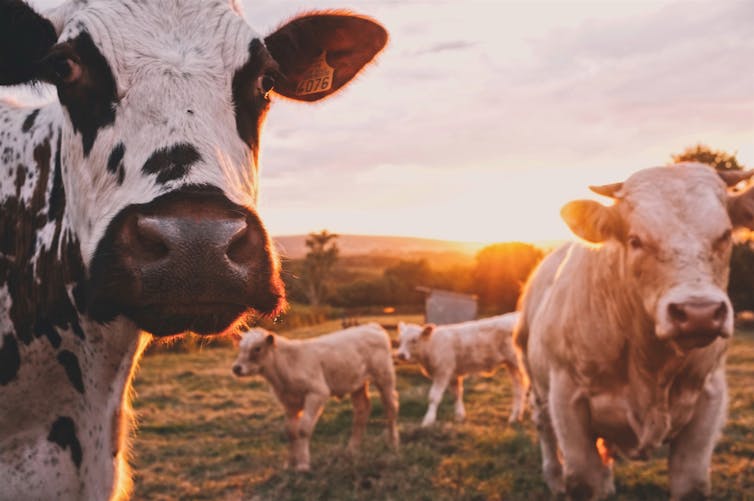 E. coli bacteria makes its way into milk from cows’ faecal matter.
Stijn te Strake/Unsplash
E. coli bacteria makes its way into milk from cows’ faecal matter.
Stijn te Strake/Unsplash
Testing can relatively quickly detect E. coli in foods or water. The presence of E. coli is an indication there is a much greater risk of infections because of the concurrent risk of other pathogens, like those listed above, being present.
So from a positive E. coli result, further testing might be conducted to see whether other pathogens are present. Generally, the presence of E. coli is enough to cause alarm and recall of contaminated foods, or to advise people not to swim in water that has been contaminated, to minimise the risk of infections.
Pasteurisation and testing
The government has mandated that milk sold in Australia should be pasteurised to eliminate any harmful bacteria and protect public health. This process also extends the shelf-life of the product by reducing other bacteria that cause milk spoilage.
Pasteurisation involves heating the milk for sufficient time to eliminate the pathogenic bacteria; usually to 72–74°C for 15–20 seconds. The time and temperature of pasteurisation are monitored in real time and, if the conditions are less than required, the “suspect” milk is diverted and not filled into retail containers.
As an additional check, the pasteurised milk is subjected to further testing for the presence of E. coli after those processes. These tests, however, typically require 12–20 hours to obtain results. Because of all the other safeguards in place, the milk is assumed to be safe for sale and distributed before the test results are obtained, unless the other tests show a process failure requiring a product recall.
Read more: Explainer: what is raw milk and why is it harmful?
This recall shows the system is working
This recent recall of milk from Australian retail markets after the detection of E. coli is a very rare event. In this case, the causes of the possible pasteurisation failure remain unknown. The “back-up” testing for E. coli in the milk, however, did reveal a failure in the system that will now be investigated to prevent recurrence.
Importantly, the detection of E. coli does not mean the milk is unsafe, but indicates that it could be.
The identification of E. coli in the milk initiated a rapid product recall of specifically “at-risk” products, and removal from sale of all potentially contaminated milk, alongside alerts to consumers. These actions are part of the food safety systems in place in Australia and many other nations.
This process was also implemented earlier this month when another eight milk varieties were recalled by the food safety regulator over concerns they may be contaminated with cleaning solution.
Zoe Bartlett, an early career researcher at the University of Tasmania, contributed to this piece.
Authors: Tom Ross, Professor in Food Microbiology, Centre for Food Safety and Innovation, Tasmanian Institute of Agriculture, University of Tasmania


















