

3 unusual Australian plant ecosystems to spot on your next roadtrip
- Written by: Gregory Moore, Senior Research Associate, School of Agriculture, Food and Ecosystem Sciences, The University of Melbourne
When the growing gets tough, the tough trees and shrubs get growing.
Australia’s environment is brutal. Its ancient, low-nutrient soils and generally low rainfall make it a hard place for plants to grow. Despite this, the continent is filled with wonderfully diverse plant ecosystems.
If you don’t know what you’re looking for, it can be easy to miss these seemingly unremarkable species. So, here are three little-known Australian plant species and ecosystems to look out for during your next roadtrip.
1. Cycads and eucalypts
If you are driving a coastal route along southern New South Wales, keep an eye out for the stunning combination of burrawang cycads (Macrozamia communis) and spotted gum (Corymbia maculata). These species live in harmony along the NSW coastline, from Kempsey to Bega, and inland as far as Mudgee.
If you’re on a road trip, now is the perfect time to talk to children about ancient moving continents, volcanoes and dinosaurs.
Cycads are ancient gymnosperms (cone-bearing plants) which evolved long before the Gondwanan supercontinent separated. These tough, hardy plants saw the dinosaurs come and go, and their relatives are found all around the world.
These cycads form a striking understorey to the spotted gum. As their scientific name (Macrozamia communis) suggests, they form a dense community.
Further north in Queensland, pineapple cycads (Lepidozamia peroffskyana), and Western Australia’s zamia palm (Macrozamia riedlei) are also worth spotting.
Cycad seeds are poisonous, but First Nations Australians worked out a complex process to prepare them for safe eating. This involved dissolving the plant’s toxins in running water, cooking, working and grinding the seeds into a powder.
Spotted gums evolved long after dinosaurs went extinct. Early eucalypt fossils date from about 34 million years ago, while current species are often only a few million years old.
Spotted gums are a great example of how plants that survive tough environments often also do well in difficult urban situations.
Cycads are similarly found growing in poor soils and arid conditions. They have long, glossy leaves up to about 1.5 metres in length with lots of leaflets.
There are both male and female plants. The female cone is an impressive, wide-domed structure that can be almost half a metre across. Its bright orange-red seeds are eaten by foraging marsupials, large birds and flying foxes.
Spotted gums are tall, straight eucalyptus trees with dark green, glossy leaves. Old bark creates dark grey spots against their cream coloured trunk, giving them a mottled look.
It is interesting to see ancient and modern species in such a close community relationship in cycad-spotted gum forests. Both are also well-adapted to the fires that frequent their habitat.
2. Ancient acacias
Travelling inland, the environment gets even tougher. Most large trees disappear and are replaced by woodlands dominated by inland acacia (wattle) species.
These inland acacias are short but mighty, with deep, extensive root systems.
Two of these species, mulga (Acacia aneura) and brigalow (A. harpophylla) are part of Australian folklore. A Banjo Paterson character says: “You know how the brigalow grows […] saplings about as thick as a man’s arm”.
Nutrients and water resources are limited, so mulga and brigalow trees are often evenly spaced across the landscape. This eerie symmetry makes it look like they were planted by humans.
Many people are unaware that the twisted, stunted specimens they see are more than 250 years old and occupy vast tracts of the Australian landscape.
Waddy-wood (Acacia peuce) is a rare species of acacia, found in just three locations on the edge of the Simpson Desert. This tree has very strong wood, and was used by Indigenous Australians for making clubs (waddys) and tools for carrying fire.
Inland acacias were widely used by Indigenous Australians for their wood, resins and medicinal properties. They have also been used as fodder for livestock, especially during drought.
These crucial species provide important habitat for other plants and animals. But they are under threat.
As old trees collapse and die, there are no young trees replacing them. This is because of drought and grazing, compounded by climate change.
Desertification – where fertile land is degraded until it essentially becomes desert – is becoming a huge problem due to the massive area dominated by acacias.
3. Boabs
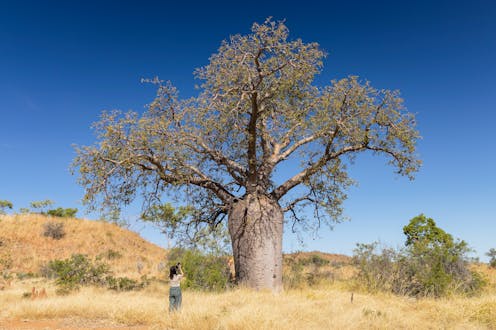
If you’re driving across the Northern Territory and Western Australia, you might come across the mighty boab (Adansonia gregoryii).
These close relatives of the African and Madagascan baobabs floated to Australia as seeds or seedlings around 12 million years ago.
These deciduous trees live in mostly dry environments that also experience strong monsoonal-type rains. Boabs trap and store water in their trunks, allowing them not only to survive but thrive.
Their African and Madagascan baobab relatives are sometimes called trees of life, as they support many species.
Australian boabs are similar. They offer habitat, roosting and nesting sites. Their flowers and fruits are food sources to many species of insects and birds.
They were – and are – important trees in First Nations cultures. Carvings and symbols on their trunks can last for more than a century, much longer than on other trees. These are called dendroglyphs.
For example, snake carvings dated to more than 200 years old have been found on boab trees in Northern Australia’s Tanami Desert.
While these special trees are usually found far from the beaten track, they can be spotted growing around Darwin and other remote towns. If you get the chance to see them, count yourself lucky.
Tough terrain, tough trees
Plant communities are remarkably resilient. They also display great creativity when evolving ways to survive tough environments.
Make sure to keep an eye out as you’re exploring Australia and enjoy the fascinating plants our country has to offer.
Authors: Gregory Moore, Senior Research Associate, School of Agriculture, Food and Ecosystem Sciences, The University of Melbourne


















