

How cyclones rip apart houses – and how to boost the chance your home stays standing
- Written by: David Henderson, Chief Engineer, Cyclone Testing Station, James Cook University
People in southeast Queensland and northern NSW have spent days racing to prepare their homes ahead of Tropical Cyclone Alfred, now expected to make landfall over several hours on Saturday.
It’s not possible to completely cyclone-proof a house. But there’s a lot you can do – in the short and long term – to boost the resilience of your home and reduce damage caused by future cyclones.
How winds affects pressure on and in the house
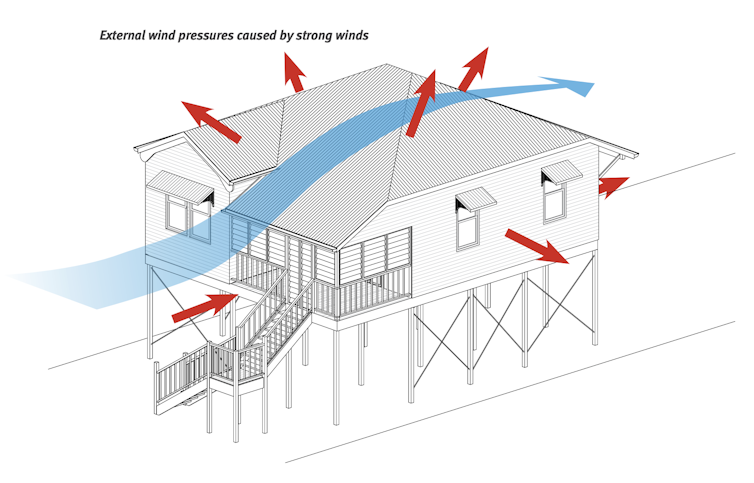
Strong winds generate pressure pushing and pulling on the outside and inside of a house.
When wind gusts hit a building, the wind is pushing on what we call the windward wall and going up and over the roof, creating a suction effect. The wind is trying very hard to peel the roof off your house, and in a cyclone is hammering the building for many hours.
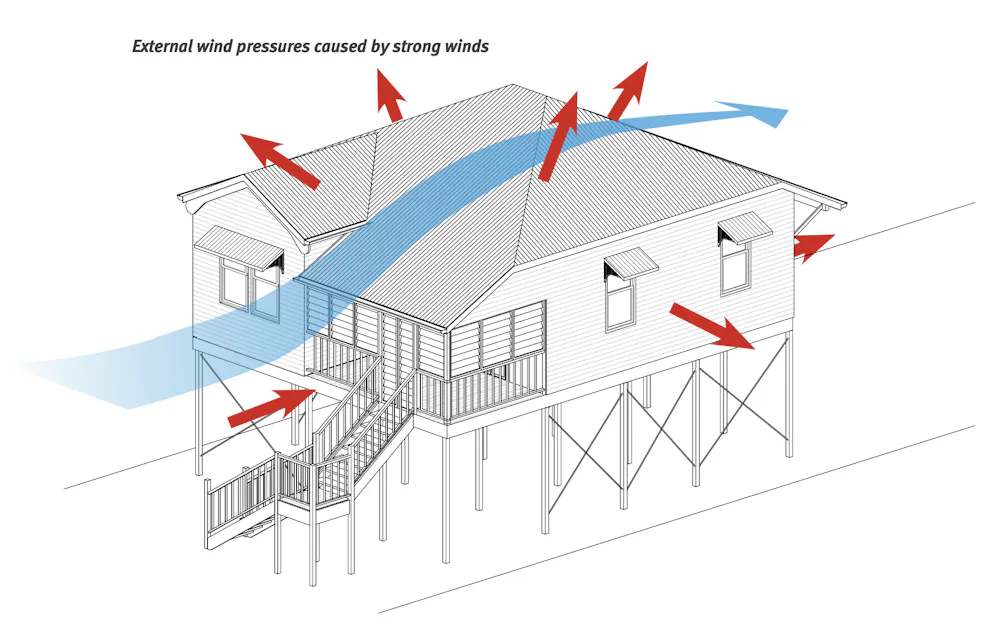
If a windward window or door blows in or gets broken by debris, wind instantaneously enters the space. This almost doubles the load that the roof now has to resist.
In southeast Queensland and northern NSW, housing is not typically designed to resist that extra upward load on the roof if a door or window blows in.
Cyclone resilience is about maintaining the function of a building during severe weather, so even if there is some damage, it still can be used after the storm has passed. So it’s vital the roof stays on.
In practice, that means thinking about what’s known as the “tie down chain” – how all pieces of the house are held together to carry the wind loads from the roof to the ground.
A weak link in this tie down chain can lead to winds lifting entire roofs from homes. All the connections involved in keeping a roof on the house are exceptionally important.

Weather resistance in building codes is generally designed for rain that falls straight down and flows off the roof.
But in a cyclone, rain can come horizontally. It can get pushed under the the roof, into gutters and under sliding doors. And it’s not just a little bit – buckets and buckets of water can inundate a house.
Wind pressure can also mean water is blown into the house through gaps you may not even know existed. Wind-driven rain ingress can happen at wind speeds that don’t cause structural damage.
It comes in under doors and through windows, including holes in window sills. It can lead to buildings being unusable and a large number of insurance claims.
Dispelling major myths
You might have seen people taping a big “X” on their windows and glass doors. Unfortunately, this doesn’t really do much to improve window strength.
Some people put the tape on and then, during the cyclone, sit there watching their glass flex, falsely believing tape magically makes the window stronger. This is incredibly dangerous. If that glass shatters, the bystander would be hit by shards of glass travelling at high speed.
It is much better to tape a garbage bag or a sheet of plastic along the bottom of the window sill and tape it up about 300mm each side. It can then catch the water that seeps in the window and allows it to flow back out when the wind pressure drops.
Sometimes people open a window to reduce pressure inside the house that happens if a door or window breaks. It’s true this might reduce some pressure, but it depends which side of the house is currently being hit by wind. And given wind direction can change during a cyclone, emergency services recommend it’s better just to stay sheltered in the smallest room; they don’t want you standing in front of a window during a cyclone.
Close all internal doors so if any windows do blow in, the high pressure is restricted to just that room (not spread throughout the house).
Designing beyond the bare minimum
Building codes require buildings to build to a “wind classification” according to the “wind zone” of that area.
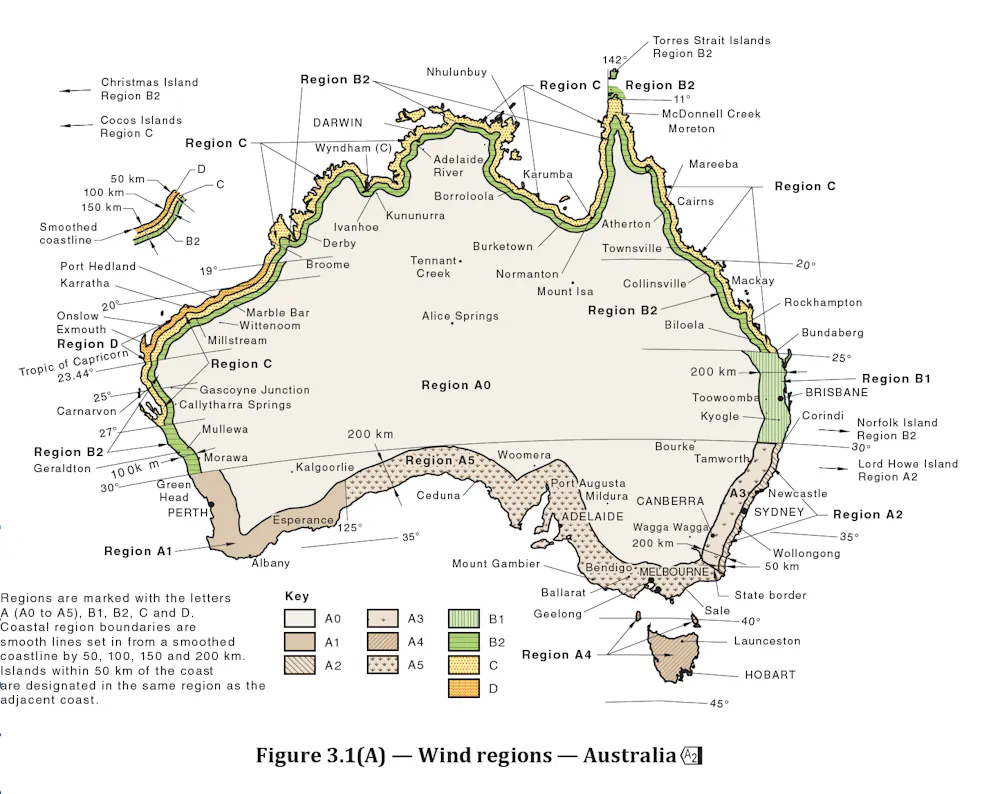 Wind zones sometimes cross state borders.
Standards Australia AS/NZS 1170.2:2021 amendment 2 2024., Author provided (no reuse)
Wind zones sometimes cross state borders.
Standards Australia AS/NZS 1170.2:2021 amendment 2 2024., Author provided (no reuse)
Buildings are often built only to the minimum standard of the Building Code. However, if we want a house to function after an extreme tropical cyclone, we should consider building beyond the minimum standard using resilience features that will keep your roof on in a cyclone and minimise the entry of rainwater.
Cyclone resilience also includes incorporating resilient building materials in your home – such as linoleum or vinyl floors instead of carpet, and ceilings from fibre-cement sheeting instead of plasterboard.
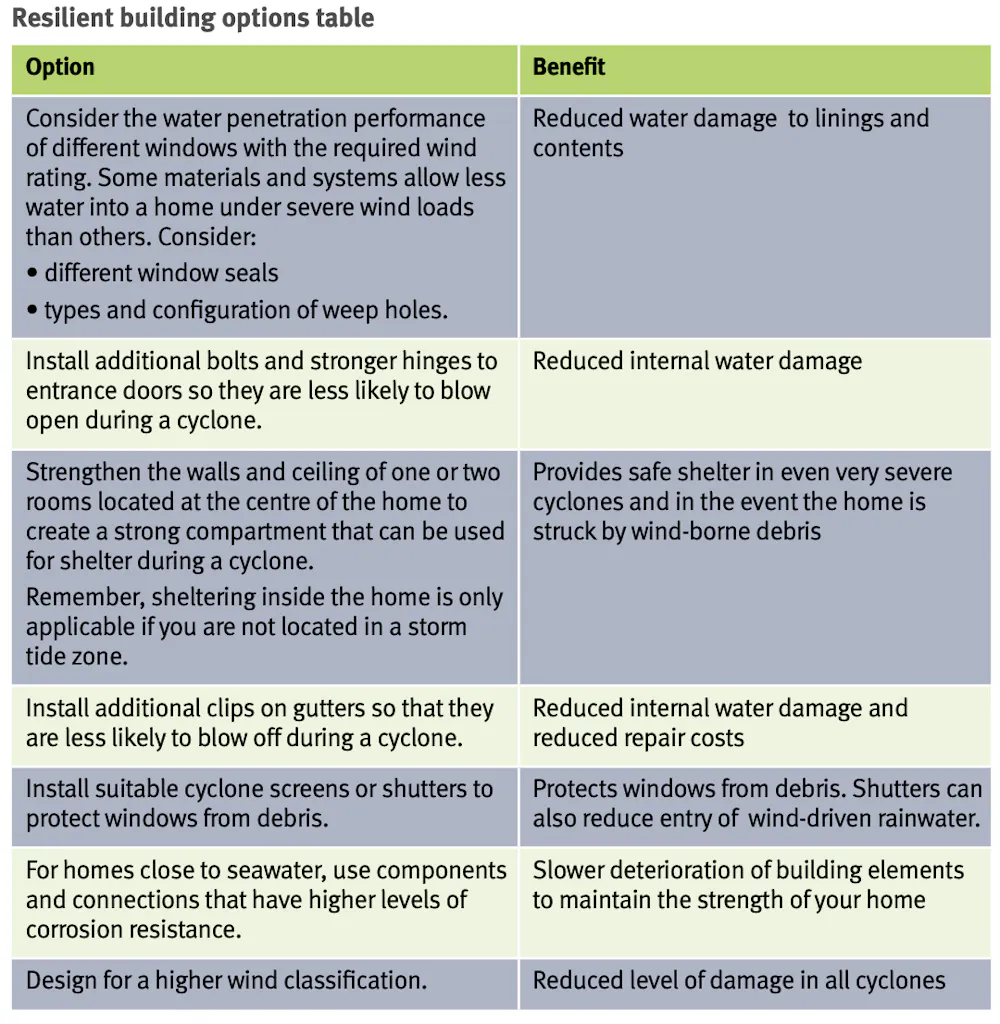 Resilient building options you could consider.
© The State of Queensland (Queensland Reconstruction Authority), CC BY
Resilient building options you could consider.
© The State of Queensland (Queensland Reconstruction Authority), CC BY
Eternal vigilance
It’s also important all elements holding your house together are well maintained through the life of the building.
That means ensuring regular inspections by a trained professional to identify any potential weaknesses such as rot, rust or UV damage.
These inspections are not something you and a mate can do yourselves. It requires a building professionals to get into the roof and look for weak spots.
Think beyond your house. What about the carport? A pergola? That shed or patio you added? Are the solar panels installed correctly with the right fixings and brackets to resist the wind forces?
If all these things are not fixed down and maintained well, strong winds can pick them up and throw them at your house or your neighbours.
Just as you get your car serviced, you should get your house checked every five to seven years. Our homes have many important parts and a failure in one can lead to disastrous and expensive problems.
Authors: David Henderson, Chief Engineer, Cyclone Testing Station, James Cook University


















