

New play The Robot Dog reminds us there are some knowledges we hold that AI will never have
- Written by: Sarah Austin, Senior Lecturer in Theatre, The University of Melbourne
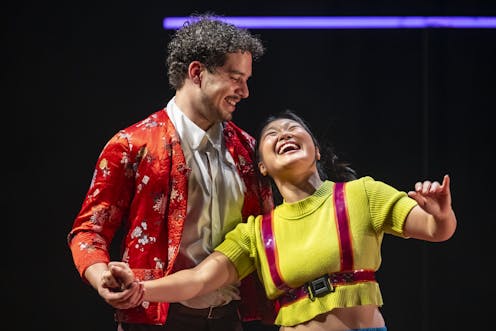
Set in 2042, new play The Robot Dog revolves around Janelle (Kristie Nguy), of Cantonese heritage, and her partner Harry (Ari Maza Long), a First Nations man.
Janelle’s mother, Wing Lam (Jing-Xuan Chan as a ghostly apparition), has recently passed. Janelle and Harry have temporarily moved back to Wing Lam’s home to finalise her belongings and reckon with her tragic death.
Part and parcel of the home is a robot dog called Dog (depicted by a real robot dog trundling around the stage), a therapy bot designed to be of service to humans, and an artificial intelligence (AI) smart house interface called Hus. Hus knows an alarming amount of information about the residents and is resolute at attempting to keep them on track with their daily tasks and responsibilities.
These two technological beings are in tension throughout. Hus works to maintain timelines and productivity (and offers inane daily motivational quotes); Dog seeks to understand the complexities humans experience in the face of grief and loss, despite his programming.

Part of the outstanding Asia TOPA Festival, which has transformed Melbourne’s cultural landscape into a vibrant and eclectic stage of storytelling and celebration, Melbourne Theatre Company’s education show The Robot Dog is co-written by Hong Kong born interdisciplinary artist Roshelle Yee Pui Fong and Luritja writer and technologist Matthew Ngamurarri Heffernan.
Through the vehicle of a family drama, the play emphasises the value of embodied knowledge and how this can never be replaced by artificial intelligence and technology.
Measuring values
The notion of robotic pets as a strategy for providing company and care for those who live alone or are elderly is not just a future imagining. It is a contemporary reality designed to battle an epidemic of isolation and loneliness.
Dog represents the best of AI with his aim to help the humans in his life. He appears to listen and learn from humans, evolving his emotional repertoire. Hus, on the other hand, represents the idea of AI as an omniscient and omnipresent being, wielding knowledge as power.
Both Hus and Dog are voiced by Chan in a masterclass performance of embodied knowledge, showcasing how nuanced vocal characterisation can create great emotion and context.

In the wake of her mother’s death, Janelle is struggling with complex emotions of anger, grief and disconnection. Her sense of cultural alienation seems compounded by the remnants of her mother’s life around her.
She finds herself frustrated at not being able to read the ingredients on a bag of salty Cantonese pork floss. She is again frustrated when the true value of her mother’s red Cheongsam cannot be calculated by the AI technology: Hus describes it as a mixture of polyester and mould, instead of understanding the garment as an invaluable material representation of her mother and her story.
To counter this feeling of disconnection, Hus encourages Janelle to use the “language augment” microchip that gives you instant fluency in your chosen language.
Eventually, in her frustration, she does. She becomes immediately able to read and speak the Cantonese language. But, of course, this approach has shortcomings. Some forms of knowledge cannot be passed down through the soulless automation of AI. They exist as spiritual, tactile and embodied understandings of equal and significant value.
Likewise, Harry ignores many calls from his mother because she speaks so fast in Language. He feels shame that he cannot keep up.
He experiences racial profiling in his workplace and uses the language augment to support his application for promotion, framing the idea of language acquisition as an economic benefit – rather than a personal reclamation of culture and belonging.
Intersecting cultures
The story moves through complex territory navigating cultural disorientation, systemic racism, dystopian AI futures and the ghosts and ancestors of our pasts.
At the centre of many narrative threads and ideas is a blending of two distinct cultures we don’t often see interwoven in this way. This intersection of Cantonese and First Nations Australians comes sharply and hilariously into focus in a debate about whose culture lays claim to the blue, red and white checkered plastic “Hong Kong/Blakfulla” bags that all Janelle’s mothers earthly belongings have been packed away in.
Reflecting the many intersecting complexities in the play, the bags function as a symbol of cultural tension and of grief, most notably when Harry attempts to “clean up” with little regard for what may be important to Janelle.
 At the centre of the play is a blending of two distinct cultures we don’t often see interwoven in this way.
Tiffany Garvie/MTC
At the centre of the play is a blending of two distinct cultures we don’t often see interwoven in this way.
Tiffany Garvie/MTC
The Robot Dog is a frank look at a possible future relationship between humans and AI, suggesting we are unlikely candidates for easy programming and will resist subordination to the pulse and rhythm of technological apparatus.
At the core of the play is a proverb, a key line of text from the show, “to forget one’s ancestors is to be a brook without a source, a tree without roots”.
Perhaps this suggests we may respond and adapt to new technological possibilities in our environment, but we remain anchored to ancient wisdom which exists in places that technology may never be able to reach.
The Robot Dog is at the Melbourne Theatre Company’s Southbank Theatre until March 21, before touring to Ballarat and Mildura.
Authors: Sarah Austin, Senior Lecturer in Theatre, The University of Melbourne


















