

Houses for a warmer future are currently restricted by Australia's building code
- Written by: Anir Kumar Upadhyay, Lecturer in Built Environment, UNSW
Australian houses use significantly more electricity to stay warm or cool than estimated during the design stage.
To design a new house in Australia, the building needs to meet the national construction code. One way to do this is by using software to simulate the building’s thermal efficiency, to see if it meets the minimum requirements of the national house energy scheme. The scheme divides Australia geographically into 69 different climate zones and requires new houses to be thermally appropriate for their environment.
Read more: Are heatwaves 'worsening' and have 'hot days' doubled in Australia in the last 50 years?
Unfortunately, this software does not properly take into account our warming weather. Our recent report found the climate assumptions used by the government drastically underestimate the length and heat of summers in the near future.
In fact, buildings that perform best for heat waves predicted by 2030 are actually banned by the government’s building code. We urgently need to update our building codes to cope with our changing climate.
Understand the future local climate
We took Richmond in New South Wales as an example to understand the effect a changing climate might have on building performance. By taking predictions from CSIRO’s medium greenhouse gas emissions scenario, we analysed Richmond’s likely weather for every week of 2030.
The future outlook, shown below, is strikingly different from the weather files used to determine whether houses meet the minimum thermal performance requirement of the National Construction Code. In 2030, Richmond will experience a warm period almost four times longer than predicted by the official weather file.
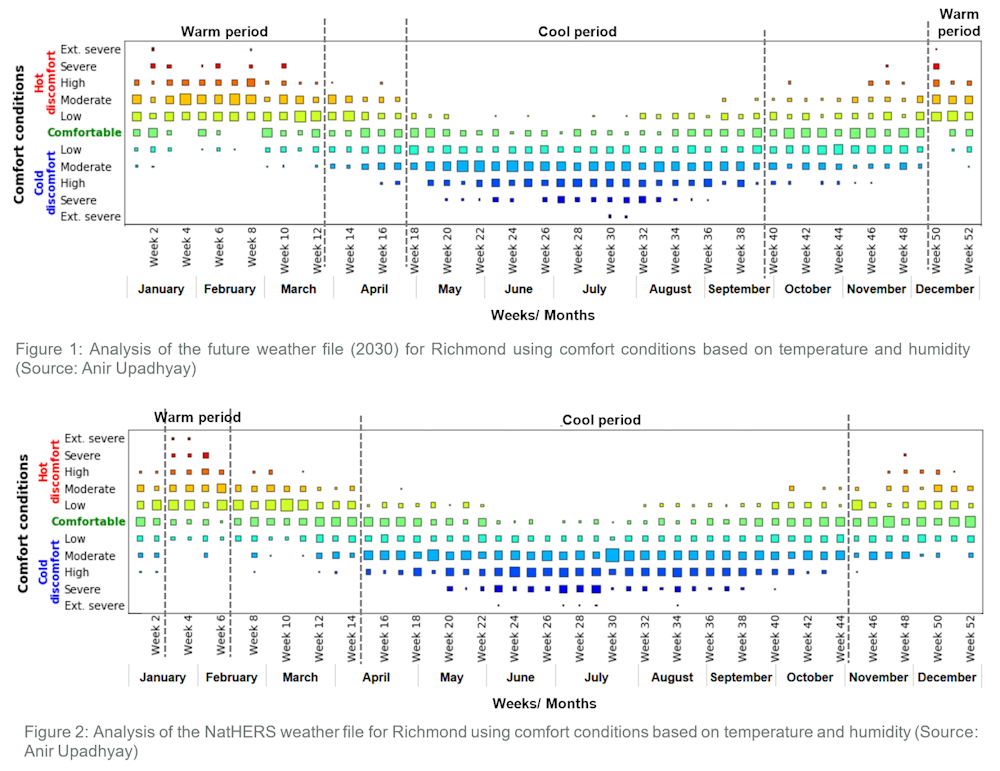 Author provided
Design for the future
Based on the future climate scenario, the design strategy for buildings in Richmond should focus on well shaded and insulated buildings to avoid any heat gain in the warm period, but should also harness sunlight to warm up the indoors in the cool period.
The warm period will last from December to March, when keeping the house cool is the priority. Passive solar heating, such as northern windows and well-insulated walls, floor and ceilings, are important during the May to September cool months, while direct ventilation is largely all that’s needed during the mostly comfortable April and October to November.
To test how houses will perform in a hotter future, we modelled a house in Richmond using AccuRate software. We found a design and construction solution that performed well (achieving 7.6 stars out of 10) for the 2030 scenario failed to meet a heating threshold that is legally required in NSW. In effect, the house that makes the most sense for the immediate future, could not be built.
These thresholds for heating and cooling are based on assumptions that are out of step with current conditions, let alone the future. Between 2016 and 2018 Richmond’s annual average temperature was 17.8℃, whereas the NatHERS weather file assumes it to be 16.7℃. This difference is set to increase.
In a 2019 amendment, the National Construction Code adopted NSW’s approach to heating and cooling thresholds to other climate zones in other states. The heating threshold puts a restraint on designing buildings that are optimised to mitigate extreme heat events.
This highlights the limitation of out-of-date climate files, and the current regulation that acts as a barrier to developing energy efficient designs for a future warmer climate.
Build to perform
A 2013 CSIRO study found that houses with higher star ratings using more energy in summer.
One of the reasons is the trade-offs on the thermal performance of one building component against another in the Nationwide House Energy Rating Scheme (NatHERS) software. For example, a window without shading on the western façade is acceptable in a NatHERS simulation, whereas the same window would not be allowed if a glazing calculator developed by the National Construction Code were used to demonstrate the thermal performance of a house.
Other issues are trade workmanship, such whether a building is airtight. Airtightness in residential buildings is ignored in the national construction code. However, considerable energy savings can be achieved if a house can be made airtight.
Author provided
Design for the future
Based on the future climate scenario, the design strategy for buildings in Richmond should focus on well shaded and insulated buildings to avoid any heat gain in the warm period, but should also harness sunlight to warm up the indoors in the cool period.
The warm period will last from December to March, when keeping the house cool is the priority. Passive solar heating, such as northern windows and well-insulated walls, floor and ceilings, are important during the May to September cool months, while direct ventilation is largely all that’s needed during the mostly comfortable April and October to November.
To test how houses will perform in a hotter future, we modelled a house in Richmond using AccuRate software. We found a design and construction solution that performed well (achieving 7.6 stars out of 10) for the 2030 scenario failed to meet a heating threshold that is legally required in NSW. In effect, the house that makes the most sense for the immediate future, could not be built.
These thresholds for heating and cooling are based on assumptions that are out of step with current conditions, let alone the future. Between 2016 and 2018 Richmond’s annual average temperature was 17.8℃, whereas the NatHERS weather file assumes it to be 16.7℃. This difference is set to increase.
In a 2019 amendment, the National Construction Code adopted NSW’s approach to heating and cooling thresholds to other climate zones in other states. The heating threshold puts a restraint on designing buildings that are optimised to mitigate extreme heat events.
This highlights the limitation of out-of-date climate files, and the current regulation that acts as a barrier to developing energy efficient designs for a future warmer climate.
Build to perform
A 2013 CSIRO study found that houses with higher star ratings using more energy in summer.
One of the reasons is the trade-offs on the thermal performance of one building component against another in the Nationwide House Energy Rating Scheme (NatHERS) software. For example, a window without shading on the western façade is acceptable in a NatHERS simulation, whereas the same window would not be allowed if a glazing calculator developed by the National Construction Code were used to demonstrate the thermal performance of a house.
Other issues are trade workmanship, such whether a building is airtight. Airtightness in residential buildings is ignored in the national construction code. However, considerable energy savings can be achieved if a house can be made airtight.
 Author provided
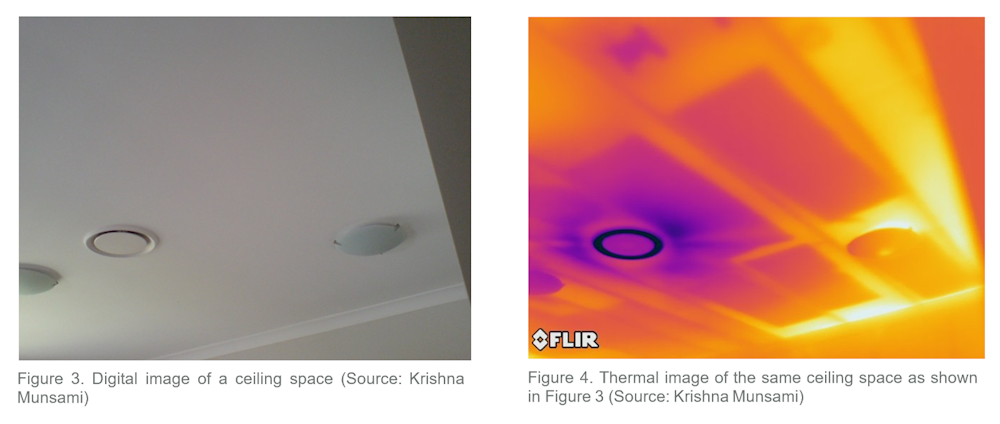
Similarly, missing or displaced insulation in the ceiling, as shown above, can cause significant discomfort and additional heating and cooling costs. We all, from builders to homeowners, need to understand insulation must be carefully installed and cannot be moved later, or even well designed buildings will become inefficient.
Windows are the main option for ventilating most houses. However, if you live in a high-pollution or noisy area, or in a place with very little wind, open windows might not be desirable or practical. Consequently, households may not be getting enough fresh air to maintain a healthy indoor environment. A mechanical ventilation system, which uses little energy, is an ideal alternative.
Read more:
Too many Australians have to choose between heating or eating this winter
The current weather files and heating thresholds used to develop minimum building standards are inadequate for our warming climate. Our report presents a framework for designing and building houses that consider climate change. We hope to see further research on other Australian population centres, so we can develop a comprehensive overview to help us build energy efficient and healthy houses for the future.
Author provided
Similarly, missing or displaced insulation in the ceiling, as shown above, can cause significant discomfort and additional heating and cooling costs. We all, from builders to homeowners, need to understand insulation must be carefully installed and cannot be moved later, or even well designed buildings will become inefficient.
Windows are the main option for ventilating most houses. However, if you live in a high-pollution or noisy area, or in a place with very little wind, open windows might not be desirable or practical. Consequently, households may not be getting enough fresh air to maintain a healthy indoor environment. A mechanical ventilation system, which uses little energy, is an ideal alternative.
Read more:
Too many Australians have to choose between heating or eating this winter
The current weather files and heating thresholds used to develop minimum building standards are inadequate for our warming climate. Our report presents a framework for designing and building houses that consider climate change. We hope to see further research on other Australian population centres, so we can develop a comprehensive overview to help us build energy efficient and healthy houses for the future.
Authors: Anir Kumar Upadhyay, Lecturer in Built Environment, UNSW


















