

Why Muslims often don’t celebrate Eid on the same day – even within one country
- Written by: Zuleyha Keskin, Associate Professor of Islamic Studies, Charles Sturt University
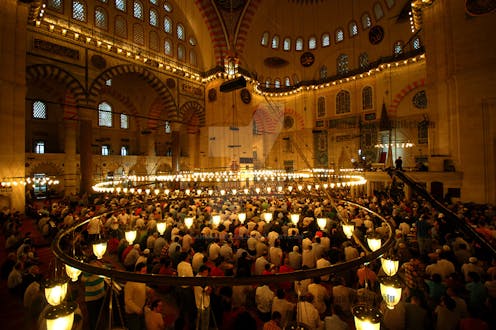
Eid is a special time for Muslims. There are two major Eid celebrations each year: Eid al-Fitr is celebrated at the end of Ramadan, the month of fasting, and Eid al-Adha is connected to the dates of Hajj, the annual pilgrimage to Mecca, Saudi Arabia.
Eid, which means “festival” or “feast” in Arabic, is a celebratory occasion for more than one billion Muslims worldwide. However, in some countries, especially multicultural ones like Australia, Muslims don’t always celebrate Eid on the same day. Here’s why.
Eid comes 10-12 days earlier each year
Beyond different groups celebrating on different days, the timing of Eid celebrations also shift as a whole each year. That’s because Islam follows the lunar calendar, based on the moon’s cycles – unlike the Gregorian calendar, which follows the sun.
As such, dates on the Islamic calendar come 10–12 days earlier each year. This means the dates of both Eids also move about 11 days forward each year.
In terms of the Islamic calendar:
- Eid al-Fitr happens on the 1st of the month of Shawwal (the 10th month), which comes right after the month of Ramadan.
- Eid al-Adha happens on the 10th of Dhul-Hijjah (the 12th month), during Hajj.
What about local discrepancies?
Since Islam follows the lunar calendar, determining the start of each Islamic month, and the dates of both Eids, requires sighting the new crescent moon, which comes directly after the new moon (the phase in which the moon is invisible).
But there are different methods for doing this, and different scholarly interpretations regarding what method is best. These variations are the reason one group in a community might celebrate on a Sunday, while others may celebrate on a Monday.

Some Muslims believe each country should rely on its own local moon sighting.
This means if the new crescent moon is visible in neighbouring countries, but not in Australia (such as if it’s hidden behind clouds), then Australia should celebrate a day after its neighbours. The organisation Moonsighting Australia follows this method, only declaring Eid when the moon is seen locally.
However, others argue if the moon has been sighted anywhere in the world, it should be accepted by all Muslims as the start of the new Islamic month. Some Muslims in Australia opt for this “global moon sighting” approach, following Saudi Arabia’s Eid announcement even when the moon is not sighted locally.
Apart from the question of where the crescent moon is sighted, there are also different views over how it should be sighted. Many scholars believe in physically sighting it with the eyes, as was practised during the time of Prophet Muhammad.
But some Muslim countries, such as in Turkey and parts of Europe, use astronomical calculations to predict the new moon’s birth. This allows them to pre-set the date of Eid months, or even years, in advance.
Australia versus majority-Muslim countries
In Muslim-majority countries, deciding the day of Eid happens at a government level.
For example, in Saudi Arabia, the Supreme Court officially declares the date based on moon sighting reports. This decision sets the timing for Eid prayers and public holidays for the entire nation, allowing for unified celebrations across the country.
But Muslims in Australia come from diverse cultural backgrounds, and hold varying views regarding how the moon should be sighted. Some may follow the Eid announcement from their country of origin. Others may rely on local announcements, or on dates set by peak bodies such as the Australian National Imams Council.
One 2023 report published by the ISRA Academy surveyed more than 5,500 Muslims in Australia to understand how they determined the date of Eid.
The findings reveal notable differences across communities. Respondents from the Arab community were almost evenly split between following their local mosque (28.5%) and the Australian National Imams Council (28.0%), with a slightly lower percentage (23.9%) following Moonsighting Australia. Only 0.6% followed their country of origin.
Among the Turkish community, 16.1% followed their country of origin, while the largest proportion (28.5%) relied on a local mosque or Islamic organisation. But given Turkish mosques tend to follow Turkey’s state religious institution, Diyanet, most Australian Turks (44.6%) ultimately align with Turkey’s decision on Eid.
Of the others, 18.8% followed Moonsighting Australia and 14.6% following the national imams’ council.
In the African Muslim community, 48.4% followed Moonsighting Australia, while 32.8% relied on a local mosque, and 11.7% on the imams’ council.
Eid celebrations will keep evolving
While celebrating Eid on different days may seem divisive and fragmenting, there are positive aspects to this.
For one thing, it means Australian Muslims actively seek out information from various religious authorities. This reflects a high level of public engagement in religious decisions – rather than following blindly.
The strong influence of organisations such as the Australian National Imams Council and Moonsighting Australia also suggests local religious institutions are a trusted source for guidance.
Moreover, the high percentage of Muslims now following Moonsighting Australia indicates a trend towards a localised determination of Eid. And this trend will likely become stronger with the emergence of third- and fourth- generation Australian Muslims who are less connected with their ancestral homelands.
Only time will tell whether most Australian Muslims will eventually celebrate Eid on the same day. In the meantime, families and communities continue to navigate these differences with understanding and respect.
Authors: Zuleyha Keskin, Associate Professor of Islamic Studies, Charles Sturt University



















