

Under a Coalition government, the fate of Australia’s central climate policy hangs in the balance
- Written by: Felicity Deane, Professor of Trade Law, Taxation and Climate Change, Queensland University of Technology
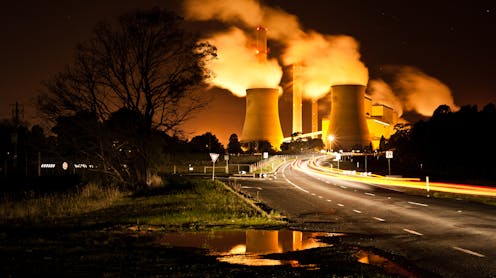
The future of Australia’s key climate policy is uncertain after Opposition Leader Peter Dutton said a Coalition government would review the measure, known as the “safeguard mechanism”, which is designed to limit emissions from Australia’s largest industrial polluters.
According to the Australian Financial Review, if the Coalition wins office it will consider relaxing the policy, as part of its plan to increase domestic gas supplies.
Evidence suggests weakening the mechanism would be a mistake. In fact, it could be argued the policy does not go far enough to force polluting companies to curb their emissions.
Both major parties now accept Australia must reach net-zero emissions by 2050. This bipartisan agreement should make one thing clear: winding back the safeguard mechanism would be reckless policy.
What’s the safeguard mechanism again?
The safeguard mechanism began under the Coalition government in 2016. It now applies to 219 large polluting facilities that emit more than 100,000 tonnes of greenhouse gases a year. These facilities are in sectors such as electricity, mining, gas, manufacturing, waste and transport. Together, they produce just under one-third of Australia’s emissions.
Under the policy’s original design, companies were purportedly required to keep their emissions below a certain cap, and buy carbon credits to offset any emissions over the cap. However, loopholes meant the cap was weakly enforced.
This meant greenhouse gas pollution from the facilities actually increased – rising from 131.3 million tonnes to 138.7 million tonnes in the first six years of the policy.
Labor strengthened the safeguard mechanism after it won office, by setting a hard cap for industrial emissions. The Coalition voted against the reforms.
Dutton has since labelled the safeguard mechanism a “carbon tax” – a claim that has been debunked. Some members of the Coalition reportedly believe the policy makes manufacturers globally uncompetitive.
Now, according to media reports, a Coalition government would review the safeguard mechanism with a view to weakening it, in a bid to bolster business and increase gas supply.
Why the safeguard mechanism should be left alone
Weakening the safeguard mechanism would lead to several problems.
First, it would mean large facilities, including new coal and gas projects, would be permitted to operate without meaningful limits on their pollution. This threatens Australia’s international climate obligations.
Second, if polluters were no longer required to buy carbon offsets, this would disrupt Australia’s carbon market.
As the Clean Energy Regulator notes, the safeguard mechanism is the “dominant source” of demand for Australian carbon credits.
In the first quarter of 2024, about 1.2 million carbon-credit units were purchased by parties wanting to offset their emissions. The vast majority were purchased by companies meeting compliance obligations under the safeguard mechanism or similar state rules.
If companies are no longer required to buy offsets, or they buy fewer offsets, this would hurt those who sell carbon credits.
Carbon credits are earned by organisations and individuals who abate carbon – through measures such as tree planting or retaining vegetation. The activities are often carried out by farmers and other landholders, including Indigenous organisations. Indigenous-led carbon projects have delivered jobs, cultural renewal and environmental benefits.
The safeguard mechanism, together with the government pledge to reach net-zero emissions by 2050, also provides certainty for the operators of polluting facilities. Many in the business sector have called for the policy to remain unchanged.
And finally, winding back the safeguard mechanism would send a troubling signal to the world: that Australia is stepping back from climate action.
Now is not the time to abdicate our responsibilities on climate change. Atmospheric carbon dioxide levels have risen dramatically since 1960. This increase is driving global warming and climate change, leading to extreme weather events which will only worsen.
A hard-won policy
The safeguard mechanism has not had time to deliver meaningful outcomes. And it is far from perfect – but it is hard-won, and Australia needs it.
The 2023 reforms to the mechanism were designed to support trade-exposed industries, while encouraging companies to invest in emissions reduction.
Undoing this mechanism would risk our climate goals. It would leave the government limited means to curb pollution from Australia’s largest emitters, and muddy the roadmap to net-zero. It would also create uncertainty for all carbon market participants, including the polluting facilities themselves.
Authors: Felicity Deane, Professor of Trade Law, Taxation and Climate Change, Queensland University of Technology


















