

how NZ’s plan to drill for ‘supercritical’ geothermal energy holds promise and risk
- Written by: David Dempsey, Associate Professor in Natural Resources Engineering, University of Canterbury
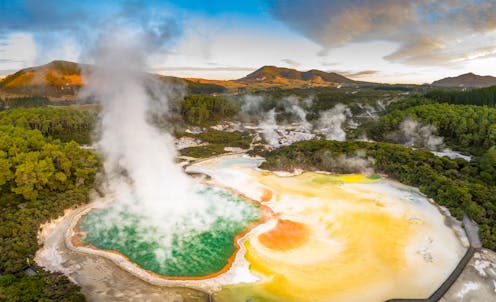
New Zealand’s North Island features a number of geothermal systems, several of which are used to generate some 1,000 MegaWatts of electricity. But deeper down there may be even more potential.
The government is now investing NZ$60 million to explore what is known as “supercritical” geothermal energy, following five years of feasibility research led by GNS Science.
Supercritical geothermal is hotter and deeper than conventional geothermal sources. It targets rocks between 375°C and 500°C, close to – but not within – magma.
Water at these temperatures and depths has three to seven times more energy for conversion to electricity, compared to ordinary geothermal generation at comparatively cooler temperatures of 200°C to 300°C.
The investment is staged, with $5 million earmarked for international consultants to design a super-deep well, and further funds to be released later for drilling to depths of up to six kilometres. Consultation is underway, with resources minister Shane Jones hoping to convince Māori landowners to collaborate.
GNS Science estimates the central North Island might have about 3,500MW worth of this resource, although actually accessing it might be difficult and expensive. The energy consulting firm Castalia was engaged to predict how much would be worth developing, suggesting between 1,300MW and 2,000MW, starting from 2037.
This would be a lot of extra power. Even better, it would reduce the peaks and troughs in generation that arise from more variable solar and wind sources, which are expected to make up a growing share of electricity generation in the future. Supercritical geothermal is reportedly cost effective, which means the technology deserves serious consideration. But such claims should be subject to scrutiny.
Successive governments have supported major state energy projects, including the Manapouri power station, petroleum exploration during the early 2000s, early geothermal drilling and the investigation of a pumped hydro scheme at Lake Onslow. The need for energy security clearly motivates such investments.
But New Zealand has a healthy geothermal industry. In the past two decades, geothermal companies have invested $2 billion in hundreds of new wells and new power plants. The industry already knows how to drill wells and profit from them. So why is the government stepping in now?
In practice, supercritical geothermal exploration and development faces several research, technical and economic risks. Private enterprise seems unwilling to bear them alone, prompting the government to step in to establish feasibility.
How to crack soft rock
One problem supercritical geothermal might encounter is that drilling deeper might find lots of hot rock, but not much water. Drilling experiments in Japan and Italy have shown that reaching 500°C is possible, but in both cases the rock was so ductile (pliable and easily stretched) because of the high temperatures that it couldn’t keep open the gaps needed for water to flow.
However, the experience was different in Iceland where two wells managed to find water above 400°C. At this stage, it’s not clear whether this is because Iceland has special rocks – particularly basalts, which are less ductile – or because the country is being stretched through tectonic forces at a high rate. New Zealand is less able to count on basalts but it does experience rapid tectonic stretching.
Deep drilling would test this key hypothesis: is there permeability (gaps for water to flow through) at supercritical conditions? The only way to know for sure is to drill down.
If there isn’t permeability, the government could either abandon the investment or look into methods to create it. Multi-stage hydraulic fracturing (“fracking”) is an option which has worked overseas in the North American shale gas industry. It has also recently been demonstrated in some US geothermal systems.
Even if we did find permeability, the water produced in Iceland’s supercritical wells was enormously corrosive. A better option then might be to inject cold water into the well, suppressing the corrosive fluids. The injected water would heat up and rise into the overlying geothermal system – flushing the heat upwards.
However, both water injection and fracking can trigger earthquakes, perhaps a magnitude 4-5 every year or a magnitude 5-6 every few decades. This happened in 2017 in Pohang in South Korea where water injection triggered a magnitude 5.5 earthquake. It resulted in the cancellation of the geothermal project.
But there are many other geothermal projects where injection has not led to concerning earthquake activity.
Fierce competition from solar, wind and batteries
The other risk is economic. Supercritical geothermal might one day be technically feasible, but its potential contribution in New Zealand will be limited if it can’t beat other generation technologies on cost.
Worldwide, the renewable energy sector continues to be disrupted by unprecedented cost decreases driven by innovations in utility-scale battery storage and solar photovoltaics.
But the supply chains are largely overseas, mostly concentrated in China. This adds geopolitical complexity to the energy security calculus. Homegrown solutions are a strength.
Nevertheless, the International Renewable Energy Agency reports cost reductions for solar and battery modules of 89% and 86% between 2010 and 2023. Solar costs drop 33% each time the built amount doubles. Drops in battery cost are enabling large deployments for daily smoothing of the peaks and troughs of intermittent solar and wind generation.
This shifting cost landscape creates financial uncertainty for energy investors. While cost declines might not continue forever, it’s hard to pick when they will level off. Meanwhile, geothermal costs have been flat for a long time. A billion-dollar geothermal investment might quickly become uncompetitive.
Despite all these caveats, we shouldn’t overlook the positive signal of the government taking a bet on New Zealand science and innovation. It will be exciting to see what’s happening at six kilometres of depth underground. And although the plan is not to drill for magma, an accidental strike (as happened in Iceland) would lead to some amazing science.
Lastly, energy security deserves to be taken seriously over the long term. While supercritical geothermal won’t fix our immediate vulnerability to winter scarcity, it could help avoid similar issues in the 2040s.
Authors: David Dempsey, Associate Professor in Natural Resources Engineering, University of Canterbury


















