

Media watchdog's report into Christchurch shootings goes soft on showing violent footage
- Written by Denis Muller, Senior Research Fellow in the Centre for Advancing Journalism, University of Melbourne
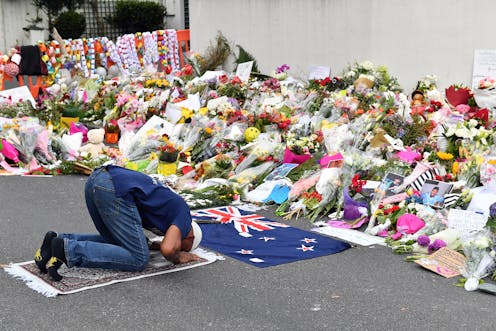
Coverage of the Christchurch terrorism by Australia’s television channels raised “serious questions” about whether they had breached the television codes of practice, according to the broadcasting regulator, the Australian Communication and Media Authority (ACMA).
However, it has declined to make specific findings that the codes were in fact breached.
Instead, it proposes to discuss with the television industry whether the codes are adequately framed to deal with the kind of material generated by the atrocity, especially the footage from the terrorist’s bodycam.
Read more: Why news outlets should think twice about republishing the New Zealand mosque shooter's livestream
The ACMA launched its inquiry into the coverage in the immediate aftermath of the March 15 attacks, reviewing 200 hours of coverage spanning March 15, 16 and 17.
It found that no material had been broadcast explicitly showing a person being shot, injured or killed.
However, footage had been shown of
a person being shot at
a victim who had already been shot
the scene inside the Al Noor mosque, where most of the victims were killed.
The report is open to the interpretation that the threshold for violence acceptable for broadcast in these circumstances is footage that does not show someone actually being shot.
That is likely to be a central point of discussion between the ACMA and the television industry in the discussions that the report says will now take place.
The most relevant clause in the existing Free TV Australia code of practice says a broadcaster cannot show material that is likely to seriously distress or seriously offend a substantial number of viewers unless there is a public interest in doing so.
Of course there was a very strong public interest case here. However, ethically speaking, a test of necessity is also required: how much and what level of violence is it necessary to show in order to convey to the audience a comprehensive account of what has happened?
The various Australian television channels answered this question differently.
Sky News, Seven and Nine all showed footage of someone being shot at.
Ten showed footage of gunfire more generally.
All four – Seven, Nine, Ten and Sky – used moving footage from the terrorist’s bodycam.
The ABC was the most cautious. It used stills from the bodycam.
SBS showed largely unedited footage from overseas in which the smoke from the gunfire was the only thing obscuring the view of people who had been shot.
A further issue that caused the ACMA concern was what it called the high degree of repetition of certain high-impact depictions within a short space of time. It stated that “excessive and gratuitous repetition may not be proportionate to the public interest and may have the effect of heightening distress or offence to the audience”.
These high-impact depictions included actions that killed a person, strongly implied that a person would be killed, or a person who had just been killed.
The ACMA also questioned whether the broadcasting of the bodycam footage from inside the Al Noor mosque, some of which included the sound of injured people, could be “properly justified”.
In this context, it suggests that in reviewing its code of practice, the television industry take account of the provisions of the new laws against the online streaming of abhorrent violent material, passed by federal parliament in the immediate aftermath of the Christchurch terrorism.
The ACMA drew an important distinction between footage from inside the mosque taken from the terrorist’s bodycam and the footage from a survivor that was also shown.
The distinction was that while the bodycam footage was propaganda, the survivor’s footage was not seeking to glorify the violence but to show the horror being experienced by the victims.
The overall effect is of a report that is nuanced but very tame.
It takes a particularly narrow reading of the relevant clause in the code of practice to avoid saying it was breached.
A breach of the code should be based on a broad reading because the codes are designed to provide broad guidance to journalists making big decisions in a hurry. They are not designed to be parsed for legal niceties, but too often this is exactly what the ACMA does.
Read more: Christchurch attacks provide a new ethics lesson for professional media
At the very least, the stations should be told that the mistakes identified in the report — even if they are called “questions” – will attract a penalty if repeated in the future.
Of course this was a difficult story to cover and mistakes were made.
But the ACMA is wrong to say that it was uniquely difficult.
The genuinely unique feature of it was the use of the bodycam by the terrorist to propagandise his atrocity.
There have been many propaganda videos made by terrorists, although not from a bodycam.
When a British soldier, Lee Rigby, was run over and stabbed to death in London in 2013, there was a long propaganda video showing one of the assassins holding a bloodied knife and making a propagandising speech.
To minimise the propaganda effect, many channels cut off most of the sound and did a voice-over. Many also pixillated the bloodied knife.
And there have been many cases where footage has been taken from inside a scene of carnage, notably the Paris Bataclan dance hall terror attack in 2015.
Authors: Denis Muller, Senior Research Fellow in the Centre for Advancing Journalism, University of Melbourne

















