

Most bees nest in the ground. Offering rocks and gravel is a simple way to help them thrive
- Written by: Freya Marie Jackson, PhD Candidate, School of Veterinary and Life Sciences, Murdoch University
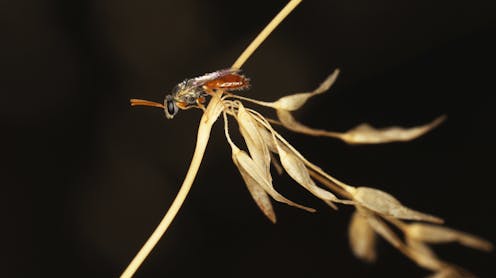
Of the more than 20,000 bee species in the world, 70% nest in the ground. And like many of their counterparts that nest above ground, these bees are facing rapid population declines.
But while there has been research into providing habitat for above-ground cavity-nesting bees, the nesting ecology of ground-nesting bees remains largely understudied.
This gap in knowledge is concerning. For one, these bees play a crucial role in ecosystems. For another, ground-nesting bee habitats are threatened by land degradation, urbanisation, pesticides and agricultural expansion.
Our recent study addresses this research gap. Published this week in Austral Entomology, it examines the soil type preferences of ground-nesting bees and provides a simple, practical approach to enhancing their habitats.
A high diversity of native bees
Australia hosts a high diversity of native bees found nowhere else in the world – more than 1,600 scientifically named species.
Lasioglossum (Homalictus) dotatum is a small, ground-nesting bee species native to Australia. It measures approximately 3–4 mm.
Unlike the introduced European honey bee (Apis mellifera), which lives in large, highly organised colonies with complex social structures, L. dotatum exhibits an “apartment living” social structure, with independent nests situated close to one another. This aggregation behaviour indicates certain environmental or habitat features that are necessary for the species to thrive.
This species is widely distributed across mainland Australia. It nests in a range of sandy soil types. Because of this, it offers a valuable opportunity to examine how different environmental conditions shape its nesting preferences.

A prolific pollinator
A key feature of the nests of this species is the presence of small conical mounds of excavated soil, known as tumuli, which surround the entrance. These mounds can resemble small ant hills. As a result, the nests are sometimes mistaken for ant nests, leading to accidental pesticide application and destruction of the bees’ habitats.
This bee is also known to visit a range of plants of ecological importance, which makes understanding its role in ecosystems essential. It has been recorded visiting the flowers of jarrah, marri and yarri trees – all of which are vital for maintaining biodiversity and supporting wildlife in southwestern Australia.
Lasioglossum dotatum has also been observed in avocado orchards, a crop of significant economic value in Western Australia.
While it remains uncertain whether L. dotatum is a major crop pollinator, its presence in these orchards suggests it could play a supplementary role in pollination. This potentially makes it an intriguing subject for research exploring native alternatives to honey bees (Apis mellifera) for crop pollination.

Understanding bees’ nesting preferences
Our research focused on understanding the nesting preferences of L. dotatum. The study sought to explore how environmental features, such as soil type and surface cover, influenced where these bees chose to nest.
Specifically, the study tested whether L. dotatum preferred bare sand or rock gravel as a nesting substrate.
The study also examined whether the cleanliness of the sand – whether steam-treated or left untreated — impacted the bees’ nesting decisions.
The study used artificial nesting pots filled with sand from the Swan Coastal Plain, a region known for its sandy soils, to simulate nesting conditions around active bee aggregations. During the summer nesting season of February 2022, researchers monitored how the bees interacted with these artificial nesting sites, using the number of nest entrances (or tumuli) as a measure of nesting activity.
Getting into the gravel
Our study found L. dotatum strongly preferred nesting in pots covered with rock gravel over those with bare sand. This preference likely arises from the benefits provided by rock gravel, such as improved moisture retention, temperature regulation, and protection from predators.
The experimental pots with rock gravel had significantly more nest entrances. This indicated that rock cover helps create a more stable and favourable microhabitat for nesting.
The bees also showed a preference for steam-treated sand, suggesting that factors such as microbial contaminants or organic residues in untreated soil may deter nesting.
Interestingly, when the rock gravel was removed, many nests were found concealed beneath the gravel. This highlights the importance of rock cover in enhancing nest stability and reducing the risk of disturbance.
 Lasioglossum dotatum preferred nesting in pots covered with rock gravel over those with bare sand.
Freya Marie Jackson, CC BY-NC-ND
Lasioglossum dotatum preferred nesting in pots covered with rock gravel over those with bare sand.
Freya Marie Jackson, CC BY-NC-ND
A simple, practical approach to conservation
These findings have important implications for native bee conservation, particularly in urban and agricultural areas.
The preference for rock gravel suggests that incorporating this material into urban landscapes could improve nesting conditions for ground-nesting bees such as L. dotatum.
By creating spaces for these ground nesting bees, we can better support these vital pollinators.
As native bees continue to face habitat loss and degradation, these findings provide a simple, practical approach to enhancing their habitats, ultimately contributing to more sustainable pollinator populations in urban and rural settings alike.
Authors: Freya Marie Jackson, PhD Candidate, School of Veterinary and Life Sciences, Murdoch University


















