

Fossil fuel companies ‘poisoned the well’ of public debate with climate disinformation. Here’s how Australia can break free
- Written by: Naomi Oreskes, Professor of the History of Science, Harvard University
President Donald Trump has issued an executive order that would block state laws seeking to tackle greenhouse gas emissions – the latest salvo in his administration’s campaign to roll back United States’ climate action.
Under Trump, the US has clearly abdicated climate leadership. But the US has in fact obstructed climate action for decades – largely due to damaging actions by the powerful fossil fuel industry.
In 20 years studying attacks on climate science and the powerful forces at work behind the scenes, I’ve come to think the United States is simply not going to lead on climate action. The fossil fuel industry has so poisoned the well of public debate in the US that it’s unlikely the nation will lead on the issue in our lifetimes.
Australia, on the other hand, has enormous potential.
I recently visited Australia from Harvard University for a series of public talks. This nation is very close to my heart. I trained as a mining geologist and spent three years in outback South Australia, before returning to academia.
The vacuum Trump has created on climate policy provides a chance for other countries to lead. Australia has much more to gain from the clean-energy future than it stands to lose – and your climate action could be pivotal.
The climate crisis: a long time coming
Scientists first warned against burning fossil fuels way back in the 1950s. When the US Clean Air Act was passed in 1970, the words “weather” and “climate” were included because scientists had already explained to Congress that carbon dioxide was a pollutant with serious — even dire — effects.
In the late 1980s, scientists at NASA observed changes in the climate system that could only be explained by the extra heating effect of atmospheric carbon dioxide. The predictions had become reality.
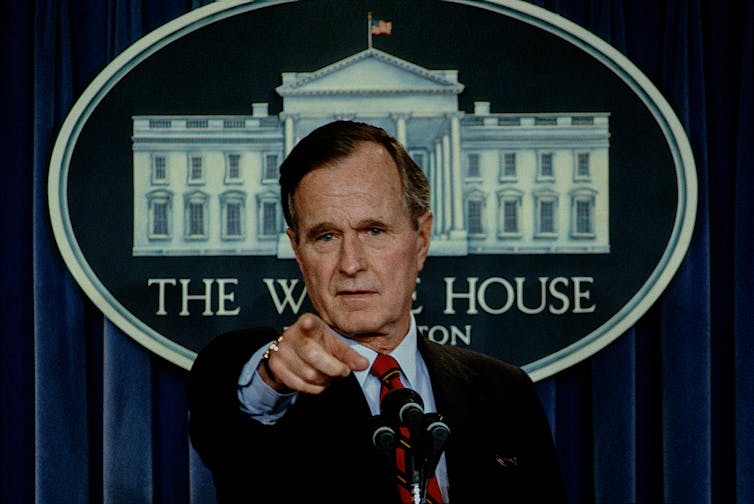
When George H.W. Bush ran successfully for president in 1988, he promised to use the power of the “White House effect” to fight the “greenhouse effect”. In 1992, Bush and other world leaders gathered in Rio de Janeiro, Brazil, to sign the United Nations Framework Convention on Climate Change. Together, 178 countries promised action to prevent “dangerous anthropogenic interference” with Earth’s climate. But that action never came.
Trump has undoubtedly been bad news for global climate action. He makes preposterous claims about science and is dismantling the federal agencies responsible for supporting climate science and maintaining climate data.
But the US has long failed to play its part in cutting dangerous greenhouse gas emissions. The reason for this lies largely outside the White House.

A long-running campaign of disinformation
The fossil fuel industry has known about climate change for as long as scientists have.
In the late 1970s and early 1980s, scientists at Esso (later ExxonMobil) actively researched the topic, building climate models and coauthoring scientific papers.
The scientists informed their managers of the risk of catastrophic damage if the burning of oil, gas and coal continued unabated. They even suggested the company might need a different business model – one not so dependent on fossil fuels.
But managers at ExxonMobil made a fateful decision: to turn from information to disinformation. Working in tandem with other oil, gas and coal companies, as well as automobile and aluminium manufacturers, ExxonMobil launched an organised campaign, sustained over decades, to block climate action by casting doubt on the underlying science.
They ran ad campaigns in national and local newspapers insisting the science was too unsettled to warrant action. They created “astroturf” organisations that only pretended to be green, and funded “third-party allies” to argue that proposed remedies would be too expensive, cost jobs and damage the economy.
The company funded outlier scientists to publish papers claiming atmospheric warming was the result of natural climate variability. They pressured journalists to give equal time to “their side” of the story in the name of “balance”.
Over the next three decades, whenever any meaningful climate policy seemed to be gaining traction, the industry and its allies lobbied Congress and state legislatures to block it. So, neither Democratic nor Republican administrations were able to undertake meaningful climate action.
While people were dying in climate-charged floods and fires, the fossil fuel industry persuaded a significant proportion of the US population, including Trump, that the whole thing might just be a hoax.

Rise up Australia
In a matter of weeks after becoming president, Trump pulled out of the Paris Agreement to limit global warming, shut down government websites hosting climate data, and withdrew support for research that dares to mention the word “climate”.
This has created a vacuum that other countries, including Australia, can step up to fill.
Few countries have more to lose from climate change than Australia. The continent has already witnessed costly and devastating wildfires and floods — affecting remote areas and major cities. It’s not unreasonable to worry that in coming years, significant parts of Australia could become uninhabitable.
Like the US, Australia has a powerful fossil fuel industry that has disproportionately influenced its politics. Unlike the US, however, that industry is based mainly on coal for export, which Australians do not depend on in their daily lives.
And Australia is truly a lucky country. It has unsurpassed potential to replace fossil fuels with renewable energy.
More than 15 years ago, Australian researchers in the Zero Carbon Australia project offered a blueprint for how the country could eliminate fossil fuel use entirely. Since then, renewable energy has only become cheaper and more efficient.
South Australia has proved the point: the state was 100% reliant on fossil fuels for electricity in 2002, but now more than 70% comes from renewables.
Across Australia, the share of renewable electricity generation is growing. Victoria, New South Wales and Queensland are vying for second place after SA. It’s fascinating to watch the National Electricity Market balance supply and demand in real time, where a large proportion of the electricity comes from rooftop solar.
For decades, the fossil fuel industry has told the public our societies can’t manage without fossil fuels. Large parts of Australia have proved it’s just not so. The rest of the nation can follow that lead, and model the energy transition for the world. Here’s your chance.
Authors: Naomi Oreskes, Professor of the History of Science, Harvard University


















