

how it works, where new incinerators could go, and how they stack up
- Written by: Ali Abbas, Associate Dean (Research), University of Sydney
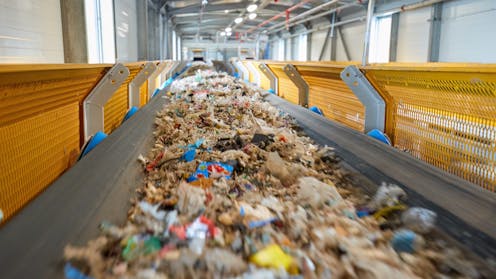
Every year, Australia buries millions of tonnes of waste in landfills. But these sites are filling fast, recycling has its own limitations, and most waste export is banned. So councils and state governments are looking for alternatives.
Several large-scale incinerators have been proposed, to turn municipal solid waste into electricity. One is already up and running in Perth’s outer suburbs.
The A$1.5 billion Parkes Energy Recovery project planned for New South Wales would be Australia’s biggest. However, community backlash over potential health risks could put the plan in doubt.
As chemical engineers, we recognise the potential benefits of this technology. Modern facilities operating around the world show these processes can be efficient, safe and environmentally controlled. However, minimal risk does not mean zero risk. Understanding both the benefits and challenges is crucial to address community concerns.
What is waste-to-energy?
Waste-to-energy, also known as energy-from-waste, can transform waste otherwise destined for landfill into electricity, heat or fuel.
This does not replace recycling. Instead, it offers a solution for materials that are difficult or impossible to recycle. Care must be taken, however, to ensure waste-to-energy technologies complement rather than supplant recycling efforts.
How does it work?
There are three main types of waste-to-energy technologies:
Thermal: use heat to generate steam, which spins turbines to create electricity. The heat can come from burning waste, producing carbon dioxide, water and ash. Alternatively, solid waste can be turned into gas (hydrogen and carbon monoxide). This process is known as gasification.
Biological: use microorganisms to break down organic matter in the waste stream, producing biogas, mainly methane. This is then used for power or heat generation.
Chemical: use processes such as pyrolysis or hydrothermal liquefaction to convert hard-to-recycle materials into fuels or chemicals. These can feed into industrial and manufacturing processes.
What’s holding Australia back?
When most Australians hear about making energy from waste, they think of old-fashioned incinerators. Those outdated facilities released smoke and toxins into the air.
But modern incinerators use advanced air pollution control systems that capture harmful emissions.
Some use static electricity to remove dust or smoke particles from the gas stream. Other pollution control systems include acid gas scrubbers, catalytic converters and fabric filters.
This can cut emissions of fine particles by up to 99%.
The volume of waste sent to landfill is also reduced by up to 90%. What remains includes incinerator bottom ash and fly ash. Often these can be reused in making concrete, pavement and other construction materials. But regulatory issues will need to be overcome before this can happen in Australia.
Introducing the Parkes project
The Parkes Energy Recovery project, announced in March, promises to process around 600,000 tonnes of waste a year. This should generate at least 60 megawatts of electricity – enough to power 80,000 homes.
To receive development approval, the project must comply with stringent environmental and health standards. This includes preparing an Environmental Impact Statement and Human Health Risk Assessment. The NSW Environment Protection Authority may then issue an Environment Protection Licence. Such a licence requires ongoing monitoring and frequent audits.
Extensive community consultation is underway.
Other projects around Australia
There are two waste-to-energy plants in Western Australia, one at Kwinana and another under construction at East Rockingham. A third plant has been given the go-ahead in Victoria, at Maryvale.
Kwinana received its first delivery of waste in July 2024.
Licences to build other major waste-to-energy facilities have been issued in Victoria. Various proposals are also being considered in New South Wales, Queensland and South Australia.
Australia’s first standalone, large-scale waste-to-energy plant in WA | ABC News.Taking tips from overseas
A shortage of landfill sites in cities across Europe and Asia originally promoted investment in waste-to-energy technology. These power plants are now commonplace in Germany, the Netherlands and Japan, substantially reducing reliance on landfill.
The Amager Bakke plant in Copenhagen shows how such facilities can also enrich a community. This award-winning building doubles as a public recreation space, complete with a rooftop ski slope.
In China, the proposed Shenzhen East Waste-to-Energy Plant could process 5,000 tonnes of waste a day. That works out to 1.8 million tonnes of waste a year, if run continuously.
One of the world’s largest waste-to-energy plants is in Shenzhen, China (Dezeen)Waste-to-energy and the circular economy
Waste-to-energy technology is useful in the transition to a circular economy. This is an economy where resources are continually cycled through the system and never wasted.
Reusing, recycling and reducing waste must remain top priorities. Waste-to-energy technology should then be used as a last resort, extracting value from hard- or impossible-to-recycle materials.
It’s certainly better than sending waste to landfill. When buried underground, waste can leach toxins into soil, ground and surface water. The potent greenhouse gas methane is also released when food rots in landfill.
Over-reliance on waste-to-energy could supplant more sustainable circular recycling efforts. But incineration plants are being scaled back in Europe, as the focus shifts to reuse.
Copenhagen’s power plant is also a ski slope (The Impossible Build)The case for waste-to-energy
Despite its potential, waste-to-energy technology remains controversial in Australia. Some local communities remain concerned about emissions and potential long-term health risks. Environmental groups also question the potential effects on recycling rates.
Nevertheless, growing awareness of the limitations of recycling, increasing landfill levies, bans on waste exports, and ambitious federal and state circular economy strategies are making waste-to-energy a more pragmatic option. Stringent regulation and community consultation will be necessary to get these projects off the ground.
Responsible use of modern waste-to-energy technology can generate electricity and heat for homes with minimal emissions, and can extend benefits that serve local communities. It can also complement Australia’s renewable energy targets while taking a better approach to managing waste.
Authors: Ali Abbas, Associate Dean (Research), University of Sydney


















