

Something borrowed, something blue? Why the reign of the traditional wedding dress may be over
- Written by: Jye Marshall, Lecturer, Fashion Design, School of Design and Architecture, Swinburne University of Technology
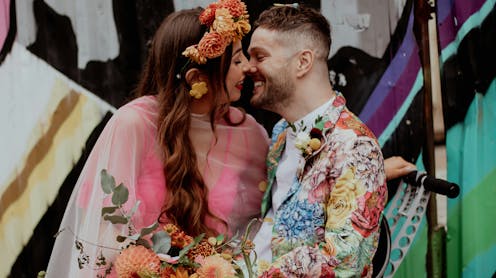
The family and friends are all gathered, wedding bells are ringing, and the bride walks down the aisle in her beautiful bubblegum pink wedding dress.
Twenty years ago, this would have raised some eyebrows. But not so much now, as a growing number of women opt to buck the traditional bridal gown for more unique and colourful finery.
The origins of the white wedding dress
The white wedding gown tradition wasn’t cemented in the West until the 19th century. Before then, brides across Europe wore all manner of hues on their wedding day, including reds, blues, yellows, and even black (often in cases where the bride was mourning a close family member).
During the Victorian era (1837–1901), fashion trends were heavily influenced by the wealthy, and especially by the royal families. So it was Queen Victoria’s 1840 wedding that truly kicked off the white wedding gown trend.
In a bridal context, the colour white often came to be associated with “purity” – symbolism that can be traced back to ancient Rome, where white was worn by brides and by “vestal virgins” – the priestesses who served in the cult of Vesta, the goddess of the hearth.
In the decades following Queen Victoria’s wedding, we continued to see British royal brides adorned in shades of white, and particularly ivory, cementing what a traditional wedding dress should look like.
Breaking the mould
That said, this tradition might now be on its way out, reflecting broader shifts in societal attitudes towards marriage.
Figures from the Australian Bureau of Statistics show a steady long-term decline in the percentage of people getting married – as well as an increase in the median marriage age for both men and women.
Australia has also become increasingly multicultural. And with more multicultural marriages comes a unique blend of marriage traditions and colour palettes. For instance, in many Asian cultures, including Chinese and Vietnamese, it is customary to wear red due to its positive associations with luck, joy and happiness.
Religious adherence also has a role to play in the overall aesthetic of modern weddings. A growing number of young Australians are identifying as non-religious, which means they’re less likely to partake in a church wedding with a puffy white tulle dress.
Without religious protocols to follow, young couples are expressing their own youthful values at their weddings – and this often includes a more laid-back approach to dressing.
The legalisation of same-sex marriage in 2017 has also prompted bridal stores to cater to a wider market by offering a greater variety of non-traditional colours and silhouettes.
Meanwhile, social media and the rise of celebrity culture adds pressure to think outside the box.
For decades, celebrities have been innovators delivering shock value on their special day. Back in 1954, Marilyn Monroe wore a dark brown suit to her second wedding with Joe DiMaggio. Some 15 years later, Audrey Hepburn got married in a pink Givenchy minidress.
Today’s stars are following suit. In 2018, singer Mandy Moore donned a pink dress on her wedding day, while model Emily Ratijowsky chose a bright yellow Zara pantsuit.
In Australia, designers have spent decades distancing themselves from the typical European influence to forge their own fashion identity. One such person, Akira Isogawa, helped develop the bridal landscape throughout the 1990s, by pushing the boundaries of the “traditional bride”.
The Japanese-born designer brings his own flavour to bridal dresses by infusing them with Eastern elements such as different coloured silks, hand-embroidered motifs, unique beading and even woven fabric. He has also showcased his designs internationally, helping expand Australia’s fashion identity on a world stage.

Impacts on the industry
Despite the move away from traditional wedding gowns, bridal stores are expected to grow their revenue over the next few years. And the industry as a whole will likely continue to contribute to overconsumption by capitalising on the shift away from tradition.
Many stores have changed their business model to cater for more women picking off-the-rack gowns due to financial pressures. According to one industry report, about 17% of brides in 2024 had a custom wedding dress made, compared to 75% purchasing a dress off-the rack, and 7% purchasing a second-hand dress.
At the same time, a number of new fashion technologies are supporting the next generation of onshore manufacturing by allowing the creation of hyper-personalised dresses. In the future, it may be common for brides to co-design their off-the-rack wedding dress.
Recycled and upcycled bridal dresses have been slow to gain popularity, despite growing pressure on the industry to be more sustainable.
A broader cultural shift
This may just be the tip of the iceberg of the non-traditional bridal movement. Australian weddings are starting to take their own shape, becoming less about formality and more about celebrating what couples value the most.
While we won’t see every bride walking down the aisle in colours like fuchsia pink, we can expect to see more brides opt for softer pastels over shades of white.
Ideally, the bridal industry would slow down in adopting new trends and instead focus on “localism” practices, wherein consumers are looped into the process of how their clothes are made. This would emphasise sustainability through local production and consumption, while also contributing to local fashion cultures.
Authors: Jye Marshall, Lecturer, Fashion Design, School of Design and Architecture, Swinburne University of Technology


















