

Earth is heading for 2.7°C warming this century. We may avoid the worst climate scenarios – but the outlook is still dire
- Written by: Sven Teske, Research Director, Institute for Sustainable Futures, University of Technology Sydney
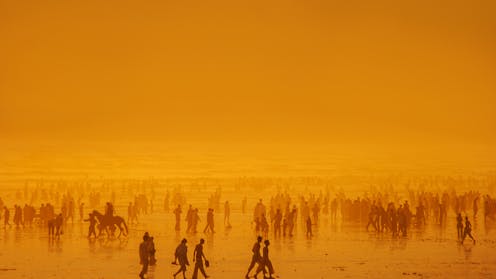
Is climate action a lost cause? The United States is withdrawing from the Paris Agreement for the second time, while heat records over land and sea have toppled and extreme weather events have multiplied.
In late 2015, nations agreed through the Paris Agreement to try to hold warming well under 2°C and ideally to 1.5°C. Almost ten years later, cutting emissions to the point of meeting the 1.5°C goal looks very difficult.
But humanity has shifted track enough to avert the worst climate future. Renewables, energy efficiency and other measures have shifted the dial. The worst case scenario of expanded coal use, soaring emissions and a much hotter world is vanishingly unlikely.
Instead, Earth is tracking towards around 2.7°C average warming by 2100. That level of warming would represent “unprecedented peril” for life on this planet. But it shows progress is being made.
How did we get here?
Global greenhouse gas emissions have risen since industrialisation began around 1850. Carbon dioxide (CO₂) is far and away the most common greenhouse gas we emit, while methane and nitrous oxide also play a role. These gases trap the sun’s heat in the atmosphere, preventing it from radiating back out to space.
In 2023, 41% of the world’s energy-related CO₂ emissions came from coal, mainly for electricity generation. Some 32% came from burning oil in road vehicles, and 21% from natural gas used for heating buildings and industrial processes.
The world is certainly feeling the effects. The World Meteorological Organization confirmed 2024 was the hottest year on record, temporarily hitting 1.5°C over the pre-industrial era. In turn, the world suffered lethal heatwaves, devastating floods and intense cyclones.

How are we tracking?
In 2014, the world’s peak body for assessing climate science – the Intergovernmental Panel on Climate Change – began using four scenarios called Representative Concentration Pathways (RCPs). These four big picture climate scenarios are based on what actions humanity does or doesn’t take. They comprise:
- rapid climate action, low emissions (RCP 2.6)
- two scenarios of some action and medium emissions (RCP 4.5 and 6.0)
- no action, high emissions (RCP 8.5).
The numbers refer to how many more watts of heat strike each square metre of the planet.
Of these four, only the RCP 2.6 scenario is compatible with the Paris Agreement’s goal of holding climate change well under 2˚C.
But Earth is tracking towards somewhere between RCP 2.6 and 4.5, which would translate to about 2.7°C of warming by 2100.
IPCC experts also developed five pathways of possible social, economic and political futures to complement the four scenarios.
Of these pathways, we are tracking closest to a middle of the road scenario where development remains uneven, the intensity of resource and energy use declines, and population growth levels off.
While effective, these scenarios are now more than a decade old and need to be updated. In response, my colleagues and I produced the One Earth Climate Model to outline rapid pathways to decarbonise. We set an ambitious carbon budget of 450 gigatonnes of CO₂ before reaching net zero – a pathway even more ambitious than the RCP 2.6.
The US, European Union and China together represent about 28% of the global population, but are responsible for 56% of historic emissions (926 gigatonnes) . The pathways compatible with 1.5°C give them a remaining carbon budget of 243 Gt CO₂. China would require the largest carbon budget to reach decarbonisation.
For this to happen, by 2050, the world would have to be 100% powered by clean sources and phase out fossil fuel use. This would limit global warming to around 1.5°C, with a certainty of just over 50%. We would also have to end deforestation within the same timeframe.
Emissions peak – are we there yet?
Emissions of carbon dioxide and other greenhouse gases have still not plateaued, despite sharply increasing renewable electricity generation, battery storage and lower-cost electric vehicles.
But there has been real progress. The EU says its emissions fell by 8.3% in 2023 compared to 2022. Europe’s net emissions are now 37% below 1990 levels, while the region’s GDP grew 68% over the same period. The EU remains on track to reach its goal of reducing emissions by at least 55% by 2030.
Australia’s emissions fell by 0.6% last year. The country is now 28.2% below June 2005 levels, which is the baseline set for its Paris Agreement goal of a 43% reduction by 2030.
In the US, emissions are still below pre-pandemic levels and remain about 20% below 2005 levels. Since peaking in 2004, US emissions have trended downward.
The world’s largest emitter, China, is finally cutting its emissions. Huge growth in renewables has now led to the first emissions drop on record, despite surging demand for power. This is good news. For years, China’s domestic emissions remained high despite its leading role in solar, wind, EVs and battery technology.
China produces almost one-third (31%) of the world’s energy-related carbon emissions – not least because it is the workshop of the world. Every cut China makes will have a major global effect.
According to the IPCC, limiting warming to around 1.5°C requires global emissions to peak before 2025 at the latest. It now looks like the peak may occur this year.
Despite daily negative news, the decarbonisation train has left the station. In 2024, renewables accounted for more than 90% of growth in electricity production globally. Electric vehicles became cost competitive, while heat pumps are developing fast and solar is on a winning streak.
So, is it too late to save the climate? No. The technologies we need are finally cheap enough. The sooner we stop climate change from worsening, the more disasters, famine and death we avert. We might not manage 1.5°C or even 2°C, but every tenth of a degree counts. The faster we make the shift, the better our climate future.
Authors: Sven Teske, Research Director, Institute for Sustainable Futures, University of Technology Sydney


















