

Antarctica’s sea ice is changing, and so is a vital part of the marine food web that lives within it
- Written by: Jacqui Stuart, Postdoctoral Researcher in Marine Ecology, Te Herenga Waka — Victoria University of Wellington
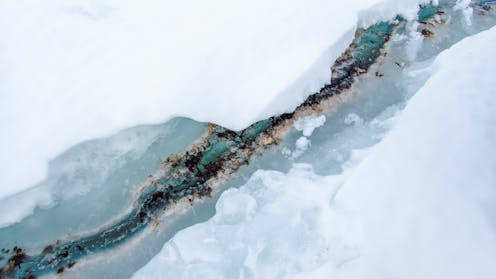
Antarctica is the world’s great cooling unit. This vital part of Earth’s climate system is largely powered by the annual freeze and melt of millions of square kilometres of sea ice around the continent.
Our research shows changes to this annual freeze cycle in McMurdo Sound can lead to shifts in the diversity of algal communities that live within the sea ice.
At the start of the southern winter, as sea water begins to freeze, it expels salt and forms heavy and very cold brine. This sinks to the seafloor, ultimately forming what’s known as Antarctic Bottom Water. This is then pumped out to the rest of the world through several major oceanic currents.
Historically, this cycle meant that Antarctica effectively doubled in size and the continent was surrounded by an enormous apron of sea ice at the peak of winter. But the changing climate is shifting this annual cycle.
For the past decade, Antarctic sea ice has been in decline. It hasn’t been a steady trend, but each year since 2016 less sea ice has formed compared to historic averages.
Antarctica’s annual maximum sea ice extent in September 2023 was the lowest on record, with approximately 1.75 million square kilometres less sea ice than normal – an area equivalent to about 6.5 times the land area of Aotearoa.
Change happening at the continental scale is usually well documented and publicised. However, smaller, more local changes are also occurring in places such as McMurdo Sound, the home of Aotearoa New Zealand’s only Antarctic outpost.
For four of the last seven years, unseasonable winter southerly storms have been associated with significant delays in the timing of sea-ice formation within McMurdo Sound.
Where measurements were taken during these “unusual” years, the sea ice that formed later was thinner (1.5 metres compared to 2.5 metres) and had less snow cover (about 5 centimetres versus 15-30 centimetres) compared to the same locations during “typical” years.
Icy reefs and algal meadows
Another type of ice, known as “platelet ice”, also appears to be affected by the later formation of sea ice.
A layer of platelet ice extends into the ocean below the sea ice in some regions around Antarctica, including McMurdo Sound. It is a fragile lattice structure made up of loosely consolidated plate-shaped ice crystals, creating an upside-down reef-like structure.
The resulting protective environment is a hot spot for primary productivity – microscopic algae that support the base of the marine food web. When sea ice forms later, the platelet ice doesn’t have as much time to accumulate beneath and can be metres thinner than beneath older ice (down to about 1 metre from more than 3 metres).
Why should we care about sea ice? Because, it isn’t just a frozen, lifeless sheet expanding out from the continent, broken by the odd silhouette of a seal or a gathering of penguins on the top.
Beneath the desolate surface, where ice meets water, green meadows of microalgae can spread out as far as the eye can see.
Microalgae are single-cell, plant-like organisms that use sunlight to create energy. Similar to land-based meadows, they provide food for many other creatures. In winter, when other sources of food can be scarce, this sea-ice superstore plays a crucial role in feeding other inhabitants of McMurdo Sound.
Diminishing algal diversity under thinner sea ice
Our research indicates that when the sea ice forms later, microalgal communities living within the ice are also different. In later-forming sea ice, these vital communities are less diverse and dominated by fewer species.
Some species usually abundant in earlier-forming sea ice are absent or in low numbers when the sea ice forms later. Interestingly, though, it appears the quantity of microalgae in later-forming ice conditions is similar to “typical” ice. However, instead of being spread out through almost three metres depth of the platelet layer, they are crammed into a metre-thick habitat instead.
These microscopic snacks are diverse in shape, size and the roles they play in the ecosystem. It can help to think of microalgal communities as the produce section in the supermarket. Each type has preferred growing conditions and different nutritional values, producing varied quantities of important resources such as proteins, carbohydrates and fatty acids.
Imagine, one winter the weather is different and all that grows are cabbages and sweet peas. These won’t provide you with all the nutrients you need. This mirrors the problem when there is less diversity at the base of the food web. As the microalgal communities shift in the ways our research has observed, the quantity and quality of resources they provide are likely to change, too.
These early signals matter. They foreshadow wider ecological impacts, especially, if Antarctic sea ice continues to thin, retreat or form later each year.
We need more research to establish the nuances of these changes and the extent of their impact. But it is worth remembering that what happens at the base of the food web in Antarctica doesn’t necessarily stay there. These changes could ripple through ecosystems further afield with the potential to affect key fisheries in the Southern Ocean.
By paying close attention now, we have a chance to understand and adapt, to ensure ecosystems stay resilient in a changing world.
Authors: Jacqui Stuart, Postdoctoral Researcher in Marine Ecology, Te Herenga Waka — Victoria University of Wellington


















