

What is uranium enrichment and how is it used for nuclear bombs? A scientist explains
- Written by: Kaitlin Cook, DECRA Fellow, Department of Nuclear Physics and Accelerator Applications, Australian National University
Late last week, Israel targeted three of Iran’s key nuclear facilities – Natanz, Isfahan and Fordow, killing several Iranian nuclear scientists. The facilities are heavily fortified and largely underground, and there are conflicting reports of how much damage has been done.
Natanz and Fordow are Iran’s uranium enrichment sites, and Isfahan provides the raw materials, so any damage to these sites would limit Iran’s ability to produce nuclear weapons.
But what exactly is uranium enrichment and why does it raise concerns?
To understand what it means to “enrich” uranium, you need to know a little about uranium isotopes and about splitting the atom in a nuclear fission reaction.
What is an isotope?
All matter is made of atoms, which in turn are made up of protons, neutrons and electrons. The number of protons is what gives atoms their chemical properties, setting apart the various chemical elements.
Atoms have equal numbers of protons and electrons. Uranium has 92 protons, for example, while carbon has six. However, the same element can have different numbers of neutrons, forming versions of the element called isotopes.
This hardly matters for chemical reactions, but their nuclear reactions can be wildly different.
The difference between uranium-238 and uranium-235
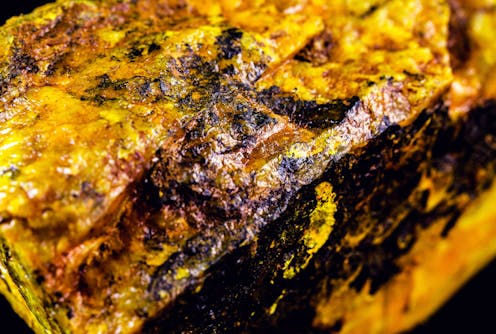
When we dig uranium out of the ground, 99.27% of it is uranium-238, which has 92 protons and 146 neutrons. Only 0.72% of it is uranium-235 with 92 protons and 143 neutrons (the remaining 0.01% are other isotopes).
For nuclear power reactors or weapons, we need to change the isotope proportions. That’s because of the two main uranium isotopes, only uranium-235 can support a fission chain reaction: one neutron causes an atom to fission, which produces energy and some more neutrons, causing more fission, and so on.
This chain reaction releases a tremendous amount of energy. In a nuclear weapon, the goal is to have this chain reaction occur in a fraction of a second, producing a nuclear explosion.
In a civilian nuclear power plant, the chain reaction is controlled. Nuclear power plants currently produce 9% of the world’s power. Another vital civilian use of nuclear reactions is for producing isotopes used in nuclear medicine for the diagnosis and treatment of various diseases.
What is uranium enrichment, then?
To “enrich” uranium means taking the naturally found element and increasing the proportion of uranium-235 while removing uranium-238.
There are a few ways to do this (including new inventions from Australia), but commercially, enrichment is currently done with a centrifuge. This is also the case in Iran’s facilities.
Centrifuges exploit the fact that uranium-238 is about 1% heavier than uranium-235. They take uranium (in gas form) and use rotors to spin it at 50,000 to 70,000 rotations per minute, with the outer walls of the centrifuges moving at 400 to 500 metres per second.
This works much like a salad spinner that throws water to the sides while the salad leaves stay in the centre. The heavier uranium-238 moves to the edges of the centrifuge, leaving the uranium-235 in the middle.
This is only so effective, so the spinning process is done over and over again, building up the percentage of the uranium-235.
Most civilian nuclear reactors use “low enriched uranium” that’s been enriched to between 3% and 5%. This means that 3–5% of the total uranium in the sample is now uranium-235. That’s enough to sustain a chain reaction and make electricity.
What level of enrichment do nuclear weapons need?
To get an explosive chain reaction, uranium-235 needs to be concentrated significantly more than the levels we use in nuclear reactors for making power or medicines.
Technically, a nuclear weapon can be made with as little as 20% uranium-235 (known as “highly enriched uranium”), but the more the uranium is enriched, the smaller and lighter the weapon can be. Countries with nuclear weapons tend to use about 90% enriched, “weapons-grade” uranium.
According to the International Atomic Energy Agency (IAEA), Iran has enriched large quantities of uranium to 60%. It’s actually easier to go from an enrichment of 60% to 90% than it is to get to that initial 60%. That’s because there’s less and less uranium-238 to get rid of.
This is why Iran is considered to be at extreme risk of producing nuclear weapons, and why centrifuge technology for enrichment is kept secret.
Ultimately, the exact same centrifuge technology that produces fuel for civilian reactors can be used to produce nuclear weapons.
Inspectors from the IAEA monitor nuclear facilities worldwide to ensure countries are abiding by the rules set out in the global nuclear non-proliferation treaty. While Iran maintains it’s only enriching uranium for “peaceful purposes”, late last week the IAEA board ruled Iran was in breach of its obligations under the treaty.
Authors: Kaitlin Cook, DECRA Fellow, Department of Nuclear Physics and Accelerator Applications, Australian National University


















