

Arts education helps school students learn and socialise. We must invest in it
- Written by: Sandra Gattenhof, Associate professor, Queensland University of Technology
There has been renewed scrutiny in recent weeks about spending on private school capital works. Alongside science labs, sporting fields, and “wellbeing spaces”, many of Australia’s richest schools feature elaborate performing arts centres.
Melbourne’s Wesley College’s redevelopment, for example, includes a $21 million music school and $2.3 million visual arts and design precinct. Meanwhile, programs for disadvantaged students who show artistic talent have relied on volunteers and small grants.
Usually comparisons between public and private schooling focus on academic or sporting outcomes - but what of creative education?
Increased engagement in arts education has wide ranging benefits for academic and social outcomes – and those most at risk have the most to gain. Research has long shown the arts offer many benefits beyond “art for arts sake”, with health, social and economic benefits which offer both private and public value.
Confidence gained from arts programs, and their capacity to support healthy risk taking improves academic outcomes and student behaviour. For teachers, the arts can be a way of connecting to children who struggle with conventional approaches.
An uncommon experience
Last year, the ABC’s Don’t Stop The Music showcased the work of the inspirational principal and staff at Challis Primary School, a disadvantaged school in the Perth suburbs.
Through a public donation program, the school was able to provide students with musical instruments to loan and access to music education experts. Over the series, we saw how engagement in the arts supports academic, social and emotional development – as well as redressing issues such as attrition and disengagement.
The program was lauded by school staff, parents and children, but it is not the common experience of students in Australian public schools.
Measuring creativity and the effects of arts engagement is not simple. But this will be the challenge for evaluators such as Programme for International Student Assessment, which will track creativity and critical thinking from 2021. The 2015 Australian PISA scores across reading literacy, mathematical literacy and scientific literacy placed in the middle performance range. An outcome of the measuring creativity may result in greater funding to public schools to lift the score depending on the outcome.
A non-national Australian curriculum
In 2011, then Minister of the Arts Peter Garrett enshrined arts into the Australian Curriculum.
This historic move meant all Australian children and young people would be entitled to arts education from their first moment of early schooling to the end of year 10.
But the implementation of this arts curriculum has not been fully realised. This is a result of two factors: the lack of training in arts delivery in tertiary teaching courses across Australia, and the lack of infrastructure and resources in public schools.
Don’t Stop The Music starkly showed the results of underfunding and sub-optimalfacilities for arts programs. The music program would not have been successful without the donations of instruments and additional support from external experts.
By contrast, the 2011 documentary Mrs Carey’s Concert focused on the music program at MLC School in Burwood, NSW – with its double-storey music centre – and the students’ biennial performance at the Sydney Opera House. In Don’t Stop the Music, students from Challis Primary School made do with practising in the library, staff room, or whatever empty space they can find.
Their support didn’t come from a multimillion dollar venue but from the tenacity of teachers who believed deeply in their students.
Rights of the Child
The United Nations’ Convention on the Rights of the Child states that all governments:
shall respect and promote the right of the child to participate fully in cultural and artistic life and shall encourage the provision of appropriate and equal opportunities for cultural, artistic, recreational and leisure activity.
Scott Rankin, CEO and Creative Director of Big hART, one of Australia’s leading arts and social change organisations, takes this further:
Culture is far from recreational, elitist or optional. It is an issue of justice, which plays out in pragmatic ways, as an essential service.
The centrality of the arts in the lives of children and young people is key to developing entrepreneurship, social intelligence, problem solving and critical thinking skills, which are becoming increasingly essential as preparation for work in the 21st century.
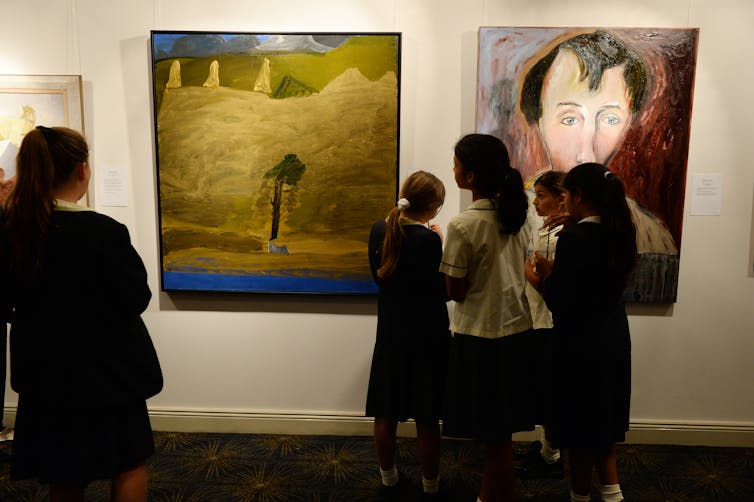 Students gain more from creative education than just art appreciation.
Dan Himbrechts/AAP
Students gain more from creative education than just art appreciation.
Dan Himbrechts/AAP
The career outcomes for students who had access to state-of-the-art creative facilities versus those who did not have yet to be quantified in Australia. In 2016, British research showed that award-winning actors there were over twice as likely to have been educated at an independent school. Conversely, this was not true of popular musicians.
If inequitable education funding continues, Australia’s children and young people in low socio-economic or marginalised communities will not have the creative skills and innovation mindsets to see them become successful and productive citizens both now and in the future.
It’s time to reprioritise funding and direct it to Australia’s creative kids who could most benefit.
Authors: Sandra Gattenhof, Associate professor, Queensland University of Technology


















