

Google AI


Modern Australian

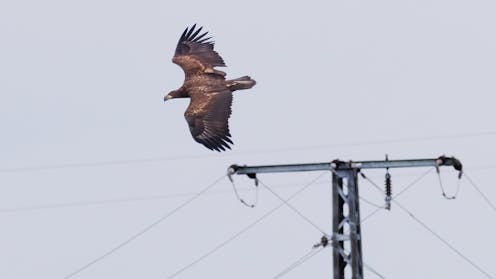
Overhead power lines kill millions of birds a year. Scientists found a way to help cut the devastating toll

  • Written by: James Pay, Postdoctoral Research Fellow, School of Natural Sciences, University of Tasmania
Overhead power lines kill millions of birds a year. Scientists found a way to help cut the devastating toll

Millions of birds are killed by power lines each year. Sometimes they collide with the lines when flying and are either electrocuted or fatally injured. Other times they are electrocuted when perching on power poles.

Power line collisions are one of the leading causes of injury and death for large birds of prey. In Tasmania, an endangered population of wedge-tailed eagles lost 110 individuals to power lines between 2017 and 2023.

New research I led, the first of its kind in Australia, used GPS tracking data to predict which power lines were most dangerous for these eagles.

We hope the findings will help protect birds and other wildlife from overhead wires as electricity networks expand.

Power lines and birds: a fatal mix

Overhead power lines span more than 90 million kilometres of our planet. The network keeps growing as demand for electricity rises and renewable energy projects expand into new areas.

In the United States alone, between 12 and 64 million birds are estimated to be killed by power lines each year. These deaths can damage populations of some species.

Birds can also be killed when perched on poles – for example, if they stretch their wings and connect two energised parts.

A worker attaching a device to a power line.
Objects attached to power lines can make them more visible to birds. TasNetworks, Author provided (no reuse)

The economic costs can be considerable – disrupting electricity services, causing fires and damaging infrastructure.

Energy companies can reduce the risks through various measures. They include attaching objects to power lines to make them more visible to birds, and redesigning poles to reduce the likelihood of electrocution.

But these solutions can be expensive, and challenging to implement on a large scale. So, prioritising the riskiest power lines is the most cost-effective solution.

The presence of bird carcasses has traditionally been used as a way to identify high-risk power lines. But this approach can give a biased picture, because people are more likely to find dead birds in accessible, less vegetated areas.

New research by my colleagues and I explores a different approach.

Tracking Tasmania’s wedgies

We used GPS tracking of animal movements to predict which power lines were most dangerous for Tasmania’s wedge-tailed eagles.

GPS tracking can record a bird’s location, altitude and speed – as frequently as every few seconds. This detailed information can show how birds behave around power lines, helping identify when and where they’re most at risk.

In 2017, my colleagues and I attached lightweight GPS trackers to 23 Tasmanian wedge-tailed eagles, then analysed six years of tracking data. We identified more than 9,400 power line crossings at risky altitudes.

We then linked these crossings to different landscape features. This allowed us to build a model predicting where eagles are most likely to cross power lines at dangerous heights across Tasmania.

Power line crossings were most likely at or near open land, forest edges, rural residential developments, wet forest and freshwater sources. Risky crossings peaked in autumn and winter.

Almost half of known collisions occurred on the 20% of Tasmania’s power line network with the highest risk.

Importantly, we tested our predictions against locations where eagles had collided with power lines. The model accurately predicted many of these collision sites, confirming that areas with more low-flying eagle activity carry a greater risk of collisions.

This means our model can not only pick up on known hotspots, but can reveal risky areas that would be missed if carcass records were used exclusively to identify risk. It also means dangerous power lines can be identified before birds have died.

A flock of birds flying over power lines.
GPS information can show how birds behave around power lines. Julian Stratenschulte/picture alliance via Getty Images

A powerful new tool

Our research is part of a growing number of studies examining animal movement to improve wildlife management.

Risky animal behaviours have been monitored using GPS trackers and then used to inform models predicting the risk of wildlife interactions with road vehicles, wind turbines and aircraft.

Recently, GPS tracking data was used in Europe, North Africa and North America to map and reduce wildlife risks around power lines.

Like ours, these studies can help guide where devices should be attached to lines and inform where new lines are built.

GPS tracking data offers a powerful tool to guide the sustainable design of power lines, target mitigation efforts, and make our expanding energy infrastructure safer for wildlife.

Authors: James Pay, Postdoctoral Research Fellow, School of Natural Sciences, University of Tasmania


Read more https://theconversation.com/overhead-power-lines-kill-millions-of-birds-a-year-scientists-found-a-way-to-help-cut-the-devastating-toll-258295

Pool and Deck Design: How to Plan the Perfect Outdoor Living Space for Your Sydney Home

For many Australians, the backyard is where life happens. Summer barbecues, weekend swims and long evenings outdoors are all part of the lifestyle, ...

Is Solar Pool Heating Worth It? What Sydney Homeowners Should Know

There's nothing quite like a backyard pool on a hot Sydney day. But once autumn rolls in, many pools sit unused for months because the water is simp...

Planning a Luxury House Move: A Week-by-Week Timeline for Prestige Sydney Homes

Selling or buying a prestige home is a major milestone. Whether it's a waterfront residence in Birchgrove, a grand Federation home in Haberfield or ...

Downsizing or Upgrading Your Caravan? Here's How to Sell It Without the Hassle

Selling a caravan can feel like a major task, especially when you are unsure about its value, paperwork, or how to find a buyer. Whether you are dow...

The Best Overseas Adventure Holidays for Australians Who Love the Outdoors

Australia offers no shortage of incredible outdoor experiences, but sometimes the best way to satisfy your sense of adventure is to head overseas. A...

Cape Town Wine Shuttle: Winelands Tasting & Tours

Embark on an unforgettable journey through the picturesque Cape Winelands, where world-class wines and breathtaking scenery await. Our Cape Town Win...

Why Giant Rats Tail Grass Keeps Coming Back After Spraying

Giant Rats Tail Grass (GRT) is one of the most frustrating pasture weeds for farmers and lifestyle property owners. You spray an infested area, see th...

When Custom Cardboard Boxes Make Sense for Your Business

Custom cardboard boxes can be useful when a standard carton does not fit a product, packing method or presentation requirement particularly well. A ...

Virtual Livestock Fencing and GPS Tracking: Improving Visibility Across Cattle Properties

What Virtual Livestock Fencing Means for Modern Cattle Management Managing cattle across extensive properties requires more than knowing where anim...

Sydney Pawnbrokers Explained: How Hocking Your Car Actually Works

Sometimes you need cash, and you need it soon. If you own a car, you may already have a way to get it. That's what people mean when they say they've...

Moving Interstate from the Gold Coast to Brisbane (or Back)? What Removalists Wish You Knew First

Have you talked to anyone who’s done the move? They say the same thing: the drive up the M1 is the easy part. It's everything around it that catches...

Why the Spring School Holidays Are a Great Time to Visit Coffs Harbour

The spring school holidays are a good time to spend a few days on the Coffs Coast. The weather is starting to warm up, there is plenty to do outdoor...

What to Do When an Older Car Is No Longer Worth Keeping in Melbourne

Ever looked at another repair quote and wondered whether your old car is still worth the trouble? It is a common turning point for Melbourne motoris...

Your Baby's First Year: A Local Guide to Feeding, Sleep, and When to Get Extra Support

Ask ten parents in a Brisbane mothers' group how their baby is feeding or sleeping, and expect ten different answers.  Someone's baby sleeps throug...

Kitchen and Laundry Makeover Ideas That Don't Require a Full Renovation

Full kitchen renos are expensive — and most people don't actually need one.  They need the kitchen to stop looking like it's stuck in 2009, or they...

How Technology Is Reshaping the Modern Australian Commercial Kitchen

The commercial kitchen has always been shaped by technology. Refrigeration changed how ingredients could be stored, modern ventilation transformed k...

The Number on a Roller Blind Fabric That Nobody Explains

Somewhere in the fabric book, next to the colour name, there is a percentage. Three per cent. Five per cent. Ten per cent. Nobody explains it, most c...

What’s Trending in Men’s Jewellery This Father’s Day!

Finding a Father’s Day gift that feels personal, stylish and genuinely wearable is not always easy. While socks and novelty mugs have traditionally ...















