

A look into the decades of labour that helped bring LGBTQIA+ stories to Australian TV
- Written by: Damien O'Meara, Lecturer, School of Media and Communication, RMIT University
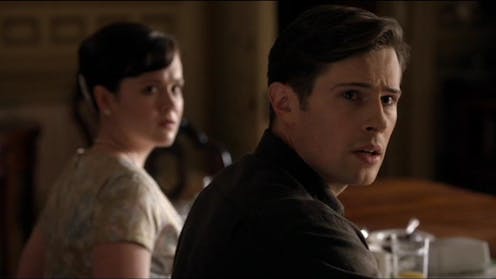
When the Seven Network’s Bevan Lee created the story of James Bligh, a gay man living in 1950s Australia, in A Place to Call Home (2013–18), it was the culmination of a lifetime of work in commercial TV.
Lee’s success shows the importance of queer labour in getting queer stories in Australian television.
When I interviewed Lee for my research, his advice to emerging creatives was: “Don’t just, for the sake of being representative, drop one [queer character] into a show”.
“For the first 30 years of my career, and on most of our shows […] I did that, because it was the only way of getting them in,” he said.
I would argue Lee spent his career blazing the trail that makes this advice possible.
He is one of ten lesbian, gay and bisexual television creatives and executives featured in my new study about the motivations, barriers and labour behind the queer stories that appear on Australian screens.
These industry leaders are working in what gender and sexuality studies scholar Margot Canaday describes as the “straight work world”. My research identifies the hurdles this world can present to developing queer stories for mainstream TV, as well as how queer industry leaders manage to jump them.
Read more: We studied two decades of queer representation on Australian TV, and found some interesting trends
What motivates queer TV professionals?
Australian TV is commercial in nature; even our public service broadcasters need to think about ratings.
The motivations of the lesbian, gay and bisexual TV professionals I interviewed were embedded in this commercial mindset.
They had two, often overlapping, motivations. One was “to tell engaging, dramatically truthful stories” for commercial success. The other was to see themselves and their communities represented onscreen.
According to screenwriter David Hannam, queer perspectives offer “the story, or the version of the story, that you’ve never seen before”. But this story has to be commercial – finding universal appeal in that specific experience.
My interviewees told me they used their own motivation and experiences to achieve commercial outcomes. They might pursue a story they themselves would have liked to see while growing up.
Or, they might take an opportunity to challenge troubling tropes by being in the room and contributing their perspective. One such trope is the troubling practice of unnamed bisexuality. This is where a bisexual character’s sexuality is referred to as “gay” or “straight”, and changes according to their partner’s gender.
Screenwriter and director Julie Kalceff told me her series First Day (2020–22) was inspired by the experience of a trans child, and their parent, who she personally knew – and the knowledge that such a story onscreen could help others like them.
Barriers to queer stories
One major challenge to telling queer stories on Australian TV was (and is) the long-held industry perception that such stories lack broad audience appeal.
Australia has a small television market, which until 2005 was limited to five free-to-air channels and one PayTV provider (Foxtel).
This meant intense competition and less niche programming, including fewer queer stories, compared to other dominant markets such as the United States and United Kingdom.
Even since the introduction of the digital signal and multichannels (secondary channels such as ABC2) from 2005, and streaming from 2015, this limitation has taken time to ease.
The creator of The Newsreader (2021–25), Michael Lucas, said there was a perception within the industry that including queer stories “would cause massive, cataclysmic dips in your ratings”.
My interviews reveal this perception stood as a key barrier to queer TV storytelling for decades. And these barriers can still come up today, at a time when the TV distribution landscape is becoming increasingly fractured due to global streaming.
The labour of seeing ourselves
My study found queer labour has been crucial to the successful development of queer stories for Australian TV.
Outland (2012) creators Adam Richard and John Richards self-funded a short film and sent it around the festival circuit to prove an audience. This was key to getting a production house onboard, securing funding and getting the series commissioned by the ABC.
Similarly, Julie Kalceff produced Starting From … Now (2014–16) as a web series, before making the rare leap to broadcast television.
Out industry leaders have been champions of queer TV projects. Benjamin Law, creator of The Family Law (2016–19), noted how Tony Ayres had “already been doing the work […] broadening out representation and diversity and inclusion”.
He explained how Ayres – a gay, Chinese television industry leader – was able to champion his comedy-drama about an Asian family with a gay child in suburban Queensland.
Queer labour is also shifting, as audiences grow to expect authentic representation onscreen and in writers’ rooms.
While it can be a challenge for queer creatives to get those crucial early onscreen credits, especially with streaming giants affecting local career pathways, established queer creatives and executives are taking on the task of bringing in new and underrepresented voices.
The question now is: what will queer labour look like in the future? Will distinctly Australian queer stories be prioritised in the age of streaming giants? And how might a lack of local content quotas contribute to the future of queer Australian TV stories?
Authors: Damien O'Meara, Lecturer, School of Media and Communication, RMIT University


















