Changes are brewing in the Indian Ocean. Does this mean Australia should get ready for a soggy spring?
- Written by Andrew King, Associate Professor in Climate Science, ARC Centre of Excellence for 21st Century Weather, The University of Melbourne
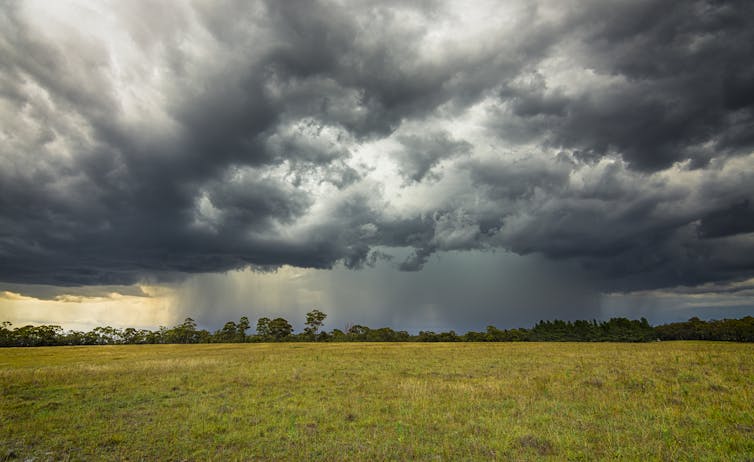
As spring in Australia nears and the days get longer, you might be wondering what the rest of the year holds for our weather.
There are signs that changes in the Indian Ocean will bring a few wet months to our part of the world. Specifically, the Indian ocean may be entering a negative “dipole” phase.
When this happens, the tropical eastern part of the ocean is warmer than average, and the tropical western part is cooler than average.
These conditions influence moisture levels and affect circulation in the atmosphere, raising the probability of supercharged spring rains across much of Australia.
But the devil’s in the detail – and it’s too early to say all of Australia is definitely in for a drenching.
Looking for clues in the ocean
After early autumn heat, Australia has, on average, experienced a warmer-than-normal winter to date.
July was Australia’s second-coldest in a decade. But under climate change, our winters are gradually warming. So the July just gone was considerably warmer than the typical July of the 20th century.
When it comes to rain, this winter has been fairly average so far. Parts of South Australia, Victoria, Tasmania and Western Australia are, however, in drought with some of the lowest multi-year rainfall totals on record.
Recent falls have helped in some drought-stricken areas, but more is needed.
So what do the next few months hold? For clues, we can look to the oceans around Australia.

A nation girt by sea
Australia is surrounded by the Pacific, Indian and Southern oceans. That means our climate is heavily influenced by the seas around us.
Warm or cool conditions on the sea surface often persist for long periods. This affects where weather systems form and move, and where moisture builds in the atmosphere.
In turn, this helps drive changes in rainfall and temperatures on land over months or seasons. So, understanding and predicting these ocean conditions can be useful.
La Niña and El Niño events are the most well-known type of ocean variability to affect Australia.
During a La Niña, the west Pacific Ocean warms, increasing the likelihood of rain-bearing weather systems affecting Australia. In an El Niño, water warms further east in the Pacific and Australia is more likely to be drier.
At the moment, we’re in neither La Niña or El Niño conditions and the Pacific looks set to remain in a neutral state.
The Indian Ocean is a different story, though.

How the Indian Ocean shapes Australia’s weather
The Indian Ocean Dipole – or IOD for short – involves variations in tropical sea surface temperatures.
In negative IOD events, warmer waters build up in the east Indian Ocean, and cooler waters build in the west. In positive IOD events, the opposite occurs.
Negative dipoles typically make the air over much of Australia more moist, and make low pressure over the continent’s southeast more likely. This tends to bring wetter conditions to much of Australia’s southeast in late winter and early spring.
Currently, the Indian Ocean is in a neutral state. However, the Bureau of Meteorology’s outlook points to warmer waters building in the east Indian Ocean and, possibly, a negative IOD forming. This would mean a few wetter months ahead.
Outlooks by international organisations also suggest a negative IOD may become fully fledged.
 Much of eastern Australia is expected to be wetter than normal this spring. Western Tasmania and northwest Western Australia may buck that trend with a higher chance of drier than average conditions.
Bureau of Meteorology
Much of eastern Australia is expected to be wetter than normal this spring. Western Tasmania and northwest Western Australia may buck that trend with a higher chance of drier than average conditions.
Bureau of Meteorology
Indian Ocean Dipole events typically weaken in late spring and lose influence over Australian rainfall by November. But they can last longer.
In 2019, a positive IOD persisted into late spring and contributed to the very dry conditions that led into the Black Summer of 2019–20.
The Indian and Pacific Oceans are, of course, connected. Negative IOD events often accompany La Niña, and the two can reinforce each other to bring big rains to much of Australia.
But without a La Niña on the horizon, however, we can’t say with full confidence that Australia is in for a very wet few months, or that rainy conditions will persist into late spring.
A fast-evolving Indian Ocean
Overall, scientists know a lot less about the Indian Ocean Dipole than we do about La Niña and El Niño.
Under climate change, the Indian Ocean is rapidly warming, which is altering the IOD. But there’s more work to do before scientists fully understand this trend.
However, studies suggest if humanity’s high rate of greenhouse gas emissions continues, we’ll see more extreme IOD phases and changes in sea temperature patterns.
Already, reconstructions of the climate over the past millennium, using coral growth records, suggest we are experiencing more positive IOD events than in the past.
Variability in the Indian Ocean is important not only to Australia’s climate, but also to those of south and southeast Asia and east Africa. It’s imperative we build a clearer picture of the Indian Ocean Dipole to support climate adaptation efforts, including in some of the world’s most vulnerable regions.
More research is needed into how the IOD will change if we continue emitting greenhouse gases – or if we succeed in reaching net zero. Scientists also need to know how these changes might intersect with regional climates.
At the moment, our projections are still unclear – and this hampers our ability to adapt.
Authors: Andrew King, Associate Professor in Climate Science, ARC Centre of Excellence for 21st Century Weather, The University of Melbourne