

Why the Eureka flag and other ‘alternative national flags’ were claimed by anti-immigration protesters
- Written by: Clayton Chin, Associate Professor in Political Theory, The University of Melbourne
The recent violence and tension around the nationwide “March for Australia” anti-immigration rallies has pushed questions around migration, diversity and Australian national identity to the centre of public debate.
The march seems to have been attended by a wide spectrum of individuals united by concerns around “mass immigration” and the future of Australian political community. But the event was clearly organised, directed and motivated by far-right and neo-Nazi political groups intent on connecting their politics to wider political dynamics.
The duality of this politics is also exposed by the visual symbols of the march. Organisers did not release many details beforehand. However, they had emphasised one directive: “no foreign flags”.
The result was a sea of Australian flags, with two notable additions: the presence of the Eureka flag and, to a lesser extent, the Australian Red Ensign. The use of these symbols is part of an ongoing trend to link these flags to a politics opposed to immigration (or high immigration).
But why these flags? And what is the point of doing this?
The origins of the Eureka flag
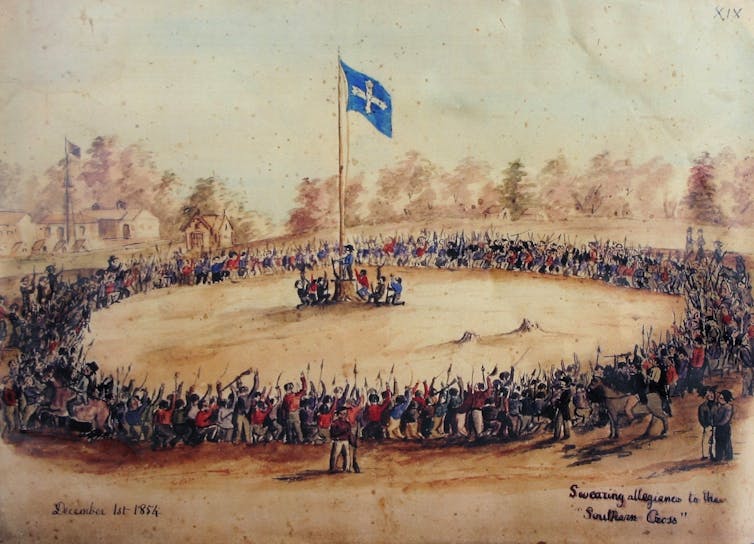
The Eureka flag originated in the Eureka Rebellion, an armed conflict between miners and government soldiers in Ballarat. Occurring in 1854, during Victoria’s Gold Rush, the miners used a hastily built fort, Eureka Stockade, in a battle that quickly saw the miners soundly defeated.
The miner’s doomed fight came to have larger political significance.

The miners were seeking greater political representation and the right to vote. As a result, their fight – and their flag – came to represent a foundational moment in Australian democracy, associated with ideas of political equality, democracy and liberty.
Historically, the flag has periodically been conflated with the Lambing Flat flag, which has some broad similarities and was used in anti-Chinese riots. Historians of the Eureka flag point out the differences, and the fact participants in the Eureka Rebellion were not all white.

Since at least 1942, the trade union movement in Australia has often employed the flag as a symbol of the ongoing fight for worker’s rights.
In recent years, with increasing frequency, the Eureka flag has been seen at far-right events. It has been employed as a symbol by the Australia First Party and used by white supremacists who marched in Ballarat on the 169th anniversary of the rebellion.
 The Eureka flag is seen during a rally organised by the Australian Council of Trade Unions in 2018.
AAP Image/Julian Smith
The Eureka flag is seen during a rally organised by the Australian Council of Trade Unions in 2018.
AAP Image/Julian Smith
Alternative national flags
This use of the Eureka flag replicates the use of “alternative national flags” by contemporary anti-immigration and government-sceptical protest movements around the world.
In the United States, the Confederate flag has been used to represent hostility to the American federal government and support for white supremacy.
 The Confederate flag was on display at the US Capitol riots, January 6 2021.
Saul Loeb/AFP via Getty Images
The Confederate flag was on display at the US Capitol riots, January 6 2021.
Saul Loeb/AFP via Getty Images
In Canada, alt-right groups using the name “Proud Boys” have attempted to use a historical Canadian flag, the Red Ensign (not to be confused with Australia’s red ensign). This flag was the official flag of Canada between 1957 and 1965.
It had been long in use in the preceding decades, and is often associated with Canada’s contributions in World War I and II. This practice does not seem to be taking root.
The Australian Red Ensign, the official flag flown by Australian registered merchant ships, has also been used sporadically by anti-immigration protesters. It was historically used by private landowners, with the blue ensign (now the national flag) traditionally reserved for government use.
But the use of this flag in anti-immigration movements is in lesser numbers and without the same history of use as the Eureka flag.
 The Australian Red Ensign flag could be seen among a sea of Australian flags on Sunday.
AAP Image/Darren England
The Australian Red Ensign flag could be seen among a sea of Australian flags on Sunday.
AAP Image/Darren England
These uses of flags share a common legitimation project. They seek to tie contemporary politics to a historical moment that enjoys broad legitimacy, is seen as founding, and in which the community struggled to achieve a broadly democratic aim.
The history of the Eureka flag is especially fertile ground. It is one of an underdog struggle for basic democratic rights against an overbearing and unrepresentative government.
The use of the flag by protesters allows them to frame themselves as similarly oppressed and unheard, resisting an unjust agenda and government.
Symbolic shift
For both attendees and organisers, the March for Australia is not only about a specific policy (migration) or a specific politics (white nationalism). It is about the soul of the Australian political community, what it means and where it is going.
Beyond the issue of migration, the march website framed itself as motivated by a perceived decline in national pride and patriotism. The website features a photograph of a protester burning an Australian flag and calls this “a symptom” of a crisis in national pride and identity. It continues: “we need to act now”.
 Protesters during the March for Australia anti-immigration rally outside Parliament House, Canberra.
AAP Image/Mick Tsikas
Protesters during the March for Australia anti-immigration rally outside Parliament House, Canberra.
AAP Image/Mick Tsikas
There is an inaccuracy in seeing the march only in terms of either of its two ends: concerned citizens about migration, or racist thugs.
The use of the Eureka flag shows us the march is part of a wider attempt at symbolic shift. Those who fly it wish to move a politics of anti-immigration, and potentially a politics of neo-Nazism, to the centre of the Australian political community and national identity.
By framing marchers and skeptics of immigration as a new Eureka movement, they cast themselves as the defenders of democracy – and the destined victors in this battle of political symbols.
Authors: Clayton Chin, Associate Professor in Political Theory, The University of Melbourne



















