

As flames encroach, those at risk may lose phone signal when they need it most
- Written by: Stanley Shanapinda, Research Fellow, La Trobe University
Yesterday, New South Wales and Queensland issued fire warnings classified as either “catastrophic”, “severe” or “extreme” - and these conditions will remain in the coming days.
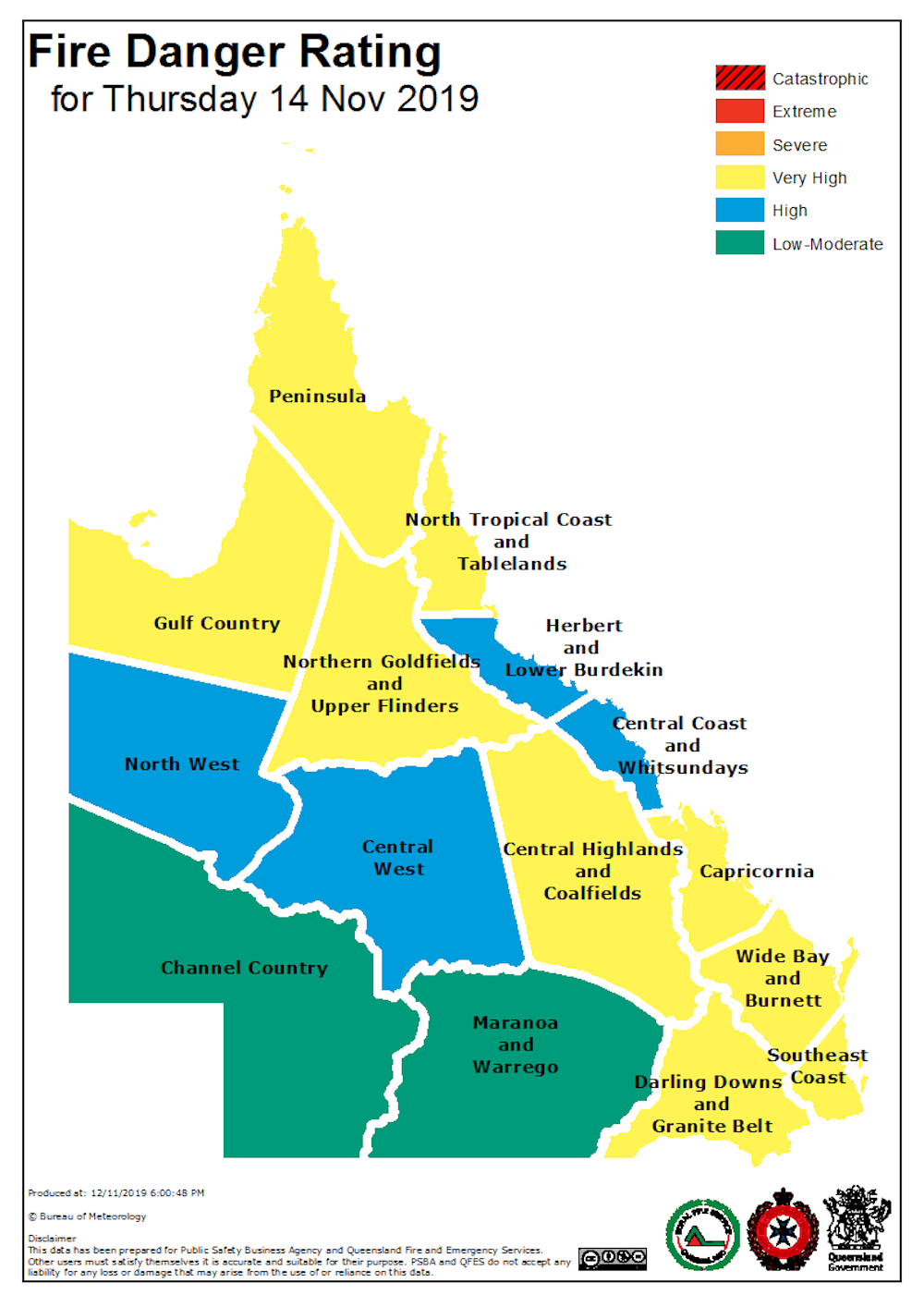 The Bureau of Meteorology’s fire danger rating for Wednesday, November 13.
RFS QLD
The Bureau of Meteorology’s fire danger rating for Wednesday, November 13.
RFS QLD
Areas under threat include the greater Sydney area, northern New South Wales, the Northern Goldfields, and the Central Highlands. The declared state of emergency means human life is at great risk.
Those at risk should evacuate ahead of time, as mobile phone services may not be reliable when needed the most.
Service outages
People in dangerous bushfire situations often have the added burden of service outages. This can happen following fire damage to infrastructure (such as signal towers) that connects base stations that relay communications within the network. A break in this connection means no signal, or weak signal, for those on the ground.
Generally, radio waves used for mobile communication behave differently as they travel, based on various factors that affect signal strength. One factor is land geography, such as the height of hills. The signal may not be able to penetrate sand hills. Gum trees may also reflect, obstruct and absorb radio signals.
Read more: Where to take refuge in your home during a bushfire
The scenarios described above can be made worse by fire environments, based on the frequencies used. Flames can produce “plasma”, which reacts with the surrounding magnetic field, and this degrades signal strength.
Rural fire service operations may use frequencies in the 400-450MHz range to communicate, but these signals are weakened during fire, in which case they may use frequencies in the 100-180MHz range. At this wavelength, signal strength doesn’t degrade as badly and can sustain better communication.
Being far away from a mobile phone tower, often in rural areas, also results in degraded communication. Rural areas don’t receive as much coverage because installing cell towers in these areas is not particularly profitable, and towers are built based on revenue estimates. There is little incentive to build networks with additional capacity in rural areas.
Get out while you can
In bushfire situations, it’s crucial to leave affected areas early to avoid becoming stuck in mobile black spots. These are regional and remote areas that have been identified as not having mobile phone coverage.
Some mobile black spots where fire danger warnings have been issued include Mount Seaview and Yarras, not far from the Oxley Highway in NSW. The status of the fires there was reported “out of control” on Tuesday morning.
Read more: What has Australia learned from Black Saturday?
Optus is planning to roll out macrocells at these locations to expand coverage between the end of this year and the middle of next year. These are base stations that cover a wide area and are typically deployed in rural regions or along highways.
Until the macrocells are deployed, people living in mobile black spots, or who may be forced to pass through these areas due to fire, continue to be at risk. When passing through a fire-affected black spot, you are virtually unreachable.
Also, although the mobile black spot program will help to increase 4G coverage in rural areas, most rural areas, including many at high risk of bushfires, rely largely on 3G. When people need extra data capacity during emergencies, the network is incapable of handling the increased traffic load, as every device is trying to connect and download data at the minimum 3G capacity of 550Kbps.
Network overload
The network gets congested at times of catastrophe due to the high volume of mobile phone traffic experienced, which exceeds the available network capacity. The mobile network in Billy’s Creek in NSW, and the areas connected to it, experienced an outage yesterday.
Telstra’s services have also been affected. As of Monday, people in Billy’s Creek, Yarras and Nimbin (among other locations) were unable to send or receive messages, make calls or access the internet, and may not have been up to date with the latest fire information, unless through radio or television.
During bushfires last year, for every three calls attempted under Telstra’s network, one was eventually answered. Everyone trying to call at once is referred to as a “mass call event”. This creates “congestive collapse” in parts of the internet-based network, blocking new connections from being made.
During congestion, the performance of the network decreases because the internet packets that carry the calls or messages are dropped, or delayed, before they reach their destination. One solution is for operators to have signal boosters installed for the affected part of the network.
There’s an app for that, if you have good connection
In the same way, the “Fires Near Me Australia” web application is likely to suffer from internet packet deliveries being delayed.
The app may be overwhelmed if too many people try to access it at once, and may crash. In such scenarios, people should reboot their phones and keep trying to connect.
Some people have made complaints of not being able to download the app, and others of the app crashing, because their phone’s model was not new enough to support it.
If the fires spread to densely populated areas, available 4G capacities may be exhausted by the sheer volume of the traffic. And congestion is made worse by more incoming traffic from across the country, from concerned family and friends.
Preventative measures may no longer be an option for many. But in the future, people in fire-prone areas may benefit from buying a personal 4G or 3G mobile signal booster ahead of time.
Read more: How to keep your mobile phone connected when the network is down
Authors: Stanley Shanapinda, Research Fellow, La Trobe University


















