

Renewables have now passed coal globally – and growth is fastest in countries like Bhutan and Nepal
- Written by: Reihana Mohideen, Principal Advisor, Just Energy Transition and Health, Nossal Institute for Global Health, The University of Melbourne
For the first time, renewables have toppled coal as the world’s leading source of electricity, in keeping with International Energy Agency projections for this historic shift.
But progress is uneven. The shift away from fossil fuels has slowed in the United States and the European Union – but accelerated sharply in developing nations.
China attracts headlines for the sheer scale of its shift. But many smaller nations are now taking up clean energy, electric vehicles and battery storage at remarkable speed, driven by governments, businesses and individuals.
Importantly, these moves often aren’t about climate change. Reasons range from cutting dependence on expensive fossil fuels and international market volatility to reducing reliance on unreliable power grids to finding ways to boost livelihoods.
Pakistan’s enormous solar boom is partly a response to spiking power prices and grid unreliability. Meanwhile Pacific nations see clean energy as a way to slash the crippling cost of importing diesel and expand electricity access.
My research has given me insight into the paths four countries in South Asia have taken to seize the benefits of clean technology, each shaped by unique pressures and opportunities. All are moving rapidly, blending necessity with ambition. Their stories show the clean energy path isn’t one-size-fits-all.
Bhutan: from hydropower giant to diversified energy
The landlocked Himalayan kingdom of Bhutan has long relied on hydroelectricity. But the country faces a persistent challenge: seasonal variability.
Most of Bhutan’s plants are run-of-the-river, meaning they don’t have large dams. As a result, power generation drops sharply during dry winter months when river flows are low, particularly between January and April.
At the same time, rapid industrialisation has driven up demand for power, outstripping winter capacity. Climate change is expected to worsen this variability.
During these months, Bhutan shifts from its role as clean-energy exporter to an importer, buying electricity from India. But imports aren’t a long-term solution.
To secure reliable supply year-round, Bhutan’s government is diversifying energy sources. To that end, up to 300 megawatts of solar is expected to be installed, potentially as soon as next year. Bhutan’s first utility-scale solar farm is under construction.
Over time, Bhutan will blend hydro with solar, wind and biomass to create a more balanced clean energy mix.

Nepal: electric cars in Kathmandu
Nepal has long imported all its petrol from India. But when India launched an unofficial blockade in 2015, vital supplies and fuel tankers stopped coming. Fuel prices surged. People queued for days at petrol stations, while black-market prices soared and public transport collapsed. Households, already enduring many hours of daily blackouts, faced even worse conditions.
The crisis exposed Nepal’s deep vulnerability. The mountainous nation makes its own electricity, largely through hydropower. But it had to import petrol.
In 2018, authorities launched an ambitious program to shift to electric vehicles and free the nation from dependence on imports. Electric vehicles would charge on domestic hydropower and reduce Kathmandu’s well-known air pollution. The plan called for electric vehicles to reach 90% share of new commuter vehicle sales (including popular two-wheelers) by 2030.
This year, the electric vehicle share for new four-wheel vehicles reached 76%, jumping rapidly in just the past year. Exemptions and incentives have supported this growth. As electric vehicles surge, new charging station and maintenance businesses have emerged.
It’s not all smooth sailing. A protest movement recently overthrew Nepal’s government, creating uncertainty. Analysts warn stable government policy and infrastructure investment will be essential.

Sri Lanka: innovation emerging from crisis
Between 2022 and 2023, a serious economic crisis hit Sri Lanka. Citizens reeled from severe energy shocks, such as fuel shortages, 12-hour blackouts and punishing electricity price hikes of over 140%. Half a million people were disconnected from the grid as they were unable to pay.
The crisis showed how fragile the island nation’s energy system was. Authorities looked for better options. Hydroelectricity has long been a mainstay, but solar and wind are growing rapidly.
Sri Lanka runs on about 50% renewables, with hydro the largest contributor by far. By 2030, the goal is to reach 70% renewable energy.
While renewables offer cheap power, they have to be coupled with energy storage and new systems to integrate them into the grid.
In response, universities, international partners and companies have worked to integrate renewable energy in the grid, developing artificial intelligence-based systems to improve reliability and supply to consumers. For instance, they can reduce voltage fluctuations associated with high uptake of rooftop solar. Importantly, some of these projects have a gender focus, prioritising women-led small enterprises and training for women engineers.
The crisis may prove a turning point by exposing vulnerabilities and pushing Sri Lanka to adopt new energy solutions.
 After a severe energy crisis gripped Sri Lanka, authorities began looking for ways to reduce reliance on imported fossil fuels. Pictured: a closed service station in Colombo in late 2022 with a sign warning of no petrol.
Ishara S. Kodikara/Getty
After a severe energy crisis gripped Sri Lanka, authorities began looking for ways to reduce reliance on imported fossil fuels. Pictured: a closed service station in Colombo in late 2022 with a sign warning of no petrol.
Ishara S. Kodikara/Getty
Maldives: bringing solar to diesel-dependent islands
Few countries are more vulnerable to fossil fuel dependence than the Maldives. Spread across 1,000 islands, the nation relies on imported diesel for power generation, with high transport costs and exposure to oil price swings.
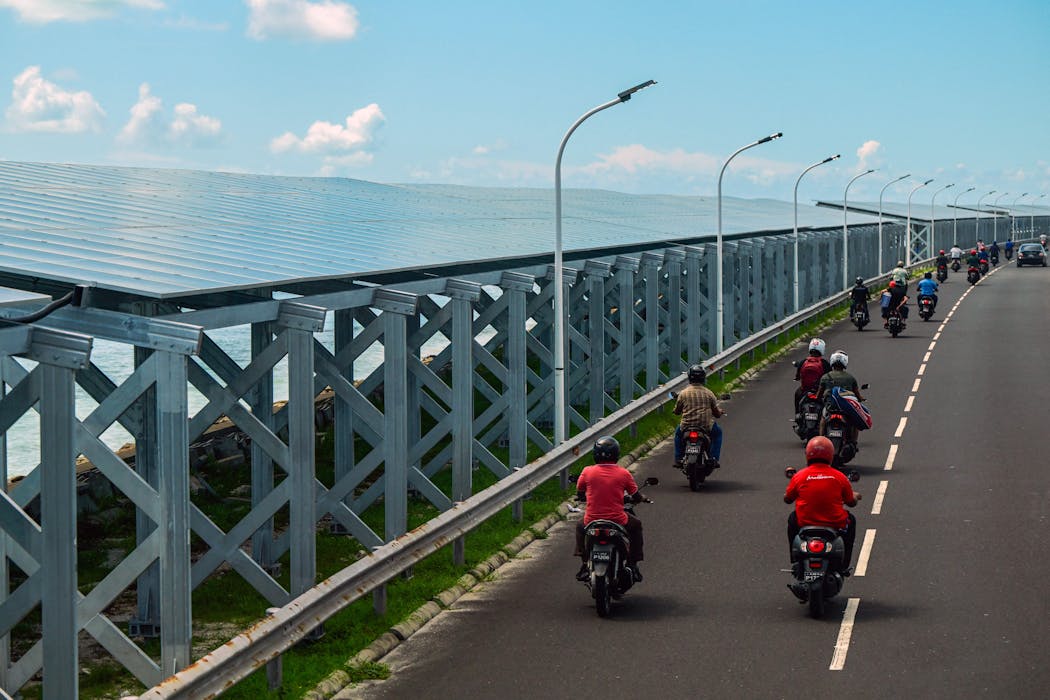
In 2014, Maldivian authorities launched the Preparing Outer Islands for Sustainable Energy Development project as part of a plan to reach net-zero by 2030. The project focuses on around 160 poorer islands further from the capital, progressively replacing a reliance on diesel generators with solar arrays, battery storage and upgraded power grids.
Women’s economic empowerment is a priority, as women-led enterprises run solar systems and utilities train female operations officers. The Maldives government released a 2030 roadmap, which has a welcome focus on the “just energy transition” – ensuring communities benefit equitably.
For the Maldives, renewables are more than an environmental choice — they are a lifeline for economic survival and resilience.
Lessons from the margins
While these energy transitions rarely make global headlines, Bhutan, Nepal, Sri Lanka and the Maldives show how smaller economies are finding their own pathways to cleaner, more resilient energy.
Their reasons to act stem from different crises, from blockades to economic upheaval. But each nation is working to turn challenge into opportunity.
Authors: Reihana Mohideen, Principal Advisor, Just Energy Transition and Health, Nossal Institute for Global Health, The University of Melbourne


















