

2019 was a year of global unrest, spurred by anger at rising inequality – and 2020 is likely to be worse
- Written by: Tony Walker, Adjunct Professor, School of Communications, La Trobe University
2019 may well go down as the most disrupted year in global politics since the fall of the Berlin wall in 1989 and the subsequent implosion of the former Soviet Union.
However, the likelihood is that 2020 will be worse, and bloodier.
Conditions that spawned global unrest on every continent in 2019 are unlikely to recede. Rather, they are likely to worsen in the face of a slowing global economy and little sign of causes of disaffection being addressed.
Washington as disruptor
In a word, the world is in a mess, made more threatening by the retreat of the Trump administration from America’s traditional role as a stabilising force.
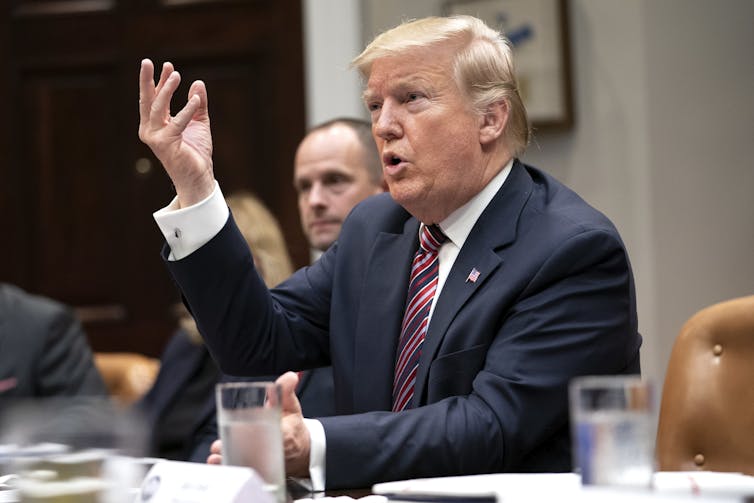 President Donald Trump has moved the US away from its traditional role of global stabilising force.
AAP/EPA/Kevin Dietsch
President Donald Trump has moved the US away from its traditional role of global stabilising force.
AAP/EPA/Kevin Dietsch
If anything, Washington is a disruptor in its abandonment of international agreements. These include: the Paris Agreement on climate change and the Comprehensive and Progressive Agreement for Trans Pacific Partnership, previously the Trans Pacific Partnership, aimed at liberalising Asia-Pacific trade. The US has also withdrawn from the Joint Comprehensive Plan of Action (JCPOA) that froze Iran’s nuclear ambitions.
Read more: Trade war tensions sky high as Trump and Xi prepare to meet at the G20
Washington’s defenestration of the JCPOA and its reimposition of tough sanctions on Iran has further destabilised the world’s most volatile region.
All this and more, including an unresolved trade conflict between the US and China, virtually guarantees 2020 will stretch the sinews of a fragile global order.
An evolving US-China technology war and risks of a technological decoupling add to the gloom.
The world is in worse shape than during the GFC
The Global Financial Crisis of 2007-08 was a period of intense uncertainty as a global financial system buckled. But, for the most part, that distress was confined to governments, boardrooms and the offices of international lending institutions.
The GFC did not fuel widespread global unrest as a shell-shocked financial world came to terms with the reality of a regulatory framework that had failed.
In 2019, the story has shifted dramatically.
Mass protests over the skewed benefits of globalisation accompanied by faltering confidence in a democratic model are challenging the assumptions on which a Western liberal capitalist system has rested. Local grievances are fuelling protests against an established order in places as far apart as La Paz in Bolivia and Beirut in Lebanon. Endemic corruption is looming larger.
If there is a defining issue that is driving popular unrest more or less across the board, it is that people do not feel they are sharing the benefits of an extended period of global economic expansion.
In January, Oxfam reported that the world’s 26 richest individuals owned as much wealth as the poorest half of the global population.
Billionaires grew their combined fortunes by US$2.5 billion (A$3.66 billion) a day in 2018, while the relative wealth of the world’s poorest 3.8 billion people declined by US$500 million a day.
A rich-poor gap is widening across the world to the point where it is no longer possible to argue that an economic growth model that advantages the few is lifting all boats.
Inequality and anger
Something had to give.
Professor Henry Carey of Georgia State University acknowledges differences in causes of localised unrest now sweeping the world, but he also identifies shared characteristics. He writes:
Each protest in this worldwide wave has its own local dynamic and cause.
But they also share certain characteristics: fed up with rising inequality, corruption and slow economic growth, angry citizens worldwide are demanding an end to corruption and the restoration of the democratic rule of law.
Carey makes the useful point that, as the world becomes more urbanised, overcrowded cities are staging points in a global wave of unrest.
In 1950, there were only two mega-cities with populations of 10 million or more – the New York metropolitan area and Tokyo. Today, there are 25 such megacities.
Of a world population of 7.7 billion people, 4.2 billion, or 55%, live in cities and other urban settlements. Another 2.5 billion will move into cities in poor countries by 2050, according to the United Nations.
Read more: Trump decision to withdraw troops from Syria opens way for dangerous Middle East power play
In other words, poverty, gang crime, drug trafficking and all the other ills associated with an impoverished urban environment will become less manageable as overcrowding gets worse in cities, parts of which have become urban slums. Carey writes:
Ignored by the municipal government, [overcrowded urban settlements] usually lack sanitation, clean drinking water, electricity, health care facilities and schools […] The injustices of this daily life underlie the anger of many of today’s protesters. From Quito to Beirut, extreme marginalisation of so many people living in big dysfunctional and dangerous places has boiled over into deadly unrest.
In these circumstances, it is no accident that Latin America, with the world’s slowest economic growth and most glaring inequality, has exploded in the longest-lasting violent protests.
In Chile, where economic grievances boiled over into days of mass protests, an Asia-Pacific Economic Cooperation forum summit was abandoned because of security concerns.
In Bolivia, the long-serving populist president, Evo Morales, was forced out of office and the country by days of urban unrest.
In Haiti, protests over corruption, lack of employment and extreme poverty have paralysed the functioning of the state for months.
In countries such as Ecuador, Peru and Venezuela, unrest is barely contained in the face of endemic corruption and government failures to provide basic services.
In the Middle East, it is a similar story.
In Lebanon, riven by protests for months, Prime Minister Saad Hariri was forced to step down amid growing anger about rising living costs, lack of job opportunities, stagnant wages and corruption.
Read more: As Turkish troops move in to Syria, the risks are great – including for Turkey itself
In Iraq, bloody protests over government failures to address inequality led to the resignation of Prime Minister Adel Abdul Mahdi amid risks of a resumption of a civil war between the country’s Shia and Sunni populations.
In Iran, days of protests over economic austerity were put down brutally by a regime that is battling crippling sanctions.
Elsewhere in the Middle East, the Egyptian regime of Abdel Fattah al-Sisi is under immense pressure from an exploding and impoverished population. Jordan has witnessed its own protests recently over economic hardship.
Libya is riven by civil war that is both driving and facilitating an asylum-seeker exodus across the Mediterranean, principally to Italy. This is, in turn, fuelling anti-immigrant tensions in that country.
In France, mass protests over President Emmanuel Macron’s attempts to address the country’s economic malaise show little sign of easing.
Elsewhere in Europe, unrest is barely contained. In Spain, tens of thousands of Catalonian independence protesters have taken to the streets of Barcelona in a tense standoff with Madrid.
In Russia, sporadic demonstrations against official corruption have become a feature, as they have elsewhere in the former Soviet Union.
In Eastern Europe, authoritarian regimes such as those in Poland and Hungary carry with them their seeds of confrontation with a disaffected population.
In Africa, all the ills mentioned above are present in spades.
South Africa is struggling to cope with huge economic challenges posed by an influx of refugees and a vast underclass camped in townships on the fringes of its major cities.
Read more: Hong Kong in crisis over relationship with China – and there does not appear to be a good solution
In Hong Kong, a proposed extradition law that would have facilitated the removal of those accused of crimes or misdemeanours to the mainland might have prompted mass protests. But at the heart of the demonstrations are economic grievances. Hong Kong’s wealth disparities are obscene.
Climate unrest
Across the globe, unrest over climate change is a common denominator and is likely to become more – not less – challenging to governments.
In Australia, in the midst of what may well prove to be the worst bushfires since white settlement, agitation over climate is exerting enormous pressure on the government of the day.
Whether this is fair or not, the government is perceived to be indifferent to climate concerns.
In a study of protest movements, the Brookings Institution found multilateralism flourished, global GDP rose and the percentage of people living in absolute poverty declined steadily after the fall of the Berlin Wall in 1989.
Paradoxically, this was an era that also sowed the seeds of present challenges. Advances in technology and globalisation, spurred by lower trade barriers, boosted global GDP but also led to the dislocation of middle-class livelihoods in many Western societies. The study concludes:
Now, in the wake of the global financial crisis, two critical dynamics have unfolded: first, the powerful democracies of the trans-Atlantic community (the bulwark of the Western-led order) are facing political turmoil at home and setbacks in the liberal quality of their own governments.
Second, the democracies find themselves losing ground internationally to authoritarian powers bent on breaking the hold of these democracies on the character of the international order.
This is not helped by an administration in Washington that has yielded ground to authoritarian dictatorships at a time of global unrest in which stable Western leadership has hardly been more necessary.
Authors: Tony Walker, Adjunct Professor, School of Communications, La Trobe University


















