

how a minor Jewish holiday was remade in the image of Christmas
- Written by: Rebecca Forgasz, Associate Professor, Australian Centre for Jewish Civilisation, Monash University
The eight-day Jewish festival of Hanukkah begins Sunday, December 22. From Melbourne and New York to Berlin and Moscow, thousands of people will gather to light giant menorahs. In many places, these public ceremonies will be accompanied by music, street food and carnivals.
These events may primarily target Jewish communities but, given their prominent locations, many non-Jews will also participate.
In the US especially, Hanukkah has become a widely recognised holiday. As well as lighting the National Menorah in Washington DC, the president hosts an annual Hanukkah party in the White House. In big cities like New York, parents of Jewish children are often invited into elementary school classrooms to explain Hanukkah to students.
Hanukkah has even entered American popular culture. The classic children’s Hanukkah song “Dreidel, dreidel, dreidel” has appeared in several episodes of South Park.
And comic Adam Sandler’s “The Hanukkah Song” became a national obsession when it was first performed on Saturday Night Live in 1994. Sandler even found two words to (sort of) rhyme with Hanukkah in the refrain:
Put on your yarmulke, here comes Hanukkah! So much fun-akah, to celebrate Hanukkah!
But in the Jewish calendar, Hanukkah is of relatively minor religious significance compared with the biblical festival of Passover or the holiest day of the Jewish year, Yom Kippur (the Day of Atonement).
So why has it become the most widely known and publicly celebrated of all Jewish holidays, particularly in the US?
The origins of Hanukkah
Hanukkah commemorates a historical event that took place in Jerusalem in the 2nd century BCE, when the Seleucid Greek empire was the ruling power. In 168 BCE, the king Antiochus IV Epiphanes outlawed Jewish practice and defiled the Jewish Temple in the city by installing an altar to Zeus Olympios and sacrificing pigs.
A small army of Jews, known as the Maccabees, rebelled against this religious persecution. They regained control over the Temple, removed the symbols of Zeus and built a new altar so they could once again offer sacrifices in keeping with Jewish law.
Read more: Hanukkah's true meaning is about Jewish survival
According to a legend recounted in the Talmud, a compilation of 3rd to 6th century Jewish teachings, a miracle occurred at this time.
There was only enough oil to keep the Temple’s menorah, one of its most important ritual objects, burning for one day. But the flame stayed alight for eight days, until a new supply of oil could be found - the basis for the eight-day celebration of Hanukkah.
An alternate version of history
Based on this version of events, Jews have seen the Maccabees as heroes who fought for religious liberty against a repressive regime.
But the historical record is more complex.
The most detailed accounts of the story of Hanukkah are recorded in First and Second Maccabees, historical books that describe the military and political events leading up to and following the Maccabean revolt. They are not included in the Hebrew Bible, but are part of the Catholic biblical canon.
According to First Maccabees,
lawless men came forth from Israel, and misled many, saying, ‘Let us go and make a covenant with the Gentiles round about us’. … [T]hey built a gymnasium in Jerusalem, according to Gentile custom, and removed the marks of circumcision, and abandoned the holy covenant. They joined with the Gentiles and sold themselves to do evil.
These “lawless men” were not the Seleucid rulers, but Jews who wanted to integrate aspects of Greek (Hellenistic) culture with Jewish tradition.
Hellenistic culture was based on the Greek language, literature, art and philosophy, as well as the distinctively Greek form of social and political organisation, the polis. But Hellenistic culture also involved the worship of Greek gods and social customs, such as athletic contests, that some considered incompatible with Jewish tradition.
These Hellenising Jews were the targets of the Maccabees’ vengeful attacks as much as the Seleucid Greek regime itself. As First Maccabees relates:
They organised an army, and struck down sinners in their anger and lawless men in their wrath; the survivors fled to the Gentiles for safety.
In this light, the Maccabees were not heroic liberators and defenders of religious freedom. Rather, they could be viewed as intolerant religious zealots, intent on stamping out any attempt to “modernise” Jewish tradition.
Today, most Jews would still consider the Maccabees to be heroes and defenders of Judaism. Certainly, it’s the story that children are taught in Jewish schools and synagogues. However, they would be surprised, and likely rather disturbed, by the religious fundamentalism of the Maccabees that is represented in the historical sources.
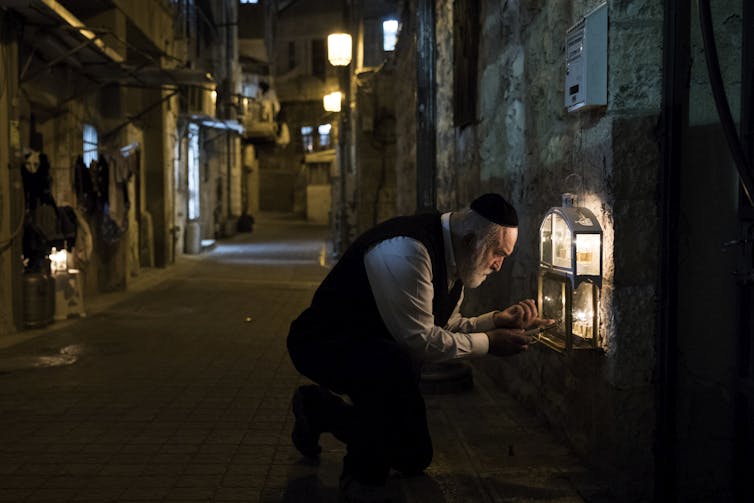 A Jewish man lighting a Hanukkah candle outside his house in Jerusalem.
Abir Sultan/EPA
A Jewish man lighting a Hanukkah candle outside his house in Jerusalem.
Abir Sultan/EPA
Remaking Hanukkah in the image of Christmas
Diane Ashton, an American religious historian, has traced the history of Hanukkah in the US and described how Jews have transformed Hanukkah in the past two centuries to reflect the evolving traditions of Christmas.
Inspired by children’s Christmas events in churches, American rabbis began introducing special Hanukkah celebrations for children at synagogues in the 19th century. They would tell the story of Hanukkah, light candles, sing hymns and hand out sweets. This was a way to entice children to attend synagogues, which otherwise offered little of interest to them.
Over time, Hanukkah became one of the only times of the year that many Jewish families engaged with Jewish tradition.
Read more: How Hanukkah came to America
In the early 20th century, with the commercialisation of Christmas well under way, more changes occurred. Gift-giving was never a feature of Hanukkah historically, but new Jewish immigrants from Europe began buying presents for their children as a way of signifying their economic success in the new world.
In more recent years, the public display of menorahs has also been promoted by Chabad, the Orthodox Jewish Hasidic movement that aims to bring Jews closer to their own religion.
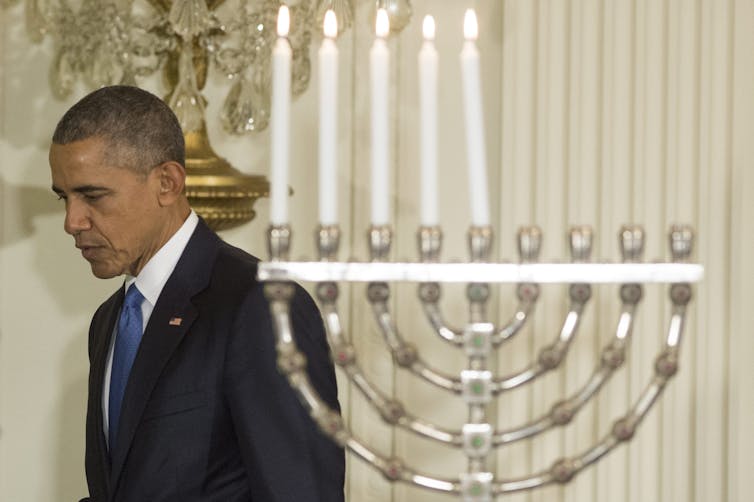 President Barack Obama, during a Hanukkah reception at the White House in 2015.
Michael Reynolds/EPA
President Barack Obama, during a Hanukkah reception at the White House in 2015.
Michael Reynolds/EPA
These displays, often alongside Christmas trees, have elevated the significance of Hanukkah in the minds of both Jews and non-Jews. They were even the subject of a US Supreme Court ruling in 1989, when the court rejected a request by the city of Pittsburgh to bar a large menorah from a public building, ruling it did not amount to a government endorsement of Judaism.
Over time, American Jews have thus remade Hanukkah in the image of Christmas. In doing so, they have been able to participate in the festive season in a way that is distinctly Jewish, balancing their desires to both assimilate and retain their unique cultural identity.
Read more: What Hanukkah's portrayal in pop culture means to American Jews
Elsewhere in the world, while large-scale public menorah lightings have become more widespread, Hanukkah is mostly a time for families to come together. Fried food, to commemorate the miracle of the oil, features heavily in family celebrations, including the popular potato fritters called latkes and deep-fried, jam-filled doughnuts known as sufganiyot.
Giving small gifts to children has become common, though nowhere has Hanukkah reached the level of commercialisation and kitsch that it has in the US.
For any other Jewish festival, this might be seen as a corrupting influence. But given that Hanukkah remains, for most Jews, a relatively minor holiday, it is viewed with some bemusement as just another example of American meshugas (craziness).
Authors: Rebecca Forgasz, Associate Professor, Australian Centre for Jewish Civilisation, Monash University


















