

how the ancients invested in precious metals
- Written by Konstantine Panegyres, Lecturer in Classics and Ancient History, The University of Western Australia
“All I want is an income of 20,000 sesterces from secure investments”, proclaims a character in a poem by Juvenal (1st-2nd century CE), the Roman poet.
Today, 20,000 sesterces would be equivalent to about A$300,000 in interest from investments. Anyone would be very happy with this much passive annual income.
Like today, people in ancient times understood that investing money could help them consolidate and grow their wealth.
As the Roman novelist Petronius (1st century CE) once wrote,
Whoever has money sails with a fair breeze, and governs his fortune as he wishes.
So, how exactly did ancient people invest their money?
A lofty house with hidden silver
In ancient Greek and Roman times, there was no stock market where you could buy and trade shares in a company.
If you wanted to invest your cash, one of the more popular options was to obtain gold or silver.
People did this to protect against currency fluctuations and inflation. They usually kept the metals either in bullion form or in the form of ware like jewellery. Storing these items could be risky and prone to theft.
The Roman poet Virgil (70-19 BCE) describes the estate of a wealthy person that included “a lofty house, where talents of silver lie deeply hidden” alongside “weights of gold in bullion and in ware”.
A talent was the largest unit of currency measurement in ancient Greece and Rome, equivalent to about 25kg of weighed silver.

Usually the metals were stored in a special vault or security cupboard.
The Roman writer Cicero (106-43 BCE) recalls how a wealthy lady named Clodia would take gold (perhaps bars or ingots or plates) out of a security cupboard when she wished to lend money to someone. The gold could then be exchanged for coinage.
Market booms – and busts
The price of these metals could, however, occasionally be subject to unpredictable fluctuations and crashes in price, though less often than currency.
The Greek historian Polybius (c. 200-118 BCE) says that when a new gold vein was discovered in Aquileia, Italy, only two feet deep, it caused a gold rush. The new material flooded the market too quickly and “the price of gold throughout Italy at once fell by one-third” after only two months. To stabilise the gold price, mining in the area was quickly monopolised and regulated.
When people wanted to trade precious metals, they would sell them by weight. If the gold or silver or bronze had been worked into jewellery or other objects, this could be melted down and turned into bullion.
People must have delighted in owning these precious metals.
The Athenian writer Xenophon (c. 430-350 BCE) gives a clue about the mindset of ancient silver investors:
Silver is not like furniture, of which a man never buys more once he has got enough for his house. No one ever yet possessed so much silver as to want no more; if a man finds himself with a huge amount of it, he takes as much pleasure in burying the surplus as in using it.
A number of Roman wills reveal people leaving their heirs silver and gold in the form of bars, plates or ingots.

Commodities that could not be ‘ruined by Jupiter’
Aside from metals, agricultural commodities were also very popular, especially grain, olive oil, and wine.
To profit from agricultural commodities, people bought farmland and traded the commodities on the market.
The Roman statesman Cato thought putting money into the production of essential goods was the safest investment. He said these things “could not be ruined by Jupiter” – in other words, they were resistant to unpredictable movements in the economy.
Whereas precious metals were a store of wealth, they generated no income unless they were sold. But a diversified portfolio of agricultural commodities guaranteed a permanent income.
People also invested and traded in precious goods, like artworks.
When the Romans sacked the city of Corinth in 146 BC, they stole the city’s collection of famous artwork, and later sold the masterpieces for huge sums of money at auction in order to bring profit for the Roman state.
At this auction, the King of Pergamon, Attalus II (220-138 BCE), bought one of the paintings, by the master artist Aristeides of Thebes (4th century BCE), for the incredible sum of 100 talents (about 2,500kg of silver).
Eccentric emperors
Political instability or uncertainty sometimes raised the price of these metals.
The Greek historian Appian (2nd century CE) records how during the Roman civil war in 32-30 BCE:
the price of all commodities had risen, and the Romans ascribed the cause of this to the quarrelling of the leaders whom they cursed.
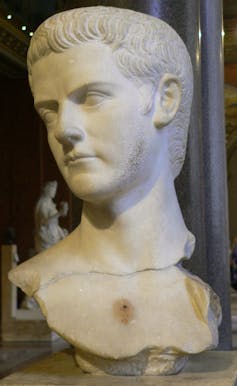
Eccentric emperors might also impose new taxes or charges on commodities, or try to manipulate the market.
The Roman historian Suetonius (c. 69-122 CE) tells us the emperor Caligula (12-41 CE) “levied new and unheard of taxes […] and there was no class of commodities or men on which he did not impose some form of tariff”.
Another emperor, Vespasian (17-79 CE), went so far as to “buy up certain commodities merely in order to distribute them at profit”, says Suetonius.
Clearly, investing in commodities 2,000 years ago could help build personal wealth – but also involved some risk, just like today.
Authors: Konstantine Panegyres, Lecturer in Classics and Ancient History, The University of Western Australia



















