

AI has powerful uses for First Nations oral cultural knowledge. Here’s how
- Written by Elizabeth Vaughan, Rock Art Australia Kimberley Research Fellow, The University of Western Australia
Aboriginal and Torres Strait Islander readers are advised this article contains names and images of people who have died.
Much of the conversation about artificial intelligence (AI) and Indigenous peoples focuses on harms, such as cultural appropriation, cultural flattening and digital exclusion. These risks are real.
But behind them sits an assumption that rarely gets challenged: because Aboriginal cultures are ancient, they must be static. Rooted firmly in the past, to stay there. That they cannot adapt to something as disruptive as generative AI.
This misreads tens of thousands of years of history. And it misses something our work with Traditional Owners in the Kimberley in Western Australia has made increasingly clear: Indigenous cultures are not only capable of adapting to AI – the way they have always held and transmitted knowledge may make them natural users of it.
‘Say it properly’
When I (Liz) first began working with Wororra people in the Kimberley, the late Janet Oobagooma taught me Wororra words. A senior cultural Elder for the Dambimangari community, she was exacting. When I got tongue-tied, she would growl at me: “If you’re gonna talk, say it properly”.
That strictness is structural, not personal. Wororra is an oral language. There is no written form to fall back on.
All societal laws, historical records, kinship information and cultural practices accumulated over millennia must be held in living memory – encoded across an entire population in songs, mythology, art, dance and ceremony. Nothing is filed in a single place. Everything is distributed, collectively maintained, and must be practised to survive.
This is fundamentally different from Western text-based, institutionalised knowledge systems.
And it raises a practical question: if oral knowledge was never meant to be read off a page, are libraries and archives really the best way to return it to the communities it belongs to?
Locked away in archives
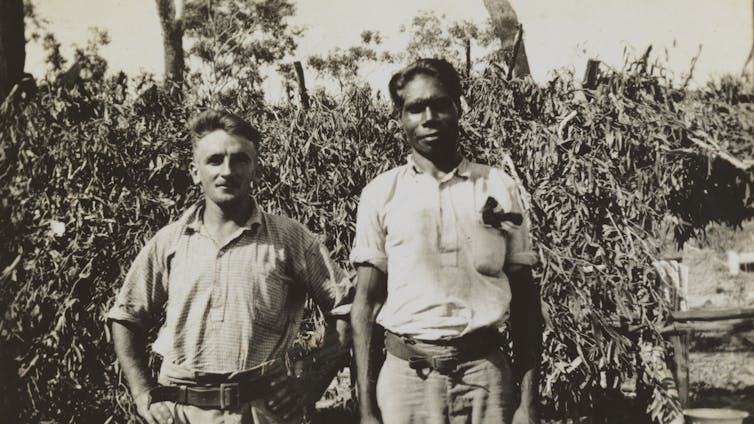
The renowned Wororra lawman Sam Woolagoodja – co-author Francis Woolagoodja’s grandfather – worked with anthropologists, filmmakers and linguists over decades. Among them were missionary linguist Howard Coate, filmmaker Michael Edols, and bush adventurer Malcolm Douglas, who filmed Sam repainting Wandjina rock art at Raft Point.
Malcolm Douglas’s film ‘Beyond the Kimberley Coast’ featuring Sam Woolagoodja in 1976.Over more than 40 years Sam shared cultural knowledge with these researchers. The recordings, field notes and translations captured during this period contribute some of the most detailed documentation of Wororra culture in existence.
Today, this material sits in institutions across the country, thousands of kilometres from the communities it belongs to.
This isn’t only a matter of preservation. For Aboriginal corporations managing Country, this data informs modern governance. Genealogies determine who speaks for Country. Heritage records shape native title decisions – as traditional owners have said to each other in management forums: “people are making up their own story about us”.
What AI made possible
Working with Sam’s descendants, we set out to gather his legacy of archived cultural material and explore ways to return it to community.
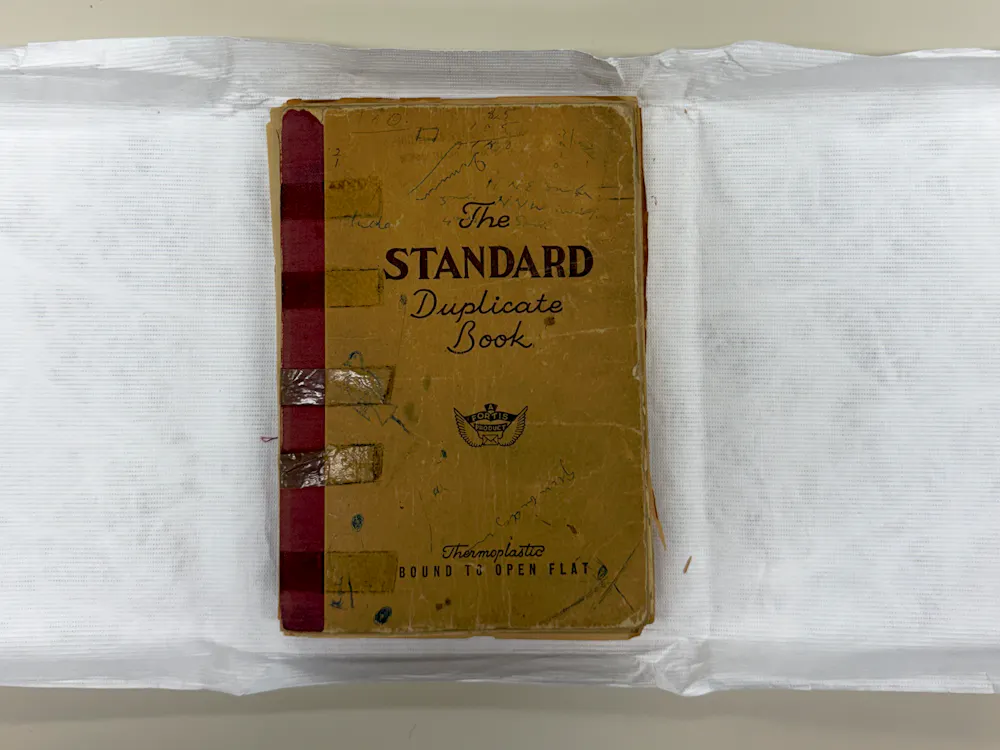
We began using a generative AI tool – Claude, made by Anthropic – to assist in making sense of data provided to Howard Coate by Sam.
We used it for deciphering difficult handwriting in decades-old field notebooks, cross referencing genealogies across multiple sources, and organising hundreds of extracted PDF scans into usable files. Work that normally takes months could be completed in hours.
But the real shift came when we began directing the AI to work only within a defined set of curated sources – published research, verified archival material, community-approved records – rather than drawing from the open internet.
Within that controlled environment, we could ask questions about Wororra culture in plain language and receive grounded answers drawn only from material we trusted.
It became a way of learning through dialogue rather than reading dense academic text. For those of us working to understand a culture’s depth from scattered published sources, it accelerated learning dramatically.
This experience gave us an idea. If a curated AI environment could help researchers engage with cultural knowledge through conversation, could a purpose-built system do the same for community members – especially younger generations living in town, away from Country?
The limitations of AI
General-purpose AI still has serious limitations. It has no understanding of cultural protocols or Indigenous data sovereignty, no concept of restricted knowledge governed by gender, age or ceremonial authority.
It can present errors with complete confidence, mixing up sources, misattributing cultural information, or presenting guesswork as fact. In heritage work, accuracy is not optional.
So we are developing a purpose-built concept. A closed-system AI governed by the community, where sources are verified, culturally appropriate and collectively endorsed.
The intent is not to replace oral tradition but to give communities a way to interact with their heritage through dialogue using AI. That’s closer to how this knowledge was always meant to be used than any library shelf or academic paper.
Janet Oobagooma and the Elders who contributed to the Dambimangari community’s published history, Barddabardda Wodjenangorddee (“we are telling all of you”), always emphasised that culture is not a museum exhibit.
It is alive, it adapts, and it demands to be spoken. AI is just the latest tool that could help make that happen – if communities are the ones holding it.
Authors: Elizabeth Vaughan, Rock Art Australia Kimberley Research Fellow, The University of Western Australia

















