

Australian children now have half as many moles as kids in 1992. That’s good news for melanoma risk
- Written by David Duffy, Research Fellow, Genetic Epidemiology Lab, QIMR Berghofer Medical Research Institute
About one in two Australians will be diagnosed with skin cancer by age 70. The most dangerous kind is melanoma, which develops in skin cells called melanocytes that have been overexposed to the sun.
Common moles also develop from melanocytes, and appear as small dark marks or bumps on your skin. They are usually harmless growths, but any individual mole has a low risk of developing into a melanoma.
The more moles you have, the more likely one may become malignant. So a high “mole count” is one of the strongest risk factors for melanoma.
But there’s good news. Over the last 25 years, our team of researchers has tracked the number of moles on almost 4,000 Australian children and observed a nearly 50% drop in that period. Here’s what we found.
Why moles matter
Most Australian children develop moles, with the average teenager having 50 moles by age 15. They are most common in people with paler skin who are exposed to intense ultraviolet radiation (UV).
People with more than 100 moles are seven times more likely to develop melanoma during their lifetime, compared to those with fewer than 15 moles.
Other risk factors for melanoma include having paler skin or hair colour, a family history of unusual moles or melanoma, and certain genetic conditions.
What we studied, and what we found
In the early 1990s, our research team began the Brisbane Twin Nevus Study.
Each year, we examined 12-year-old twins and their siblings living in sun-drenched south-east Queensland. We studied twins because they can help us measure how both genetic and environmental factors affect mole count.
In total, we followed 3,957 children in the years between 1992 and 2016. We found the average number of moles on children’s bodies fell by 47% over that period.
Based on this drop, we predict this would reduce these children’s lifetime risk of developing melanoma by four times, compared to children born in the 1980s.
It is hard to know exactly what caused this halving of childhood mole numbers. But our best explanation is that better sun protection and avoidance in early childhood has led to this drop.
The success of ‘Slip, Slop, Slap’
Research suggests children today, compared to kids in the 1990s and 2000s, are getting less UV exposure before age 12. We calculated that our observed drop in mole count between 1992 and 2016 could be explained by the average UV exposure dropping by 12%.
This is most likely the result of decades of sun safety campaigns which encouraged parents, schools, and communities to take UV protection seriously.
The “Slip, Slop, Slap” campaign is the most well-known example. It was launched by the Cancer Council in 1981. Thanks to a board short-wearing seagull and sun-smart jingle, this campaign has become an iconic part of Australian culture.
As researchers, it’s hard to establish a clear link between the impact of public health messaging and measurable health outcomes. But one 2023 study examined the sun protection practices in 25 Queensland childcare centres. It found centres which required children to wear sun-smart clothing saw a 25% decrease in the number of moles found in kids aged five and under.
Sid the Seagull first launched in the 1981 campaign.But parents can’t be complacent
A 47% drop in childhood mole numbers is worth celebrating. But the work doesn’t stop there.
Parents must be especially careful about sunburn. Sunburn is a sign your skin has been damaged by too much sun exposure. And repeated sunburns in childhood are one of the strongest risk factors for melanoma later in life.
Parents can also look out for any unusual moles on their child’s skin. Especially in children, moles are usually benign and very rarely turn into a melanoma. But if your child has a mole which changes in size, shape or colour, it’s best to get it assessed by a doctor.
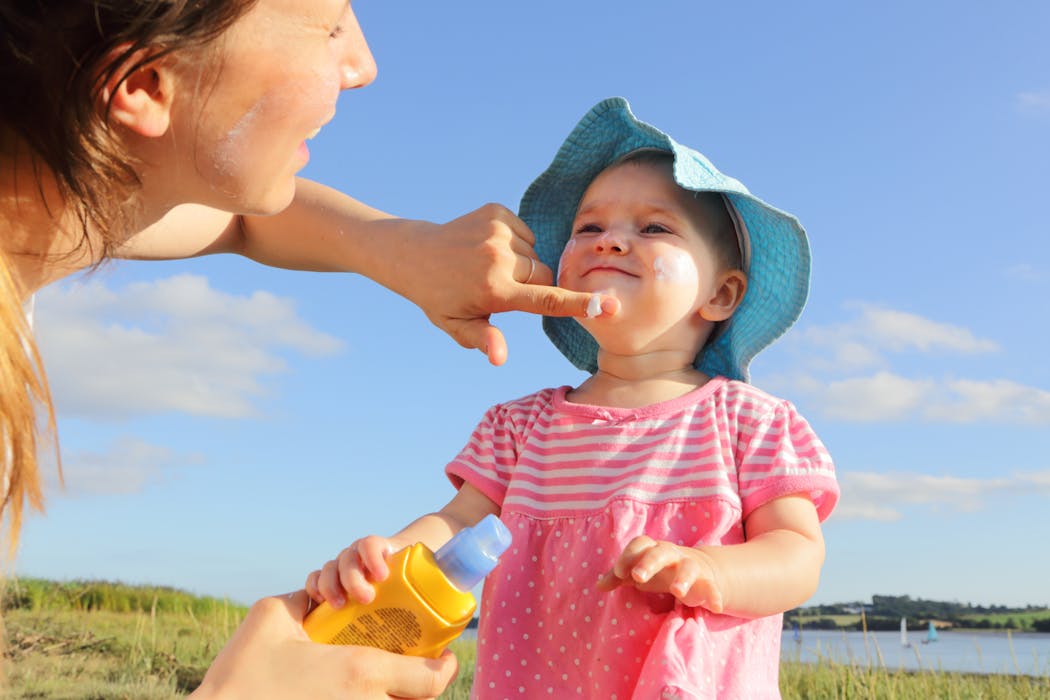
And don’t forget about sun-smart habits. Our study reinforces the fact early sun protection, such as applying sunscreen, wearing hats and long-sleeved shirts, works. And they are easy to build into your family’s routine.
Many Australian parents are already teaching their kids about sun safety. But our study shows their everyday efforts, coupled with strong public health messaging, can save lives.
Authors: David Duffy, Research Fellow, Genetic Epidemiology Lab, QIMR Berghofer Medical Research Institute

















