

It might sound 'batshit insane' but Australia could soon export sunshine to Asia via a 3,800km cable
- Written by: John Mathews, Professor of Strategic Management, Macquarie Graduate School of Management, Macquarie University
Australia is the world’s third largest fossil fuels exporter – a fact that generates intense debate as climate change intensifies. While the economy is heavily reliant on coal and gas export revenues, these fuels create substantial greenhouse gas emissions when burned overseas.
Australia doesn’t currently export renewable energy. But an ambitious new solar project is poised to change that.
The proposed Sun Cable project envisions a ten gigawatt capacity solar farm (with about 22 gigawatt-hours of battery storage) laid out across 15,000 hectares near Tennant Creek, in the Northern Territory. Power generated will supply Darwin and be exported to Singapore via a 3,800km cable slung across the seafloor.
Sun Cable, and similar projects in the pipeline, would tap into the country’s vast renewable energy resources. They promise to provide an alternative to the export business of coal, iron ore and gas.
Read more: Australia's energy exports increase global greenhouse emissions, not decrease them
As experts of east-Asian energy developments, we welcome Sun Cable. It could pioneer a renewable energy export industry for Australia, creating new manufacturing industries and construction jobs. Importantly, it could set our economy on a post-fossil fuel trajectory.
Long-term cost benefits
Sun Cable was announced last year by a group of Australian developers. The project’s proponents say it would provide one-fifth of Singapore’s power supply by 2030, and replace a large share of fossil fuel-generated electricity used in Darwin.
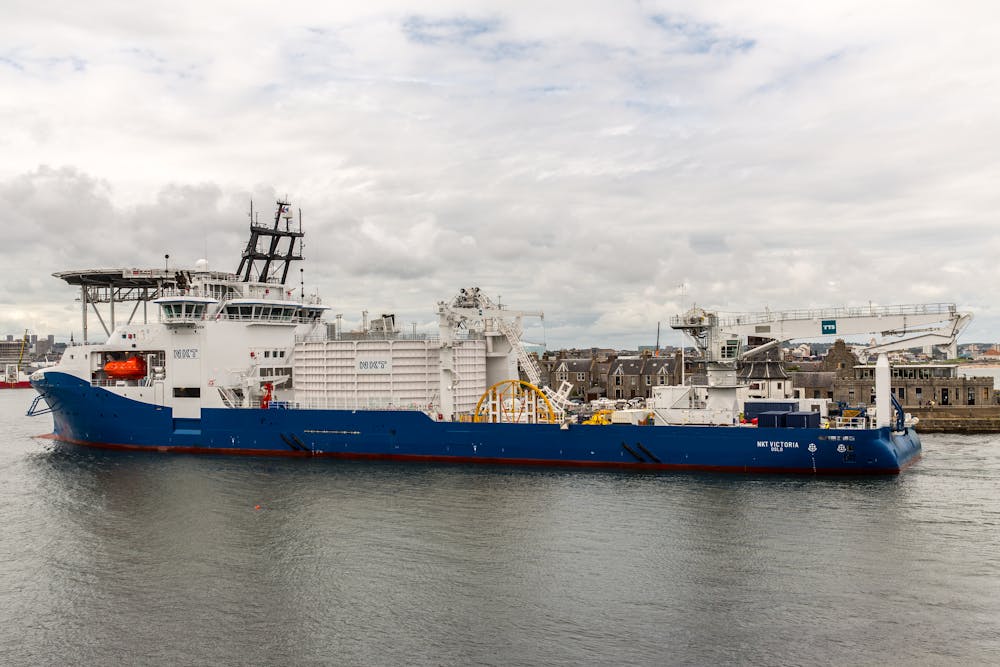 Submarine cables are laid using deep-sea vessels specifically designed for the job.
Alan Jamieson/Flickr, CC BY
Submarine cables are laid using deep-sea vessels specifically designed for the job.
Alan Jamieson/Flickr, CC BY
To export renewable energy overseas, a high-voltage (HV) direct current (DC) cable would link the Northern Territory to Singapore. Around the world, some HVDC cables already carry power across long distances. One ultra-high-voltage direct current cable connects central China to eastern seaboard cities such as Shanghai. Shorter HVDC grid interconnectors operate in Europe.
The fact that long distance HVDC cable transmission has already proven feasible is a point working in Sun Cable’s favour.
The cost of generating solar power is also falling dramatically. And the low marginal cost (cost of producing one unit) of generating and transporting renewable power offers further advantage.
The A$20 billion-plus proposal’s biggest financial hurdle was covering initial capital costs. In November last year, billionaire Australian investors Mike Cannon-Brookes and Andrew “Twiggy” Forrest provided initial funding to the tune of up to A$50 million. Cannon-Brookes said while Sun Cable seemed like a “completely batshit insane project”, it appeared achievable from an engineering perspective.
Sun Cable is expected to be completed in 2027.
Bringing in business
The proposal would also bring business to local high-technology companies. Sun Cable has contracted with Sydney firm 5B, to use its “solar array” prefabrication technology to accelerate the building of its solar farm. The firm will pre-assemble solar panels and deliver them to the site in containers, ready for quick assembly.
The Northern Territory government has also shown support, granting Sun Cable “major project” status. This helps clear potential investment and approval barriers.
Read more: Making Australia a renewable energy exporting superpower
Across Australia, similar renewable energy export plans are emerging. The Murchison Renewable Hydrogen Project in Western Australia will use energy produced by solar and wind farms to create renewable hydrogen, transported to east Asia as liquid hydrogen.
Similarly, the planned Asian Renewable Energy Hub could have renewable hydrogen generated in Western Australia’s Pilbara region at 15 gigawatts. This would also be exported, and supplied to local industries.
These projects align with the Western Australian government’s ambitious Renewable Hydrogen Strategy. It’s pushing to make clean hydrogen a driver for the state’s export future.
 Projects such as Sun Cable could reduce Australia’s reliance on coal exports.
AAP
Projects such as Sun Cable could reduce Australia’s reliance on coal exports.
AAP
Reliable solutions
Generating and transmitting power from renewable resources avoids the energy security risks plaguing fossil fuel projects. Renewable projects use manufactured devices such as solar cells, wind turbines and batteries. These all generate energy security (a nation’s access to a sufficient, affordable and consistent energy supply).
Australia controls its own manufacturing activities, and while the sun may not shine brightly every day, its incidence is predictable over time. In contrast, oil, coal and gas supply is limited and heavily subject to geopolitical tensions. Just months ago in the Middle East, attacks on two major Saudi Arabian oil facilities impacted 5% of global oil supply.
Read more: Australia's fuel stockpile is perilously low, and it may be too late for a refill
Renewing international links
Apart from exporting electricity produced on its own solar farm, Sun Cable could profit from letting other projects export electricity to Asia through shared-cost use of its infrastructure.
This would encourage future renewable energy exports, especially to the energy-hungry ASEAN nations (Association of Southeast Asian Nations) – Indonesia, Malaysia, the Philippines, Singapore and Thailand.
This would strengthen Australia’s economic relationships with its ASEAN neighbours – an importantc geo-economic goal. In particular, it could help reduce Australia’s growing export dependence on China.
However, as with any large scale project, Sun Cable does face challenges.
Other than raising the remaining capital, it must meet interconnection standards and safety requirements to implement the required infrastructure. These will need to be managed as the project evolves.
Also, since the power cable is likely to run along the seabed under Indonesian waters, its installation will call for strategic international negotiations. There has also been speculation from mining interests the connection could present national security risks, as it may be able to send and receive “performance and customer data”. But these concerns cannot be validated currently, as we lack the relevant details.
Fortunately, none of these challenges are insurmountable. And within the decade, Sun Cable could make the export of Australian renewable energy a reality.
Authors: John Mathews, Professor of Strategic Management, Macquarie Graduate School of Management, Macquarie University


















