

Animals can talk over huge distances – but humans might be changing their range
- Written by Ben JJ Walker, Researcher, UNSW Sydney
Animals are noisy. And their noises can travel a long way.
But making sounds can be a double-edged sword: it can help them communicate, sometimes over long distances, but it can also reveal them to predators.
In new research published in the Journal of Mammalian Evolution, my colleague and I studied how far the sounds of 103 different mammal species travel, and discovered some surprising patterns.
What’s more, these patterns hint at an overlooked impact humans may be having on our fellow creatures: not only changing their sonic landscapes through our own noise, but also changing the world their sounds are travelling through, with unknown effects.
What’s happening in the water?
In aquatic mammals, the relationship between the size of an animal and the farthest distance its call travels is simple. Bigger animals can be heard farther away.
On a perfect day in perfect conditions, the call of a blue whale (the largest animal in history) can travel up to 1,600 kilometres. Its (slightly smaller) cousin the fin whale can be heard over a similar distance.
These are the longest-travelling animal sounds ever reported.
What’s happening on land?
On land, the story is very different. Environmental factors are crucial to how far the sound of a terrestrial mammal travels.
Things that matter include the size of an animal’s home range (the area in which it lives and defends resources), whether a call is territorial (to defend against other animals), whether the environment is open versus densely vegetated, and if the animal is very social or solitary.
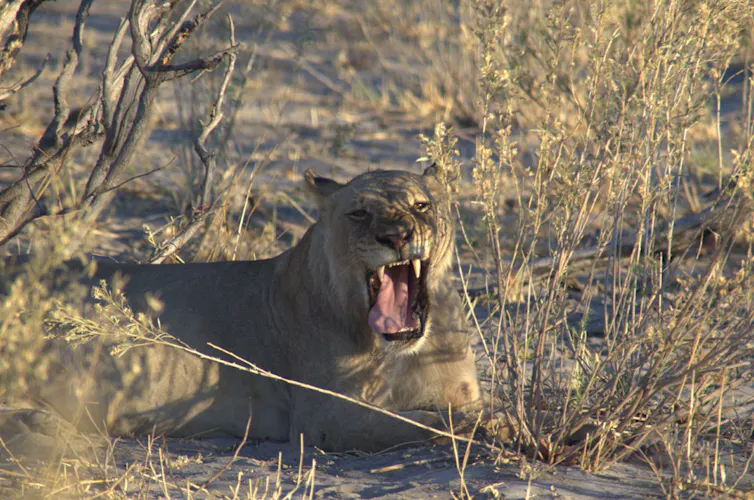
On a good day in the savannah, lions and elephants have sounds that travel 8km and 10km, respectively.
How does this work?
Our research is centred around the idea that your sound reveals you to predators, and that revelation leads to a higher risk of injury and death (potentially before you pass on your genes, and hence reducing what evolutionary biologists call “fitness”). This would be because the predator can more quickly locate its calling prey.
There is a delicate balance between using sounds to communicate and using sounds in the wrong place and at the wrong time.
If sound is revealed at the wrong distance, it may mess up the reason an animal uses the sound in the first place.
Animals that cannot adapt to changes in the sound environment may reveal themselves and be eaten, or may be unable to find their friends.
Where does this fit?
In the midst of human-induced environmental and species change, understanding how animals use sounds to communicate and find each other has become valuable to conservation. Many ecosystems are being cleared on land to make way for development and agriculture.
Our finding that land mammals in closed habitats have evolved to have relatively farther sound distances is important because of what happens when the environment changes.
If a possum has evolved in a eucalyptus forest, for example, and the forest is cleared, its sounds will travel farther (because there are fewer trees to muffle it). As a result, the possum may reveal itself to a predator when it doesn’t mean to.
This in turn means the animal’s call leaves it more exposed than it “should” in evolutionary terms. The animal may not have the same tools to escape predators that animals evolved for open environments do, and so may be more easily eaten.
What are humans doing?
Many species have reduced in body size due to things like harvesting activities and climate change.
It’s a well documented fact that many whale species have been getting smaller as a result of human whaling activities and environmental impacts.
Since 1981, for example, the length of northern right whales has become about 7% smaller. Among gray whales, animals born in 2020 are estimated to be 1.65 metres shorter than animals born in the 1980s.
Given our finding that larger body sizes mean farther-travelling sounds in aquatic mammals, smaller whales may not be able to be heard as far away.
This means that when smaller whales call to their friends or family members, their calls may not reach these individuals over the enormous distances the species travel.
What can humans change?
Our findings add a new dimension to our understanding of how humans are affecting animals, and may help inform future conservation decisions.
Do they mean anything in our everyday lives?
For one thing, they remind us to take a moment to listen to the world around us.
We might find out where an animal is. We might observe a new species.
We might even find a quiet space in the landscapes around us to sit and connect again with the world and ourselves.
Authors: Ben JJ Walker, Researcher, UNSW Sydney

















