

I borrowed my first books in Mumbai. Now, Sydney’s libraries are home
- Written by Roanna Gonsalves, Senior Lecturer in Creative Writing, UNSW Sydney
The long arm of the library has made a writer of me. This long arm, a composite of many libraries, created the conditions through which a shy reader could continue to live in her head.
I was born and raised in India. It is a country of daily wage earners in makeshift dwellings trying to survive alongside the world’s richest individuals ensconced in immovable towers. It is also a country where the practice of circulating knowledge through libraries has a long history.
It ranges from the library at Nalanda University founded in 427CE, over a thousand years before the Bodleian at Oxford, to Radhamani, the “walking library”, who takes books to villagers in rural Kerala. And from nine-year-old Muskan, who started her own library for kids in the slums of Bhopal, to Kavita Saini from Rajasthan, who opened a library for girls not allowed to leave their village.
This tradition of sharing knowledge held in written texts is bound up with aspiration, pleasure and survival.

Borrowed words as toys
For many years, my mother worked at Glaxo Laboratories in Mumbai. Along with tins of the nutrition drink Complan, she also brought home a variety of borrowed books and magazines from what we think was called the “Glaxo Workers Sports Library”.
The privilege of access to such a workplace lending library ensured that, in the safety and comfort of my home, I could read with great pleasure: Enid Blyton, The Adventures of Tintin, Woman’s Era and Savvy magazines, The Illustrated Weekly of India.

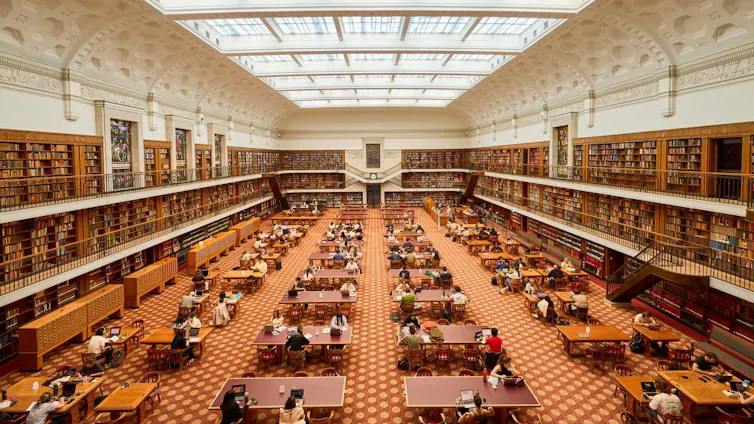 The Mitchell Library Reading Room.
State Library of NSW
This and other rare materials were lent to me, a woman from the other side of the world, simply because I asked. Weights of different shapes and sizes were provided to protect the material, guidance offered, all my questions answered. Yet again, I was a beneficiary of the long arm of the library reaching out with a commitment to the sharing of knowledge through responsible custodianship.
In March 2024, in the state of Uttar Pradesh in northern India, approximately
427 kilometres from Nalanda University, a viral video showed an eight-year-old girl running away as a politician’s bulldozers were demolishing her makeshift dwelling.
Unlike me, she was growing up without a safe and comfortable home.
As she ran for her life, she carried in her arms only the essentials for survival: not money nor food nor clothing but the things that mattered most, her books, her own little library – its long arms protecting her and being protected by her; hopefully, inevitably making her anew.
This is an extract from The Library That Made Me, edited by Richard Neville and Phillipa McGuinness, published by NewSouth Publishing in partnership with the State Library of NSW.
Authors: Roanna Gonsalves, Senior Lecturer in Creative Writing, UNSW Sydney
The Mitchell Library Reading Room.
State Library of NSW
This and other rare materials were lent to me, a woman from the other side of the world, simply because I asked. Weights of different shapes and sizes were provided to protect the material, guidance offered, all my questions answered. Yet again, I was a beneficiary of the long arm of the library reaching out with a commitment to the sharing of knowledge through responsible custodianship.
In March 2024, in the state of Uttar Pradesh in northern India, approximately
427 kilometres from Nalanda University, a viral video showed an eight-year-old girl running away as a politician’s bulldozers were demolishing her makeshift dwelling.
Unlike me, she was growing up without a safe and comfortable home.
As she ran for her life, she carried in her arms only the essentials for survival: not money nor food nor clothing but the things that mattered most, her books, her own little library – its long arms protecting her and being protected by her; hopefully, inevitably making her anew.
This is an extract from The Library That Made Me, edited by Richard Neville and Phillipa McGuinness, published by NewSouth Publishing in partnership with the State Library of NSW.
Authors: Roanna Gonsalves, Senior Lecturer in Creative Writing, UNSW Sydney 
















