

Sophie Devine’s record cricket contract can’t disguise a stubborn pay gap in NZ women’s sport
- Written by Hoani Smith, Lecturer in Sport Management and Sport Science, Lincoln University, New Zealand
When former White Ferns captain Sophie Devine secured the equal-highest deal in the United Kingdom’s pro-cricket league last week, it was greeted as another sign of how quickly investment in the women’s game is growing.
Moments like this make it easy to believe women’s professional sport has finally arrived. But Devine’s £210,000 (NZ$470,000) contract to play for the Welsh Fire also highlights something else.
She’s still an exception.
For most elite women athletes – including many representing New Zealand internationally – professional sport still doesn’t pay enough to make a living.
Take netball. Players in New Zealand’s ANZ Premiership earn relatively modest retainers compared with other professional competitions.
After a 20% pay cut earlier this year, contracts reportedly sit somewhere between NZ$20,000 and $45,000 per season. Many players need secondary employment to sustain their careers.
By contrast, Australia’s Suncorp Super Netball competition operates under a team salary cap of about A$742,212, with average salaries approaching A$89,000 drawing top Kiwi players away from home.
Rugby and league pay gaps
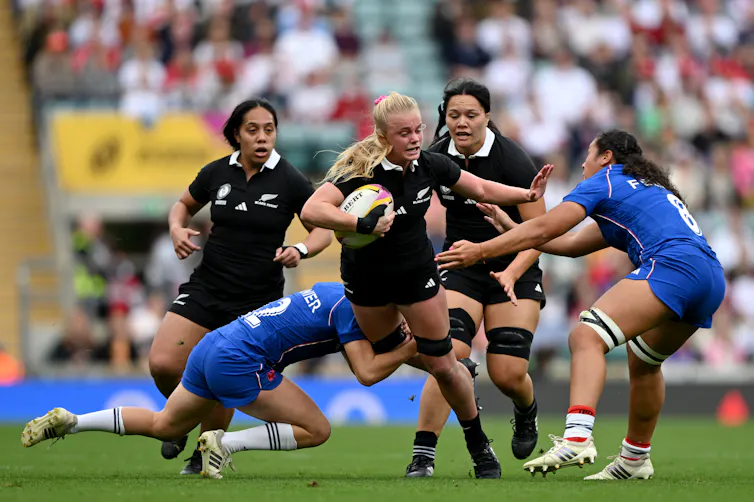
Rugby shows a similar pattern. Despite the success of the New Zealand women’s team at the 2022 Rugby World Cup – the final at Eden Park drew more than 42,000 fans, the largest ever crowd for a women’s rugby match – the pay gap with the men’s game remains large.
Black Ferns players now receive retainers of roughly NZ$50,000–$70,000, and players in Super Rugby Aupiki (the professional club competition) earn about $25,000 for the season.
Male players in the Super Rugby Pacific competition commonly earn NZ$150,000–$250,000 per season, while All Blacks can earn $400,000 to more than $1 million annually.
The story is similar with rugby league. Salaries in Australia’s NRL Women’s Premiership are steadily increasing, with minimum salaries rising from A$30,000 in 2023 to $50,600 by 2027.
Meanwhile, the men’s NRL operates under a salary cap exceeding A$12 million per club, with some top players earning $1.3–$1.4 million per season.
Money isn’t the only factor shaping women’s sporting careers, of course. Historically, pregnancy often meant the end of a professional sporting career, with contractual protections rare.
This is changing, however. Some governing bodies have introduced parental leave protections for contracted athletes, including Cricket Australia which allows players to access paid parental leave for up to 12 months while retaining their contracts.
The English Rugby Football Union’s maternity policy provides up to 26 weeks of full pay, supporting players through pregnancy and a return to elite competition.
While important steps forward, this kind of support still varies widely between sports and leagues. Many athletes remain on short-term contracts that make long-term planning difficult.
Investing for success
Whenever pay equity in sport is discussed, one argument you’ll always hear is that men’s sport pays for women’s sport.
And there is some truth to that. Many sporting organisations bundle men’s and women’s competitions together in broadcast deals and sponsorship packages, meaning revenue from men’s competitions supports the wider system.
But the real issue isn’t equal pay – it’s the way these sporting systems are designed.
Men’s professional programmes have developed over decades into layered structures – school competitions, domestic leagues, professional clubs, international tournaments and commercial franchises. Each level generates revenue.
Under the partnership agreement between New Zealand Rugby and the Players Association, for example, 36.56% of player-generated revenue is distributed to professional players. Salaries therefore reflect the commercial value of the competitions themselves.
That model works well in mature competitions. But it also highlights the challenge for women’s sports, most of which don’t yet have that same depth.
If women athletes continue to be paid strictly according to the current market value of their competitions, the gap between men’s and women’s earnings could take decades to close.
This is why some sporting organisations are not waiting for women’s competitions to generate large audiences first.
The UK’s Hundred pro-cricket league features men’s and women’s double-headers and shared match days. The US Women’s National Basketball Association has benefited from sustained investment by its parent organisation. And Spain’s Liga F women’s football competition secured a five-season, €35 million centralised broadcast deal.
The logic is simple: investment builds visibility, which grows audiences, which attract sponsors, which generate revenue.
Over time, that creates the layered professional system needed to sustain careers. Sophie Devine’s contract shows what women’s sport can look like when investment finally meets performance.
The real challenge now is building systems that allow entire competitions – not just individual stars – to thrive. If organisations invest early to build deeper competitions and stronger commercial ecosystems, the next generation of athletes might not have to leave the country – or their sport – just to make a living.
Authors: Hoani Smith, Lecturer in Sport Management and Sport Science, Lincoln University, New Zealand

















